

At various times in history, Wilpattu’s fate has been gravely threatened by politicians and forest plunderers. A stark example is the destruction of Wilpattu in recent years, for which allegations were leveled against Minister Bathiudeen and others. The Environmental Justice Center and other environmental organizations petitioned the courts seeking justice for Wilpattu. Although the court ruling brought a measure of justice for the environment, whether the judgment has been properly implemented remains a matter of contention even today. It is still unclear whether the responsibility for this lies with the Department of Wildlife Conservation or the Department of Forest Conservation — a fact well known to those who love the environment of this country.

The present government, which came to power promising to protect the environment, is treading the same well-worn path as its predecessors when it comes to environmental issues. A prime example is the granting of permission for annual festivals and monthly religious ceremonies at the Pallekandal shrine within Wilpattu, despite the heavy environmental impact. This is yet another addition to the list of questionable acts by officials. While we do not oppose the right of any community to practice its religion, we are firmly against the destruction of ecosystems in doing so.
The problem surrounding the Pallekandal site, which poses a threat to Wilpattu’s ecological balance, has now reached a peak. Allowing monthly religious ceremonies at this site — which lies within the country’s largest national park and the second to be declared in the history of the Department of Wildlife Conservation — while ignoring the serious environmental damage being caused, is highly questionable.
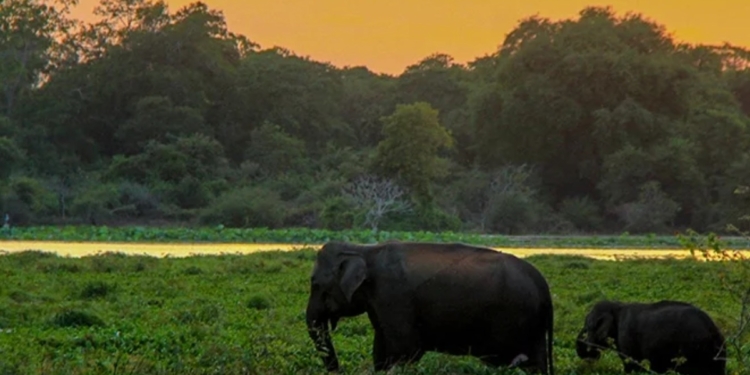
Declared between 1938 and 1973 in five separate phases, Wilpattu National Park spans across the Anuradhapura and Puttalam districts, and borders the Mannar and Vavuniya districts. It provides vital habitat for countless large and small species, including elephants, and is known for rare sightings of sloth bears and leopards. Unlike other national parks in Sri Lanka, Wilpattu is covered by dense forest, featuring dry-zone woodland, thorny scrub, and numerous lakes and sand dunes. Its unique network of “villus” (natural lakes) forms an important ecological zone. The park also boasts scenic golden beaches near Portuguese Bay and Dutch Bay, and is located close to Anuradhapura, linking it to historical ruins and ancient man-made structures.
The Pallekandal site, regarded as a Catholic place of worship dedicated to St. Anthony, was once a small forest shrine in the Pomparippu area of Wilpattu. In 1969, under the Land Acquisition Amendment Act No. 28 of 1964 and Gazette Notification No. 14886 of 20 December 1968, the government acquired the small plot as state land. When the fifth section of Wilpattu was declared a national park in 1973, the entire Pallekandal village — including the small shrine — became part of the park.
Several environmental organizations have filed petitions with the Supreme Court to prevent damage to the park. The Attorney General has presented guidelines regarding the park under case number CA/CA/82/2018(KDP) and as per orders issued on November 13, 2019. However, allegations claim that the shrine’s annual festival continues to be held in ways harmful to the park, disregarding these guidelines. Most recently, the government approved, through a Cabinet decision, the holding of monthly ceremonies every Tuesday from this August onwards with large public participation inside the park — a move that conservationists find deeply alarming.
Many officers of the Wildlife Department have sacrificed their lives protecting Wilpattu. The first time in the history of the Department of Forest Conservation that an officer died in the line of duty was at Wilpattu, when Wildlife Ranger K. Manikraala was killed by a sloth bear on July 4, 1957. On May 14, 1985, LTTE terrorists massacred 24 wildlife officers at Wilpattu’s headquarters — the single largest loss of wildlife officers’ lives in one place. In other incidents, terrorists shot and bombed seven more officers, while poachers killed three others. One officer died after being attacked by an elephant and another by a wild animal. In total, 36 wildlife officers have died protecting Wilpattu — the highest for any wildlife reserve in the country.
Against this backdrop, granting permission through a Cabinet decision for thousands of people to enter the park monthly, without any proper control, and entrusting this to the Director General of the Department of Wildlife Conservation is nothing short of a cruel irony.
Just two days ago, in blatant disregard of all laws and Supreme Court orders, 18 vehicles carrying people entered Wilpattu National Park without authorization to attend the Pallekandal shrine’s monthly service. That day will go down as a dark stain in Sri Lanka’s wildlife conservation history — a mistake that cannot be undone. We record this with the commitment to continue informing the public about such misconduct and to keep wielding our pen in defense of the environment.