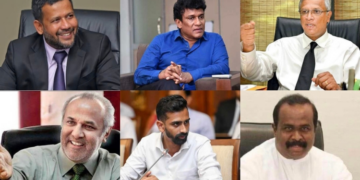
Nine years ago, now powerful government ministers Sunil Hadunnethi, Nalinda Jaytissa, and Wasantha Samarasinghe visited the U.S. embassy in Sri Lanka to deliver a petition protesting the American sanctions on Cuba.
For decades, the JVP (Janatha Vimukthi Peramuna) has maintained a close relationship with Cuba, honouring the legacy of Cuban revolutionary leader Che Guevara with annual commemorations. Since the era of Rohana Wijeweera, the party has consistently expressed solidarity with Cuba and opposed the U.S. embargo against the country.
JVP leader Anura Kumara Dissanayake has also been vocal on this issue. At a rally held to commemorate Cuban leader Fidel Castro, he called on the U.S. government to lift its sanctions against Cuba, reaffirming the JVP’s unwavering stance.
In the lead-up to the presidential election, Anura Kumara and other JVP leaders met with the Cuban ambassador. During each of these meetings, they reiterated their commitment to standing by Cuba until the U.S. embargo is lifted.
After Anura Kumara was elected president on January 28, 2025, the Cuban Ambassador met with JVP General Secretary Tilvin Silva. During this meeting, Silva reaffirmed the government’s strong support for lifting American sanctions on Cuba. The ambassador also informed Silva about US President Donald Trump’s decision to include Cuba on the list of countries that sponsor global terrorism.
This budding collaboration between the JVP and Cuba raises questions about its potential impact on Sri Lanka-US relations. Historically, Cuba has held a special place for the JVP—evident from when Cuba invited JVP leader Rohana Wijeweera to a foreign conference following his release from prison in 1977. While the JVP cannot overlook its ties with Cuba, the NPP government cannot afford to sideline the United States. America’s support is crucial for maintaining the IMF agreement, to stabilize Sri Lanka during the NPP government’s tenure. So far, the JVP has been careful not to provoke the US.
However, foreign media reports suggest that Trump’s new administration is reviewing the possibility of withdrawing from the IMF and the World Bank. If this happens, the NPP government may no longer need to prioritize American interests to uphold the IMF agreement. Such a scenario could strengthen the NPP government’s position with its leftist base.
Nevertheless, dealing with Trump’s administration might prove more challenging than previous US administrations. The current Trump administration’s approach lacks the traditional “carrot-and-stick” strategy. Should the Trump administration perceive the Sri Lankan government as adversarial, the repercussions could be severe.