

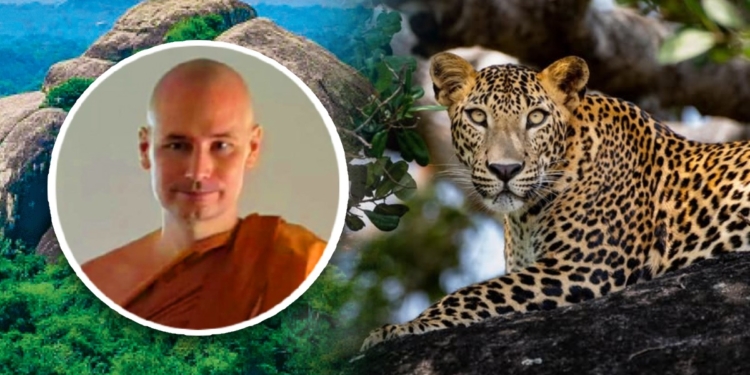
In a silent forest, amidst the constant sounds of birds and wild animals, the tragic fate that befell the foreign national monk, Venerable Nanda, on the 26th of last month shook all our hearts. Venerable Nanda had lived a life devoted to meditation, seeking liberation from the cycle of suffering. We often forget the simple truth that the forest belongs to its animals. When humans cross that boundary, we inevitably face the consequences.
This sorrowful incident occurred near the Badullā Yala National Park, in the Kuduṃbigala Forest Hermitage area. The monk involved was a 43-year-old Czech national named Venerable Nanda, who had previously worked as a software engineer. Later, he renounced all worldly comforts and came to Sri Lanka to pursue the path of Nibbāna. While seeking the true meaning of human life, he had unexpectedly the opportunity to listen to the sublime teachings of the Buddha while at home. With a mind awakened to Dhamma, he came to Sri Lanka in 2021 to enter monastic life and returned to his home country afterward. In January 2025, he again came to Kuduṃbigala Hermitage, working alongside ten other monks there.
On the morning of the 26th, Venerable Nanda’s absence from the alms round caused concern among his fellow monks. Accordingly, Venerable Siyambalawa Jinālankāra, Nanda’s senior fellow monk, went to investigate. What he saw was an unimaginable sight: the lifeless body of Venerable Nanda lying in a small hut inside a cave, blood pooling around him, apparently attacked by a leopard that roams the forest.
The police reported that the monk had suffered severe bite injuries to the abdomen. Other monks living at the hermitage confirmed that a leopard frequently comes to this area. Nayanaka Ranwella, Secretary of the Wildlife Conservation Council, stated that this region is inhabited by leopards and elephants and is a dangerous area for human habitation.
“Leopards like the Panthera pardus in Sri Lanka generally do not attack humans. When humans are present, the leopard assumes the creature is a small prey animal and attacks. It is possible that it struck from behind and bit him in the belly. Areas where leopards roam are hazardous. We can see the severe bite marks on the monk’s abdomen…” he said.
Intelligence officer Buddhika Vidana of the National Park administration confirmed that this incident took place in a rock cave between Bambaragasthalawa and Kuduṃbigala. After the incident, wildlife officers reached the location around 1:00 PM, and by 5:00 PM, the leopard had returned and was eating parts of the monk’s body. However, the leopard eventually left after being driven off, and by around 10:00 PM, the remains were taken to the hospital. Wildlife officers advised locals and monks to avoid the area, as the leopard was now feeding on human flesh.
The Kuduṃbigala Hermitage is located about 12 km inside the dense forest from the national park entrance. Historical sources indicate that the hermitage was built during the 3rd century BCE by a king for the use of meditating monks. The area contains Brahmi inscriptions and ancient Dagaba ruins and is home to various wildlife, including monkeys, elephants, and leopards.
Under the instructions of Senior Deputy Police Superintendent Varuna Jayasundara of the Eastern Province and Deputy Police Superintendent Sujith Wedamulla of Ampara, Panam police and wildlife officers are conducting further investigations. Postmortem examinations were performed at Ampara Base Hospital by Dr. Kamal Bandara. Venerable Siyambalawa Jinālankāra stated that the final rites of the monk’s body will be conducted locally.
This shocking incident has deeply affected the monks residing in Panam. The Buddha himself advised living in safe locations. Constructing huts in dangerous areas inhabited by wild predators is not recommended. Monks are encouraged to meditate in appropriate, secure locations. Although Venerable Nanda had understood the arduous path to Nibbāna through meditative practice in the forest, other monks are not expected to undergo the same extreme hardships. Meditation should be practiced in safe and suitable locations.
Ultimately, the venerable monk, striving to overcome suffering in the forest, succumbed to the natural order of life and death. Locals noted that leopards develop a taste for human blood in such cases, making the forest unsafe for humans. We must remember that the forest belongs to its animals.
The death of this venerable monk, born abroad and dedicated to meditative practice in our forests, is a significant loss for Sri Lanka. His passing in the harsh wilderness teaches us a valuable lesson about the impermanence and unpredictability of life. As the Dhammapada says:
“All conditioned things are impermanent;
When one sees this with wisdom,
One turns away from suffering.
This is the path to purity.”
May the ultimate serene peace that Venerable Nanda sought in Nibbāna be attained, and may his journey inspire all of us.

Nilanthi Renuka