
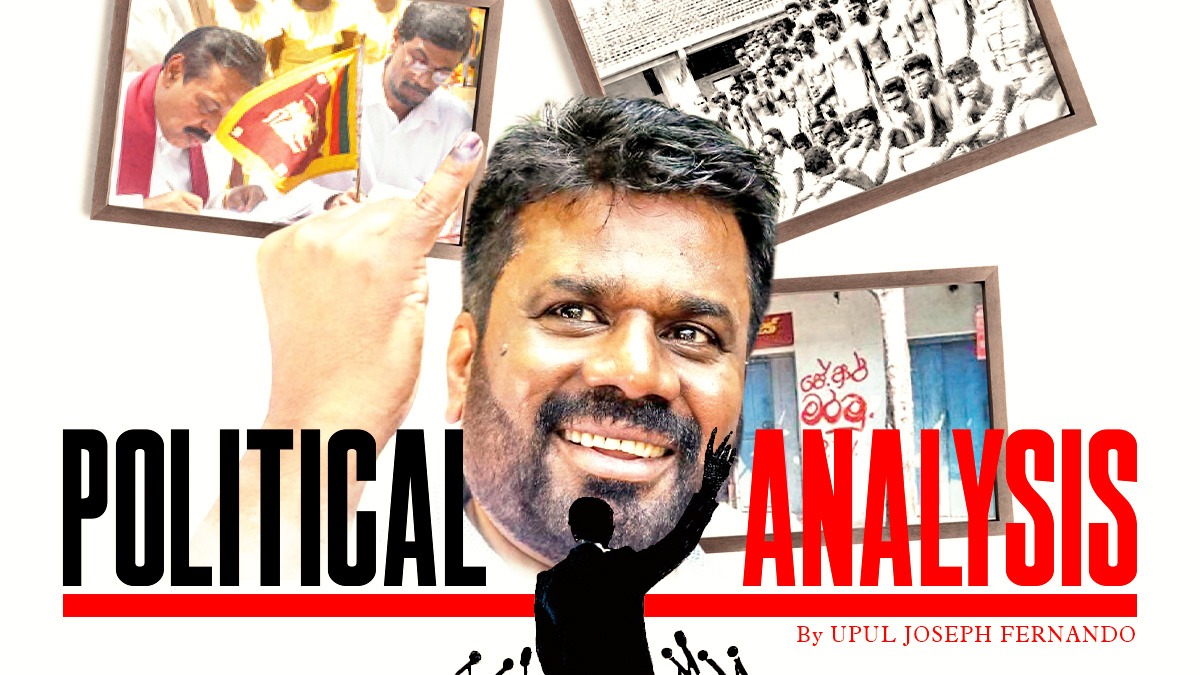
“Whenever Jupiter changes position, the JVP becomes powerful. But that power never lasts long. Within two or three years, it fades away. That happened in 1971. It happened in 1987. It happened in 2004 as well…”
This was a prediction made by a veteran astrologer before the JVP rose to power, as he demonstrated planetary movements using an astrological chart.
Whether one analyses it through planetary movements or through politics, the conclusion is the same.
Although Rohana Wijeweera founded the JVP in 1965, he truly entered active politics in 1968. It was in 1968 that Wijeweera conducted the famous “Five Classes,” completed them, and travelled around the country. That year marked the beginning of young men and women rallying around the JVP.
The first major display of JVP’s strength came during the 1970 General Election, when it supported Mrs. Bandaranaike’s United Front government and mobilised youth across the country. When that government—after promising to create a socialist state—was accused of betraying that promise, the JVP launched the 1971 insurrection against it. This uprising was the climax of the rise that began in 1968.
That insurrection astonished not only Sri Lanka but the entire world. However, it failed. Wijeweera and other JVP leaders were arrested. From that point onward, the JVP began to decline. For 16 years, from 1971 to 1987, the JVP remained politically marginalised. The party that once shook the country secured only 4.19% of the vote when its leader Rohana Wijeweera contested the 1982 Presidential Election.
Exactly 17 years later, the JVP reorganised itself in response to the Indo–Lanka Accord signed between President J.R. Jayewardene and Indian Prime Minister Rajiv Gandhi. Claiming that J.R. had betrayed the country, the JVP fuelled anti-Indian sentiment nationwide and launched an armed insurrection against the government—despite J.R. holding a five-sixths parliamentary majority. At that time, people were afraid even of the three letters “JVP.” It was not J.R. who ruled the country, but the JVP’s ‘chit’ culture and terror tactics.
Although the JVP reorganised in late 1987, it rose again with the T-56 rifle in 1988. The outcome of this massive resurgence—where the JVP effectively controlled the country through intimidation—was the boycott of the 1988 Presidential Election, which paved the way for Ranasinghe Premadasa to become President. After reaching that climax, the JVP once again began to fall from 1989 onwards. By 1990, the JVP leader and the entire Politburo had been killed, reducing the party to ashes.
In 1993, the JVP succeeded in having the party ban lifted. After gaining a reasonable number of seats at the 2000 General Election, it attempted a slow revival. However, the JVP truly rose again in 2002, opposing the ceasefire agreement between Ranil Wickremesinghe and Prabhakaran.
By aligning with the SLFP in 2004 and helping capture state power, the JVP reached the peak of this resurgence in the 2005 Presidential Election by defeating Ranil Wickremesinghe and installing Mahinda Rajapaksa as President. The biggest leap resulting from the 2002 rise was the 2005 election. From that point, a popular belief emerged that no party or candidate supported by the JVP could be defeated.
Yet, the JVP’s decline also began with Mahinda Rajapaksa’s victory in 2005. In 2007, when the JVP voted against Mahinda’s 2008 budget, Mahinda decisively split and dismantled the party.
Exactly 16 years after the JVP was fractured and weakened in 2008, it realised its long-held dream of capturing state power in 2024. Prior to that, the JVP rose again through the 2022 ‘aragalaya’ (people’s uprising). Although the JVP did not initiate the protest movement, it effectively hijacked it once Ranil Wickremesinghe became President. Had a non-partisan consensus President been appointed instead, the JVP would not have been able to seize control of the movement.
The climax of the JVP’s 2022 rise was the capture of the Presidency in 2024 and securing a two-thirds majority in Parliament.
As in 1971, 1988, and 2005, the JVP has now reached its climax. But after every such climax—1971, 1988, and 2005—the JVP began to fall.
That is the undeniable pattern.
The 1971 insurrection was the JVP’s first great leap—the final triumph of the rise that began in 1968. Yet, that very triumph led to the party’s destruction.
The second great leap was in 1988, when the JVP achieved its objective in the Presidential Election by defeating its preferred outcome through a boycott. From that leap onward, the party declined.
The third great leap came in 2005. But within two years, the very President the JVP helped elect dismantled the party.
The year 2024 represents not merely a fourth leap, but a grand exploit. Yet, even before completing one year in power, the JVP now finds itself shaken by a major political storm. While its fourth climax occurred in 2024, the rise itself began in 2022. According to the JVP’s own political chronology, this is the period when decline sets in.
Notably, every major leap of the JVP has occurred roughly 16 to 17 years apart:
- After 1971, the next leap came 17 years later in 1988.
- Seventeen years after 1988, another leap followed in 2005.
- Seventeen years after 2005, the JVP rose again through the 2022 uprising.
“So if the JVP falls this time, will it be unable to rise again for another 17 years?”
That cannot be stated with certainty. However, history shows that what the JVP perceives as its greatest heroic victory often becomes the very paradox that leads to its destruction.
- The 1971 insurrection led to the JVP’s destruction.
- Making Premadasa President in 1988 led to the JVP’s destruction.
- Making Mahinda President in 2005 led to the JVP’s destruction.
Whether stepping into the Presidential Secretariat in 2024 will once again lead to the JVP’s destruction is a question that will be decisively answered in 2026.