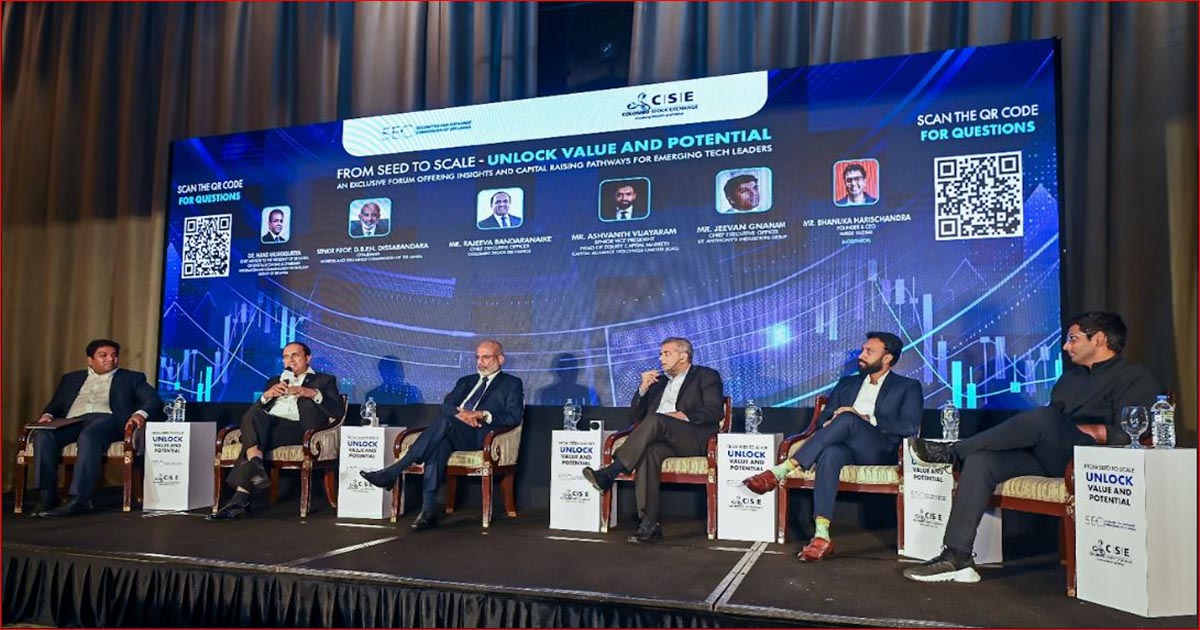
The Securities and Exchange Commission of Sri Lanka (SEC) and the Colombo Stock Exchange (CSE) recently convened a full house of technology companies in Colombo for the “Seed to Scale – Unlock Value & Potential” forum, aimed at positioning the capital market as a catalyst for mid- to long-term growth in Sri Lanka’s fast-evolving tech sector.
The event formed part of a broader initiative to actively engage tech firms and encourage them to consider debt and equity listings on the CSE as a viable source of funding. More than 60 companies from across the technology industry participated, engaging with policymakers, regulators, investment bankers, and corporate leaders to explore capital-raising pathways.
A detailed presentation by Mr. Ashvanth Vijayaram, Senior Vice President and Head of Equity Capital Markets at Capital Alliance Holdings Ltd (CAL), outlined the listing journey for companies. He highlighted listing as a cost-effective means of raising capital, explained how the secondary market can enhance valuations, and emphasized the brand recognition and strategic opportunities that come with being publicly listed. He also addressed how IT firms can best leverage capital markets to accelerate growth.
The centrepiece of the forum was a panel discussion and Q&A session featuring Chief Advisor to the President on Digital Economy and Chairman of the Information and Communication Technology Agency of Sri Lanka (ICTA) Dr. Hans Wijayasuriya; Chairman of the SEC, Snr. Prof. D.B.P.H. Dissabandara; CEO of the CSE Mr. Rajeeva Bandaranaike; Managing Director of St. Anthony’s Industries Group Mr. Jeevan Gnanam; Mr. Ashvanth Vijayaram of CAL; and CEO and Founder of Surge Global, Mr. Bhanuka Harischandra, who moderated the discussion.
Bringing together perspectives from policy advisors, regulators, investment banks, incubators and IT entrepreneurs, the discussion provided participants with a comprehensive overview of Sri Lanka’s capital market ecosystem and its relevance to tech firms seeking to build sustainable, globally competitive enterprises.
Why Sri Lanka’s Capital Market Appeals to Tech Startups
Panellists agreed that the domestic capital market offers a compelling proving ground for IT startups. Compared to foreign exchanges, Sri Lanka provides lower entry barriers in terms of cost and compliance, stronger domestic brand recognition for homegrown firms, potentially better initial valuations, and a structured platform to demonstrate transparency and build trusted reputations. Success at home, they noted, can then be leveraged when expanding into foreign markets.
Dr. Hans Wijayasuriya underscored the importance of capital mobility in enabling Sri Lankan tech firms to scale globally. He observed that many startups relocate headquarters abroad once they reach scale due to access to larger capital pools. To build a thriving digital ecosystem locally, he stressed the need to facilitate capital mobility while retaining intellectual property (IP) and headquarters in Sri Lanka.
He also revealed that special facilities for foreign direct investment (FDI) are expected, allowing capital raised in Sri Lanka to be deployed overseas for expansion—provided companies maintain their IP and headquarters domestically. The broader ambition, he said, is to see Sri Lankan-headquartered firms and IP evolve into multinational players, thereby strengthening the local digital ecosystem.
Addressing structural reforms, Dr. Wijayasuriya highlighted the issue of cascading taxes affecting venture capital (VC) funds and investors in Sri Lanka—an obstacle not commonly faced in other jurisdictions. He noted that resolving these tax inefficiencies, with the SEC playing a key role in legislative reform, would enhance Sri Lanka’s attractiveness for VC formation and foreign capital inflows. Such reforms, combined with streamlined listing processes and shorter maturity curves, would create a more vibrant environment for scaling tech firms.
Capital Formation as a Strategic Pathway
SEC Chairman Snr. Prof. Dissabandara described Sri Lanka’s tech sector as “an unfolding success story,” evolving from export-driven IT services to the development of homegrown platforms and intellectual property capable of global competition. He emphasized that capital markets must evolve to provide not only financing, but also confidence, credibility, and continuity.
He framed capital formation as more than a financing mechanism, calling it a strategic pathway for startups and tech-driven companies to scale, professionalize operations, and integrate into the formal market system. Reaffirming the SEC’s approach, he stated that the regulator’s role extends beyond oversight to market creation and facilitation, aiming to build an inclusive and dynamic ecosystem that promotes innovation, entrepreneurship, and sustainable economic growth.
Navigating Volatility and Unlocking Value
CSE CEO Rajeeva Bandaranaike addressed concerns about market volatility, advising entrepreneurs not to focus excessively on short-term fluctuations. He emphasized that listing unlocks company value, facilitates price discovery, enhances brand recognition, and offers multiple pathways—including capital raising, partial exits, or introductions to the market.
While acknowledging that markets are cyclical, he stressed that companies with strong growth narratives, sound management, healthy cash flows, and positive net assets are likely to attract investor demand. Post-listing, he noted, companies bear responsibility to deliver shareholder returns—either through dividends or capital gains—making listing fundamentally about long-term value creation rather than short-term timing.
Instilling Financial Discipline Early
Mr. Jeevan Gnanam highlighted the importance of financial governance in startups. Through accelerator and incubator programs, including those at Hatch, early-stage firms are required to maintain monthly financial statements to instill discipline and transparency from the outset. Financial discipline, he argued, builds trust; trust attracts capital; capital creates leverage; and leverage drives growth—embedding a positive cycle into the startup mindset.
Matching Investors to Growth Stages
Mr. Ashvanth Vijayaram elaborated on the evolving role of investment banks across a company’s lifecycle. He observed that many Sri Lankan founders attempt to attract later-stage investors prematurely, creating mismatches between expectations and readiness.
At early stages, he explained, the primary challenge is identifying risk-tolerant investors suited to the company’s maturity. As businesses grow, investment banks shift focus toward structuring transactions—addressing capital structures, instrument design, valuation, and timing. Thus, the question evolves from “Who is the right investor?” to “How should the transaction be structured?”
Capital Market Momentum
The forum took place against the backdrop of sustained growth in Sri Lanka’s capital market. The CSE has recorded two consecutive years of upward momentum, with 2026 seeing new milestones in January as the All Share Price Index (ASPI), S&P SL20, and overall market capitalization surpassed LKR 8.5 billion.
In 2025, the exchange recorded 25 listings, including six new companies raising funds for rapid expansion. The year also marked the introduction of innovative instruments such as Blue Bonds, Green Bonds, Social Bonds, and High Yield Sustainable Bonds—providing issuers with new avenues to access capital while catering to growing investor demand for sustainable investment options.
Picture Caption:
(L–R) Panellists at the “Seed to Scale – Unlock Value & Potential” Forum: Mr. Jeevan Gnanam, Mr. Rajeeva Bandaranaike, Snr. Prof. D.B.P.H. Dissabandara, Dr. Hans Wijayasuriya, Mr. Ashvanth Vijayaram, and Mr. Bhanuka Harischandra.