Attempts to re-expropriate assets of Sri Lanka’s privatized commercial plantations on the pretext of being under-utilized will undermine property rights and discourage investors, officials and analysts said.
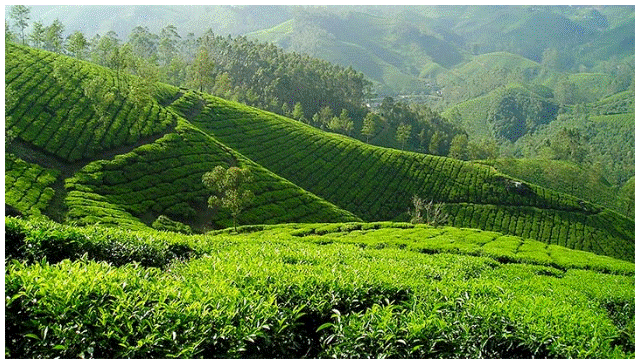
Sri Lanka’s privatized plantations which are on 50-year lease have only 70,000 hectares of land.
Plantations are an emblematic case in Sri Lanka’s post-independence economic decline where they were expropriated from foreign and domestic owners under ‘land reform’.
Many foreign owners were given land in African nations like Kenya where they set up tea plantations.
Sri Lanka state is now bankrupt and the President Ranil Wickremesinghe is trying to attract foreign investment into privatizations.
“When you give a signal to the market that the government is going to expropriate land it will further undermine the investor confidence because one of the main factors the investors are looking at is the establishment of property rights and in Sri Lanka,” Dhananath Fernando, Chief Executive of Colombo based Advocata Institute of free market think tank said.
Expropriation Fears
Renewed expropriation fears arose after reports that a proposal had been given to the cabinet to take-over so-called ‘under-utilized’ land of privatized plantations.
Sri Lanka in 2011 expropriated a number of private properties including publicly listed Pelwatte Sugar and Hotel Developers, claiming the land was ‘under-utilized’.
Land of several Board of Investment firms were also taken back despite a constitutional guarantee that they will not be expropriated.
Given the past experience with nationalized plantations and other companies then President J R Jayewardene put in the guarantee to assure foreign investors, but the country has not been able to draw large scale foreign investors unlike East Asia.
Roshan Rajadurai, spokesman for Sri Lanka’s Plantations Association, representing managers of privatized plantations said there was left uncultivated other than those that were impossible to reach due to geographical issues further or land that were environmentally sensitive.
“We have 70,000 hectares of tea; the government of Sri Lanka owns 86 percent of our country’s land millions of hectares of land is there,” Rajadurai said.
“So-called uncultivated land is the land that we can’t cultivate. Either it is a slab rock, a steep area or it is a sensitive area and other lands with environmental and geographical limitations, reservations and roadsides.”
Though the land is on long lease to plantation companies, various political forces have been chipping away the farms, usually some of the best lands bordering accessible roads according to some in the industry.
Rajadurai says plantations have been willing to part with land for public purposes.
“Every two years and three years when there is a local governmental election they will say that now the government has already taken from each company almost 100 acres taken over for this purpose and that purpose,” Rajadurai said.
“And all the lands are abandoned. We couldn’t harvest tea or rubber neither there’s anyone made use of it.”
“Moreover, these planters have been very flexible and supportive to the government all these years. When the government ask for the lease lands for the public purposes and they always have been for it.”
Bankrupt State
Meanwhile Fernando doubted whether the government had any capacity to enhance the productivity of land, given its past track record. He said property rights have to be strengthened to improve land use, and restrictions removed.
Sri Lanka defaulted on its foreign debt in 2022.
“Basically the government definitely can’t improve the efficiency and productivity of the land,” Fernando said.
“Under private ownership only the land productivity will be improved so that we actually have to give land titles for the people.”
Sri Lanka expropriated peoples lands into the Janatha Estate Development Board and the Sri Lanka State Plantations Corporation from which the privatized plantations were hived off after taking monthly handouts from the Treasury to pay workers.
There are still two plantations companies in state hands making losses, raising questions as to how well utilized units like Elkaduwa Plantations is, according to critics.
In Sri Lanka, like most countries before freehold developed in Britain, land use was governed by various types of tenure and Rajakariya.
Sri Lanka did not have freehold until European rule. Freehold developed gradually under Dutch (accommodesans) and full-blown free hold later.
The Colebrooke Cameron Commission abolished service-tenure paving the way for broader land ownership.
However the British Waste Land Ordinance took over large tracts of land which were not being used by the people at a time when free hold was under-developed making the state a big owner of land.
After independence was established, private property was expropriated under ‘land reform’ making the state the largest owner of land and reversing freehold.
(Source Economynext)