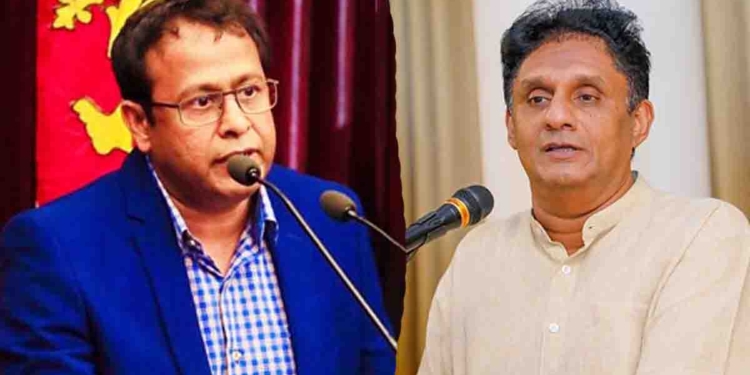
Professor Prasanna Perera of the University of Peradeniya participated in a media briefing held at the headquarters of the Samagi Jana Balawegaya.
Further expressing his views, he stated:
Economist Dudley Seers extensively discussed what happens to poverty, inequality, and unemployment alongside a country’s economic growth rate. According to his theory, when an economy grows, poverty should decline, income disparities should narrow, and the unemployment problem should be addressed. The Leader of the Opposition and leader of the Samagi Jana Balawegaya, Sajith Premadasa, accepts the economic vision of Dudley Seers.
In 2024, the government conducted a Labour Force Participation Survey. According to it, the labour force participation rate in 2024 stands at 47%. However, in 2017 it was 54%. This indicates a serious decline of 6.7% in labour force participation. Sri Lanka’s working-age population is 16.8 million, but only about 8 million are actively contributing to the country’s labour supply. The unemployment rate stands at 4.4%. Male unemployment is 3%, while female unemployment is 7.1%. Only about 30% of working-age women are formally participating in the labour force. Seven out of ten women in the country do not have jobs.
It is also observed that unemployment increases with higher levels of education. The unemployment rate among youth aged 20–24 is 20.7%, meaning one out of five young people in that age group is unemployed. Currently, about 150,000 young people in the country are seeking employment. According to data from the Department of Census and Statistics, the International Labour Organization has stated that the real nature of Sri Lanka’s labour market is being underestimated. Many people have reportedly withdrawn from the labour force due to discouragement.
In 2022 and 2023, 535,000 people migrated abroad, and in 2024 alone around 300,000 have left the country. When viewed through Dudley Seers’ model, unemployment has increased even during periods of economic growth. Compared to 2017 and 2018, poverty has doubled. Reports indicate that between 25% and 30% of the population is living in poverty. Poverty is rising, unemployment is worsening, and inequality is increasing. The government must intervene immediately.
Between 1948 and 1960, governments addressed unemployment and inequality by launching the Gal Oya project. Between 1977 and 1990, the Accelerated Mahaweli Development Project was initiated. After 1977, Free Trade Zones were established. Between 1989 and 1993, the late Ranasinghe Premadasa introduced the Jana Saviya programme, aimed at permanently lifting people out of poverty. That programme required labour participation and also launched the 200 Garment Factory Programme. However, these concepts are now in crisis. Opposition Leader Sajith Premadasa is directly aware of the seriousness of the unemployment crisis.
At present, VAT stands at 18%, corporate tax at 30%, and the top income tax rate at 36%. In such a context, Human Rights Watch has reportedly described Sri Lanka’s 2025 tax system as a destructive tax policy. Increased taxation has restricted labour supply and reduced job creation in companies. Therefore, the government must limit taxation that negatively targets the labour market. Large-scale industries are closing, and small and medium enterprises are facing employment issues. In 2023, 15.1% of jobs in the industrial sector were reportedly lost. Around 30 SMEs have closed. The migration of highly skilled professionals poses a serious threat to the country’s future, and the government must pay urgent attention to this matter.
The 15% export services tax has adversely affected Business Process Outsourcing (BPO) and Knowledge Process Outsourcing (KPO) sectors. Although there was an expectation of earning USD 3 billion in 2025, those hopes have now faded. The current tax policy increases the likelihood of young people migrating abroad.
In India, under the Mahatma Gandhi National Rural Employment Guarantee Act (MGNREGA), rural families are guaranteed 100 days of employment annually. Germany has implemented vocational education integrated with industry. The government should consider such programmes.
The government should remove harmful taxes, ensure national employment guarantees, introduce urgent youth programmes, reduce professional migration, and lower income taxes. Sri Lanka faces a serious employment crisis. Sajith Premadasa has repeatedly highlighted rising industrial sector unemployment. The government must go beyond statistics, understand ground realities, correct its mistakes, and act immediately. Otherwise, long-term economic growth will not be achievable.
Furthermore, the import of substandard coal has caused an estimated financial loss of about Rs. 8 billion, possibly even more. Additional costs arise from increased coal usage for power generation and potential mechanical failures at the Lakvijaya Power Plant. A special committee has been appointed to calculate the total loss caused by the coal fraud. However, while the committee can estimate direct financial losses, it lacks the ability to assess indirect damages such as environmental pollution, electricity purchasing costs, disruptions to uninterrupted power supply, rising production costs, and increased transportation expenses.
Therefore, the Samagi Jana Balawegaya has requested the President to include economists from the University of Ruhuna, who previously assisted him, in the committee. Otherwise, the true extent of the losses cannot be properly calculated.