
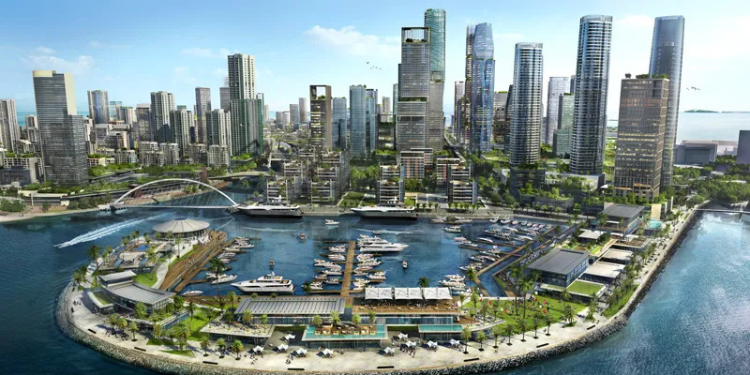
The Port City Colombo has entered a new era of US$15 billion high-velocity growth, transitioning from its primary engineering phase—the reclamation of 269 hectares of land—to vertical development and commercial operations.
This transition is marked by the commencement of major infrastructure projects and the activation of commercial spaces that are now ready for immediate occupancy.
The CHEC Port City Colombo (Pvt) Ltd has recently secured US$300 million to advance Phase II, which focuses on core infrastructure and utilities, an official of the Finance Ministry told the Sunday Times Business. The funds will be used for the development of over 100 hectares of land, streetscapes, and recreational areas. This capital is also being directed toward the commissioning of electricity, water, and sewerage systems connected to the main city grid.
The project has already secured over US$1 billion in land development investments, with a projected US$15 billion pipeline. It is also expected to contribute approximately US$13 billion annually to Sri Lanka’s GDP as vertical development continues to scale.
As of early 2026, the project has attracted nearly US$900 million in investments over a four-month period from November 2025 to March 2026, the official said, adding that transactions within the zone are now authorized in 16 designated foreign currencies, enhancing capital mobility.
New legislative revisions have streamlined the approval process for Businesses of Strategic Importance (BSI), introducing minimum investment thresholds and clearer tax exemptions.
The Port City Economic Commission has also implemented a “Green Channel” mechanism, enabling business licenses to be issued within seven days and facilitating visa approvals within five days for international professionals.
At present, nearly 200 companies are registered within the Special Economic Zone (SEZ), up from 146 at the beginning of the year.
The continued long-term investment by CHEC Port City Colombo (Pvt) Ltd reflects its commitment to the full completion of the project and represents a sustained contribution to Sri Lanka’s economic future. It is expected to strengthen foreign direct investment (FDI) inflows, support employment generation, and encourage broader economic spillovers, while positioning Port City Colombo as a strategic hub for globally oriented, high-value services aligned with national development objectives.