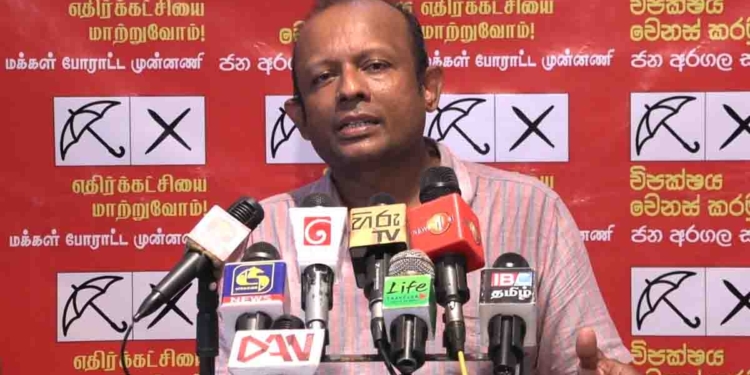
The People’s Struggle Alliance convened a media conference at the Colombo Lions Club to address the escalating coconut prices and the ongoing shortage in the market.
Insights from Pubudu Jayagoda
Pubudu Jayagoda, a National Executive Member of the People’s Struggle Alliance and Education Secretary of the Frontline Socialist Party, shed light on the crisis, stating:
“Sri Lanka is facing a critical issue with coconuts. There’s a significant shortage coupled with soaring prices, with coconuts now retailing at Rs. 192 each in some places and even coconut shells being sold for Rs. 120 in parts of Colombo. The country produces an annual harvest of approximately 3,100 million coconuts, out of which around 2,100 million are required for domestic consumption. The surplus of 800 million coconuts used to be exported, generating $400–600 million annually.
However, in 2024, the coconut harvest decreased by about 700 million coconuts, marking a severe decline. This is not a sudden issue but the result of long-term problems. For years, extensive coconut lands were auctioned, with significant involvement from the United National Party government. The fertilizer crisis during 2019–2020 further compounded the issue, affecting growers severely. Additionally, the whitefly disease that emerged in 2020–2021 devastated coconut cultivation. Despite repeated warnings, successive governments failed to address these issues effectively.
As a result, coconut production has plummeted. Climate change has also exacerbated the situation. Today, people are struggling to afford coconuts, let alone export them. Furthermore, after Sri Lanka’s open economy policies eased export restrictions, large-scale businesses formed a powerful cartel that dominates the coconut trade. Despite knowing the looming crisis, these businesses prioritized profit, increasing coconut exports from 800 million to 1,400 million, worsening the shortage for local consumers.”
Jayagoda called for urgent government intervention, emphasizing:
- Halting coconut exports until domestic needs are met.
- Regulating the coconut industry under a formal government plan to reduce dependency on large-scale businesses.
- Avoiding coconut imports to protect local agriculture from external threats.
Journalist Tharindu Uduwaragedara Speaks on Broader Food Issues
Tharindu Uduwaragedara, National Executive Member of the People’s Struggle Alliance and journalist, also addressed the rice crisis, drawing parallels to the coconut shortage.
“Despite President Anura Dissanayake’s efforts to tackle the rice issue, the market remains short of rice, and the little available is overpriced. Statistics reveal that Sri Lanka produced enough rice to meet local demand in recent years. Yet, the current shortage stems from hoarding by large-scale rice mill owners, not from climate change or using rice for beer and chicken feed as some claim.
These mill owners exploit the situation to earn excessive profits, with some making over Rs. 50 per kilo. Meanwhile, prominent figures like Dudley Sirisena spread misinformation to justify these practices, claiming exaggerated costs for production. Despite government assurances of inspections, no effective action has been taken. This negligence allows businessmen to manipulate the market further.”
Uduwaragedara emphasized that food security in Sri Lanka should not be compromised for profit. He urged the government to protect farmers and consumers by enforcing the Consumer Protection Act and curbing the undue influence of large-scale businesses.
The People’s Struggle Alliance concluded the conference with a call for immediate and decisive action to restore stability in the coconut and rice markets, highlighting the need for a people-centered approach to resolving these pressing issues.