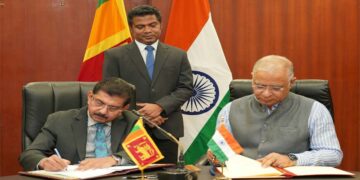
Northern fishermen find themselves entangled in a geopolitical struggle as China steps into the ongoing Indo-Lanka fisheries conflict, which has long been dominated by Indian fishermen engaging in illegal bottom trawling within Sri Lankan territorial waters.
In a bid to win over the Northern fishing community, China provided Rs 1.5 billion in humanitarian aid last June. The assistance package included a prefabricated housing scheme, fishing equipment, and rice supplies for fisherfolk in the Northern and Eastern provinces.
This support—divided into three Rs 500 million packages—marks the largest post-war humanitarian initiative by China in these regions, where India has also made significant investments in development, livelihood, and infrastructure projects.
The beneficiaries were selected through fishermen’s unions, and the distribution of dry ration packs and housing took place in Kilinochchi, Mullaitivu, Mannar, Batticaloa, Trincomalee, and Kalmunai.
In 2023, China further extended its support by donating 150 litres of kerosene per boat to 27,000 fishing vessels across Sri Lanka.
Earlier this month, Chinese Embassy Charge d’Affaires Zhu Yanwei visited Vavuniya, Mullaitivu, Kilinochchi, Jaffna, and Mannar districts, where he distributed 2,470 food packages worth Rs 16 million to families affected by recent floods.
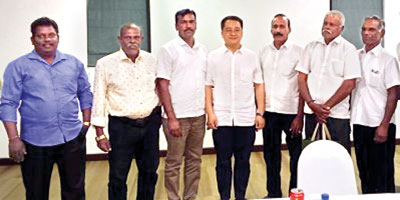
During his visit to the North, Zhu Yanwei also met with representatives of fishermen’s unions on February 10 at a hotel in Jaffna. The delegation was briefed on the hardships faced by local fishermen, particularly the ongoing bottom trawling by Indian boats in Northern waters.
“The delegation was keen to understand our struggles and assured us of future support, especially in fisheries development and knowledge transfer,” said a fishermen’s leader who attended the meeting.
This is not China’s first engagement with the region. Last December, during a visit by Chinese Ambassador Qi Zhenhong, a Rs 12 million livelihood grant was handed over to Governor N. Vethanayahan.
However, despite such foreign assistance, Northern fishermen remain skeptical about the Sri Lankan government’s commitment to addressing their long-standing grievances.
Annalingam Annarasa, Secretary of the Kayts Fishermen Cooperative Society, expressed doubts over the government’s sincerity in tackling multiple challenges faced by local fishermen. In addition to poaching by Indian fishermen, issues such as illegal fishing by locals—including trawling, dynamite fishing, and unauthorized aquatic farms—continue to threaten their livelihoods.
He also referenced a recent speech by President Anura Kumara Dissanayake in Pasiyoor, Jaffna, where he vowed to put an end to bottom trawling by Indian fishermen at the expense of Northern fisherfolk. Annarasa questioned whether the government was selectively prioritizing conflict with India for political or geopolitical gains.
“The government must strictly enforce the law, along with the recent amendments to the Fisheries Act. We suspect they are using us (Northern fishermen) against Indian fishermen for political and geopolitical interests,” he said.
Meanwhile, in response to the ongoing illegal mechanized bottom trawling by Indian fishermen, Northern island fishermen from Delft, Nainathivu, Eluvaithivu, Mandaithivu, Kayts, and Punkudithivu have planned a protest outside the Fisheries Department office in Jaffna next Thursday.
S. Anthony Vimalathas, President of the Mandaithivu Fishermen Union, confirmed the protest, citing continued encroachments by Indian trawlers.
“In Mandaithivu, we witnessed Indian bottom trawlers just 3.5 nautical miles from the coast on Wednesday. We reported this to the Navy, but no arrests were made. Our fishing nets were also damaged. We are exhausted from filing complaints,” he said.
Adding to their frustration, some 67 Indian bottom trawlers seized by Sri Lankan fisheries authorities last year remain anchored at local jetties, occupying vital space meant for Sri Lankan fishing boats.
Earlier this week, fishermen from Gurunagar, Jaffna, discovered an abandoned Indian fishing trawler net, only to find its catch consisting largely of juvenile fish—further highlighting the devastating impact of bottom trawling on Sri Lanka’s marine resources.