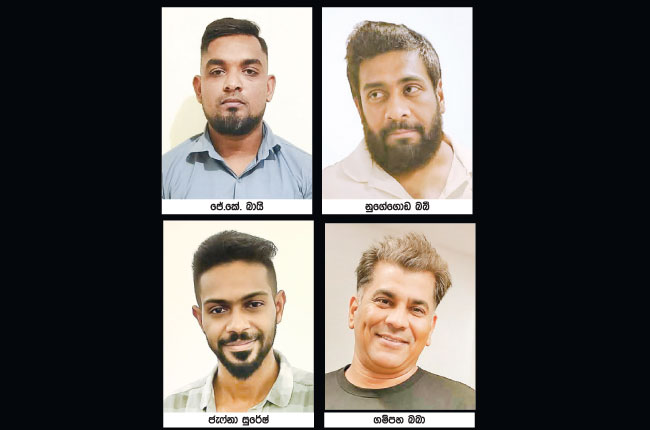
The Criminal Investigation Department (CID) has uncovered that Kahawatta Padme had planned to send Ishara Sewwandi to Mauritius by creating a fake Mauritian passport under a Mauritian woman’s name.
The forged passport was discovered after Ishara Sewwandi was arrested in Nepal.
The passport had been prepared by a man named J.K. Bai, who was arrested in Nepal together with Ishara. It had several fake immigration stamps of Mauritius placed in it, suggesting the plan was to make it appear as though she had already entered that country.
Investigations have revealed that J.K. Bai, a resident of Jaffna, frequently stays in Dubai and is involved in helping criminals flee Sri Lanka, even though he himself is not a registered criminal. He is also believed to have links with international mafia networks.
It has been revealed that Kahawatta Padme provided assistance for Ishara Sewwandi’s escape from Sri Lanka and, in return, gave J.K. Bai Rs. 10 million worth of drugs.
Although there were claims that Ishara Sewwandi fled to India by boat from Jaffna, CID officers said that further investigations are required to confirm this. They added that both Ishara and J.K. Bai will be questioned at length.
According to investigations, J.K. Bai last legally left Sri Lanka for Dubai in 2023, and there is no record of his legal re-entry into the country through an airport or seaport.
The CID has also found that Ishara’s escape operation — from Sri Lanka to India and then to Nepal — was directed by J.K. Bai himself. Once the CID confirmed her presence in Nepal, a covert mission to arrest her was launched by a limited number of Sri Lankan police officers, with support from an intelligence agency in a neighboring country.
The operation, supervised by Inspector General of Police (IGP) Attorney-at-Law Deshabandu Tennakoon and Senior Deputy Inspector General Attorney-at-Law Asanka Karawita, was planned for over six weeks, in coordination with Sri Lanka’s Ministry of Foreign Affairs and the Nepalese Ministry of Foreign Affairs.
The officers assigned to travel to Nepal for the arrest were Assistant Superintendent of Police (ASP) Rohan Olugala, Director of the Western Province North Crimes Division, and CID Inspector Gihan de Silva. They departed Sri Lanka on October 11.
Before departure, Olugala had reported being ill and had not attended work for several days, but he recovered before the trip. Upon arrival in Nepal, the two officers were welcomed by officials of the Sri Lankan Embassy in Kathmandu, who escorted them to the embassy and later facilitated a discussion with Interpol’s Nepal branch.
By that time, it was found that another associate of Bai, located in Dubai, was also coordinating with the mission.
The Nepalese police team, working with the Sri Lankan officers, first arrested J.K. Bai, who was hiding near Kathmandu. The precise location was unknown to the police until the moment of the operation, and it was thanks to a contact in Dubai that Bai’s location was exposed.
During questioning, Bai initially claimed ignorance of Ishara’s whereabouts. However, after receiving a video call from a senior Sri Lankan police officer, who appealed to him emotionally by threatening to arrest his family if he didn’t cooperate, Bai finally confessed.
He said,
“Sir, honestly, I don’t know exactly where that woman is now. I handed her over to an agent.”
This confession led police to a Nepalese handler, who was also arrested. That handler revealed that about two weeks earlier, Ishara had been moved to another location and that he had handed over her care to another person.
Using her mobile phone number, investigators tracked her signal to the Bhaktapur district, about 13 km east of Kathmandu — a busy area similar in climate to Sri Lanka’s Nuwara Eliya.
CID officers Olugala and Gihan de Silva, accompanied by Nepalese police, went to Bhaktapur to trace her. The signal covered an 800-square-meter area with many buildings and tourist lodgings, making the search difficult. Since Nepalese law requires special permission for nighttime raids, the team decided to lure Ishara out instead.
A plan was made through J.K. Bai, who called Ishara and told her to come to a certain location in Bhaktapur to collect her bank card, supposedly for her expenses.
The next morning, Nepalese police and the Sri Lankan officers went to the meeting point. When Ishara came out of her hiding place to meet Bai, she was arrested by the Nepalese police.
At that time, Olugala and the team were stationed about a kilometer away.
Following her arrest, further raids led to the capture of three others, including a woman named Thakshi, who resembled Ishara and had acted as her decoy. Thakshi, from Jaffna, was reportedly planning to travel from Nepal to a European country.

The other two arrested were Babi, from Nugegoda, and Baba, from Gampaha — both known underworld figures involved in drug trafficking and previous murders. Baba is reportedly one of Kahawatta Padme’s close associates.
All six detainees — Ishara Sewwandi, Thakshi, Babi, Baba, and two others — were brought back to Sri Lanka on a SriLankan Airlines flight, escorted by CID officers and supported by SriLankan Airlines security personnel, including a female officer.
After eight months on the run, Ishara’s return marks a major success for the CID. Further investigations will continue based on the information revealed during her interrogation.
However, police sources say that J.K. Bai is the most important figure in this operation, as he is suspected of maintaining international networks that help Sri Lankan underworld figures flee abroad with the assistance of global mafia groups. CID believes his interrogation will help uncover this entire criminal network.