High Commissioner outlines connectivity projects, trade growth and disaster response cooperation
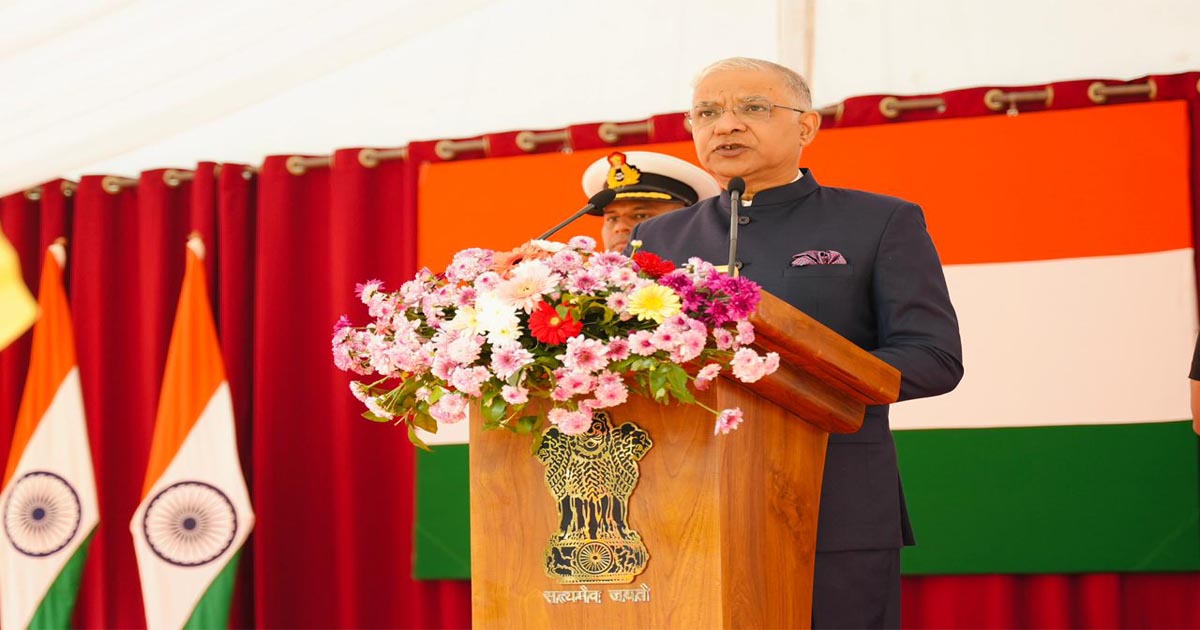
India on Tuesday reaffirmed its commitment to deepening ties with Sri Lanka through expanded connectivity, economic cooperation and security engagement, as High Commissioner of India to Sri Lanka H.E. Santosh Jha addressed the 77th Republic Day reception at India House in Colombo.
Addressing senior Sri Lankan ministers, former presidents, diplomats and business leaders, the High Commissioner described India–Sri Lanka relations as a “global model for cooperative partnership between neighbours,” rooted in civilisational ties, geographical proximity and growing strategic trust.
Marking 76 years since India adopted its Constitution, Jha said India had emerged as the world’s largest democracy and fastest-growing major economy, becoming the fourth-largest economy in 2025 and poised to rise further this decade.
He said this year’s Republic Day themes — Vande Mataram and Atmanirbhar Bharat — reflected India’s journey from independence to prosperity, stressing that self-reliance did not mean isolation but building domestic strength to be a more dependable global partner.
Sri Lanka, he said, occupied a special place in India’s Neighbourhood First and MAHASAGAR policies. Recent visits by Prime Minister Narendra Modi to Sri Lanka in April 2025 and President Anura Kumara Dissanayaka to India in December 2024 had laid out an ambitious roadmap focused on physical, digital and energy connectivity.
Among key initiatives, Jha highlighted progress on the Sampur Solar Power Project, grid inter-connection efforts and talks to develop Trincomalee as a regional energy hub in partnership with the UAE. India is also supporting major infrastructure upgrades, including railway modernisation, port development at Kankesanthurai and expanded ferry and air connectivity between the two countries.
Digitisation remains a central pillar of cooperation, with India supporting Sri Lanka’s Unique Digital Identity (SLUDI) project and the rollout of the Unified Payments Interface (UPI) to advance a cashless economy.
Economic ties continued to strengthen in 2025, Jha said, with India remaining Sri Lanka’s largest source of tourists and trading partner, and the second-largest destination for Sri Lankan exports. Indian investments accounted for around 50% of total foreign investment inflows last year.
India’s development assistance to Sri Lanka now exceeds USD 7.5 billion, including grants of more than USD 850 million, covering projects across all 25 districts. Capacity-building programmes have benefited Sri Lankan parliamentarians, officials, media professionals and workers across multiple sectors.
The High Commissioner also underscored India’s role as Sri Lanka’s first responder during Cyclone Ditwah, citing Operation Sagar Bandhu, which delivered emergency aid, medical support, engineering equipment and disaster-response teams. Following the cyclone, India announced a USD 450 million assistance package to support reconstruction, with implementation already underway.
Defence and security cooperation, he said, remained critical given the two countries’ proximity, spanning maritime security, disaster response, training and joint exercises.
Concluding, Jha emphasised people-to-people ties anchored in shared culture, religion and history, noting the upcoming public display of the Devni Mori relics of the Buddha in Colombo as a symbol of the enduring bond.
“Let us build a future of shared prosperity and well-being,” he said, reaffirming India–Sri Lanka friendship.