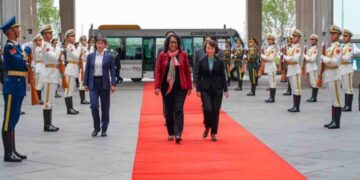


With the United States and China moving closer to a formal agreement to end their prolonged trade war, India is intensifying its diplomatic engagement with Beijing. In a significant development, Foreign Secretary Vikram Misri held talks with Chinese Vice Foreign Minister Sun Weidong, during which both nations agreed to expedite the resumption of direct air services and initiate “certain functional dialogues” to address key issues, particularly in trade and economic cooperation.
This week, Misri hosted Sun in New Delhi for a rare high-level bilateral visit from China — their second meeting this year, following an earlier engagement in Beijing in January. That visit had resulted in the announcement of several confidence-building measures aimed at normalizing relations. On this latest occasion, both parties reaffirmed their commitment to stabilizing and rebuilding ties, placing a renewed emphasis on people-to-people interactions.
According to Beijing’s official statement, India reiterated its support for China’s current presidency of the Shanghai Cooperation Organisation (SCO). The two sides also agreed to prepare for the 24th Meeting of the Special Representatives (SR) on the India-China Boundary Question, scheduled to be held in India. The SR dialogue, which resumed in December last year after a five-year hiatus, had seen National Security Advisor Ajit Doval travel to China. At that time, it was announced that his counterpart, Wang Yi, would visit India in 2025 for the next round of talks.
Beijing is reportedly eager to host Prime Minister Narendra Modi this year for the upcoming SCO summit in Tianjin, which is expected to be attended by Russian President Vladimir Putin and Pakistani Prime Minister Shehbaz Sharif. However, India has yet to confirm Modi’s participation. Observers suggest that New Delhi is likely to await the outcomes of the upcoming SR meeting — potentially as early as next month — as well as the SCO Foreign Ministers’ Meeting, which could see participation from External Affairs Minister S. Jaishankar. Notably, India’s official statement made no reference to the SCO summit. During his visit, Sun also met with NSA Ajit Doval.
“The two sides agreed to expedite steps involved in resuming direct air services between the two countries. The Foreign Secretary hoped for the early conclusion of an updated Air Services Agreement,” the Indian readout stated. It further noted agreements to take practical steps for visa facilitation, and to encourage exchanges between media organizations and think tanks.
Misri expressed appreciation for China’s support in resuming the Kailash Mansarovar Yatra this month and voiced hope for progress in trans-border river cooperation, particularly in the sharing of hydrological data. India has previously raised concerns over China’s construction of what is believed to be the world’s largest hydropower dam on the Brahmaputra River, known in Tibet as Yarlung Tsangpo.
India is also seeking to resolve bilateral trade and economic issues, including China’s export controls on rare earth-related materials, in a manner that supports long-term policy transparency and predictability. The Indian government has indicated it is in ongoing discussions with Beijing to ensure a predictable and internationally consistent rare earth supply chain.
According to India’s official statement, both nations “positively assessed the activities planned under the 75th anniversary of the establishment of diplomatic relations between India and China and agreed to facilitate the same.”
China’s readout echoed a similar tone, stating that both sides had pushed for the resumption of direct flights, enhanced people-to-people exchanges, and the steady revival of bilateral dialogue mechanisms.
Additionally, Beijing noted that Sun emphasized the importance of adhering to the understandings reached between Prime Minister Modi and President Xi Jinping during their meeting in Kazan last year, which followed the resolution of the military standoff in eastern Ladakh. He also called for increased mutual trust, proper management of differences, and a constructive approach in promoting international peace and stability.