


A significant controversy has emerged as the government is reported to have incurred a loss exceeding Rs. 5 billion due to several companies evading standard taxes on the import and refining of unrefined coconut oil from January to October 2024.
This situation has raised pressing questions regarding accountability: Who is responsible for this loss? Who orchestrated the actions behind it? And who authorized the decision not to levy the required taxes? Calls for an investigation into these matters are growing louder.
Tax Obligations Under the Law
Under the VAT law introduced on January 1, 2024, imports of unrefined coconut oil into Sri Lanka under the Special Commodity Tax are subject to an 18% VAT and a 2.5% Social Security Tax when refined locally and sold in the market.
Despite these legal requirements, three companies operating under six different names imported approximately 38.8 million kilograms of unrefined coconut oil into the country during the 10-month period. While some companies have adhered to the tax regulations, refining and re-exporting small quantities of unrefined coconut oil while paying the requisite taxes, others appear to have circumvented these laws.
Allegations of Tax Evasion
It is alleged that several large-scale companies imported significant quantities of unrefined coconut oil and released it into the local market without proper refinement or tax payments. This act not only violates tax regulations but also poses a potential public health risk, as unrefined coconut oil must be processed before it is deemed fit for human consumption.
Concerns regarding these irregularities prompted the Inland Revenue Department to conduct a raid, during which one company sought clarification from the Department of Public Fiscal Policy under the Ministry of Finance. The company, reportedly through the office of former President Ranil Wickremesinghe, requested a written explanation about the application of VAT on such imports.
Correspondence Raises Questions
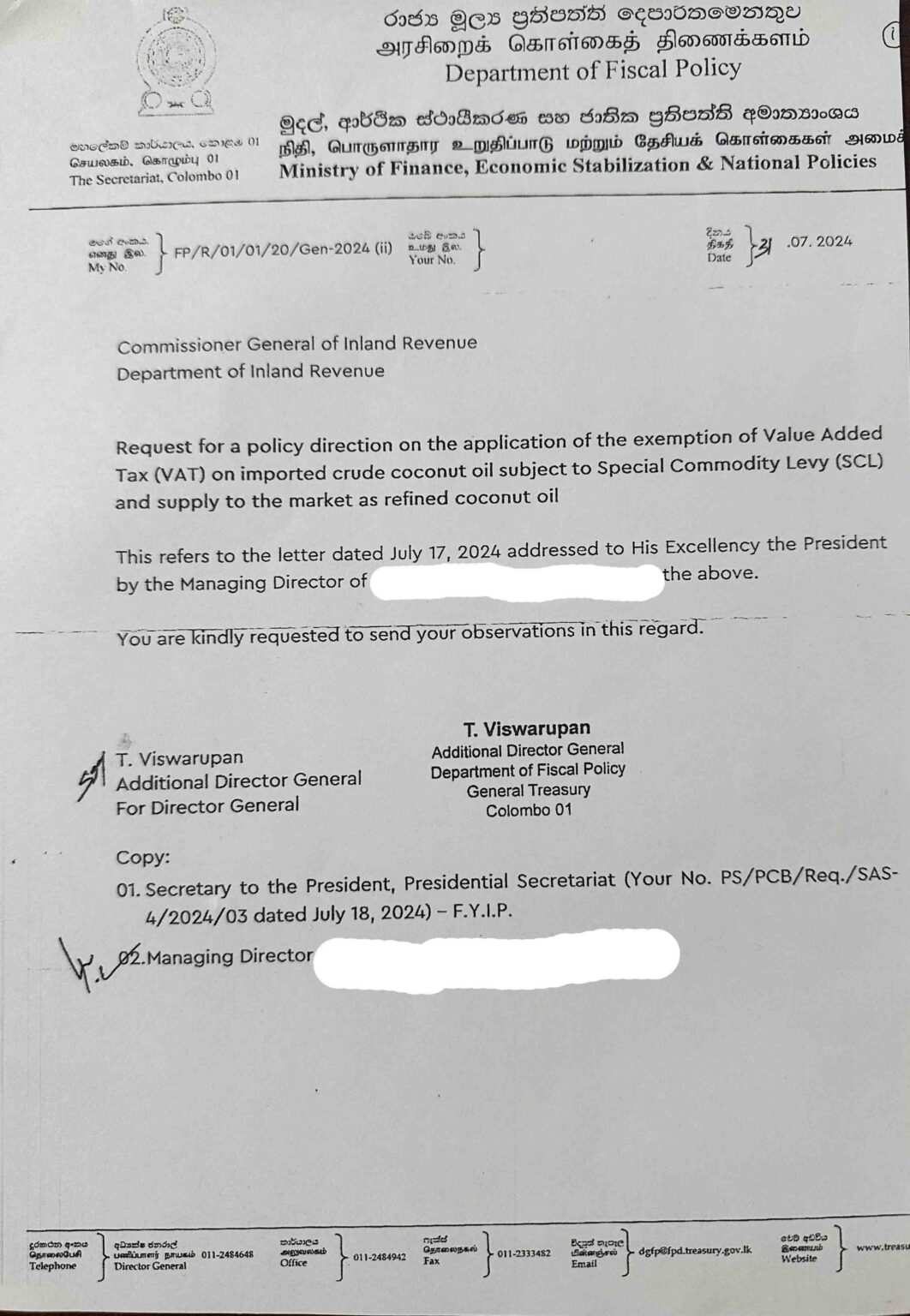
Following this request, T. Vishwarupan, an Additional Director General of the Department of Public Fiscal Policy, issued a letter on July 31, 2024, to the Commissioner General of Inland Revenue, seeking observations on the matter.
In response, on August 29, 2024, B.K. Saman Shantha, Deputy Commissioner General of the Tax Policy, International Relations, and Legal Division of the Inland Revenue Department, confirmed that the 18% VAT and 2.5% Social Security Tax were applicable as of January 1, 2024. However, in the concluding section of the letter, he noted that special consideration should be given to the company’s request, a statement that has since raised suspicions about the department’s stance.
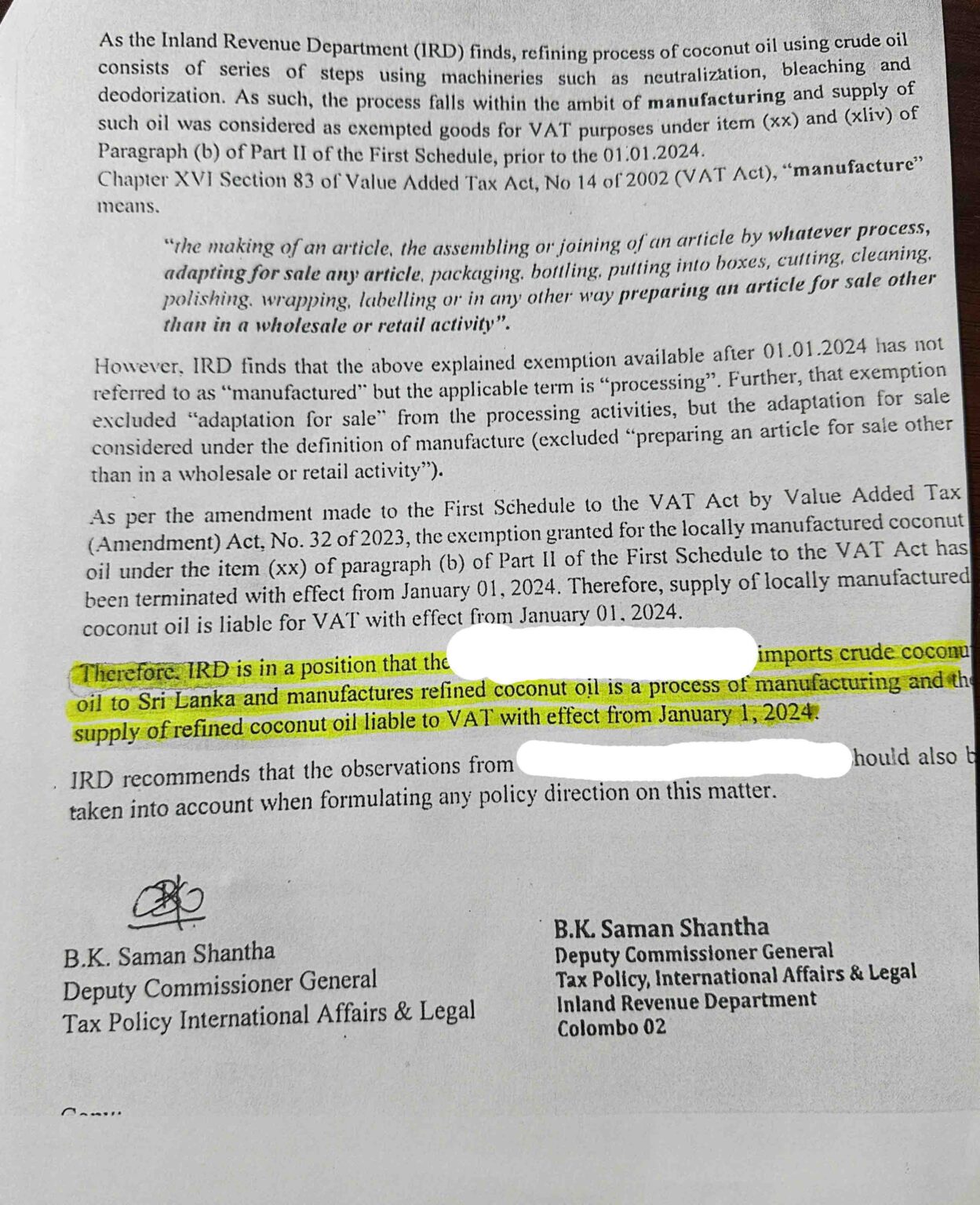
For reasons yet unclear, the Inland Revenue Department refrained from providing a definitive conclusion on whether VAT should be levied in this instance.
Impact on the Industry
The implications of this ambiguity are stark. Since the implementation of the VAT law, approximately 40 small-scale enterprises engaged in importing and refining unrefined coconut oil have ceased operations. Meanwhile, only three large-scale companies continue to dominate the market, allegedly avoiding payment of taxes amounting to Rs. 5 billion.
The allegations of tax evasion and the potential collusion between certain entities and government officials have brought this issue to the forefront of public discourse. Transparency and accountability are now critical to restoring confidence in the system and ensuring fair competition in the industry.