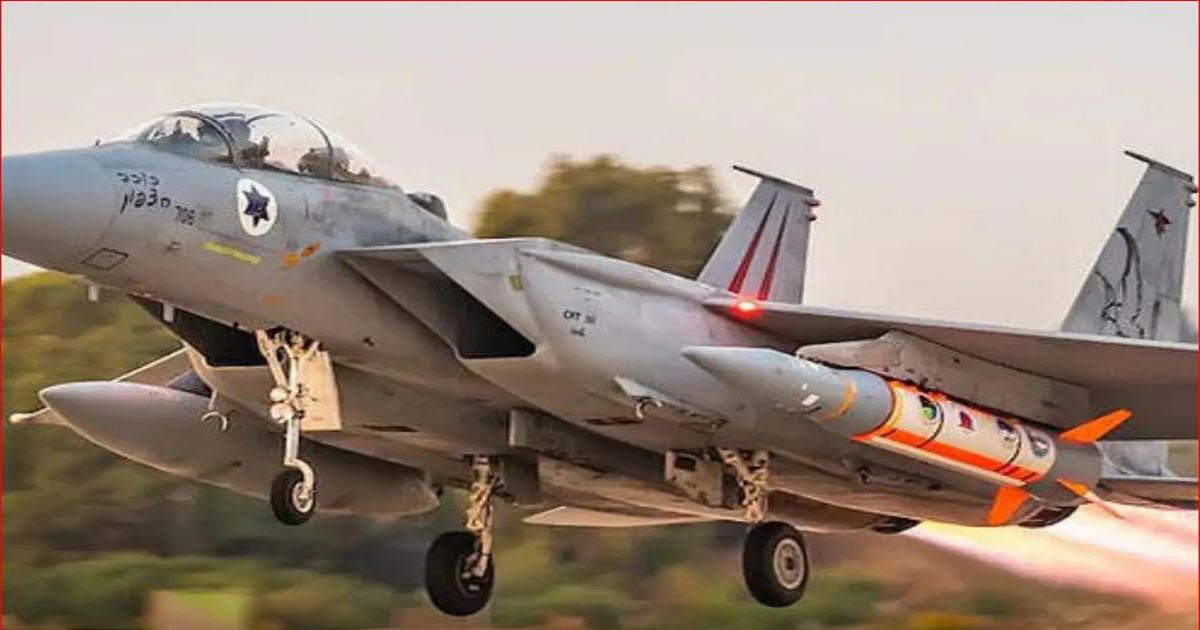
India’s defence partnership with Israel is advancing rapidly, particularly in the field of high-precision missile technology. Following the recent conflict involving Iran, global attention has turned to a powerful air-launched missile system whose technology has quietly found its way into India’s arsenal.
The Blueprint: Israel’s Blue Sparrow
When Blue Sparrow missile reportedly bypassed advanced radar systems and struck a fortified underground target during the Iran conflict, defence analysts around the world took notice.
Originally developed as a target missile to test Israel’s Arrow missile defense system, the nearly 1,900-kg Blue Sparrow was later adapted into a powerful strike weapon capable of descending almost vertically from the edge of space at hypersonic speeds.
The Offensive Variant: ROCKS / Crystal Maze 2
Building on the same booster, engine and quasi-ballistic design, Israel’s Rafael Advanced Defense Systems developed an operational strike weapon known as the ROCKS missile.
In India, the system is reportedly designated Crystal Maze 2, designed to strike hardened underground targets even in environments where GPS signals are denied or jammed.
India’s Su-30MKI Test Launch
India has not only studied the system but also tested it. In April 2024, the Indian Air Force successfully test-fired the missile from a Sukhoi Su‑30MKI over the Andaman and Nicobar Islands.
The trial demonstrated that Indian pilots could launch the weapon from safe stand-off distances, replicating the operational concept used by the Israeli Air Force.
The Quasi-Ballistic Advantage
Unlike conventional cruise missiles such as the BrahMos missile that travel at lower altitudes, the ROCKS/Blue Sparrow family climbs into the upper atmosphere before plunging down almost vertically onto its target.
This trajectory allows the missile to evade many surface-to-air missile networks, which are primarily designed to monitor threats approaching along the horizon.
Striking Without Crossing the Border
With an estimated range of 250–300 kilometers, the missile gives India the capability to hit heavily fortified targets from within its own airspace.
A fighter jet could take off, approach the border, and strike high-value targets across the Line of Control without ever entering enemy territory.
The “Golden Horizon” Expansion
Reports suggest the partnership could deepen further. During diplomatic engagements between Narendra Modi and Israeli officials in early 2026, intelligence leaks indicated that Israel offered India a larger derivative of the Sparrow family known as Golden Horizon.
This proposed air-launched ballistic missile is believed to have a range approaching 2,000 kilometers, potentially transforming India’s fighter jets into long-range strategic strike platforms.
The “Make in India” Strategy
India is also exploring domestic production of such systems under its Atmanirbhar Bharat initiative. By integrating locally manufactured components with Israeli technology, New Delhi aims to develop an indigenous version of quasi-ballistic missiles to strengthen its deterrence capabilities in a potential two-front conflict scenario.
Source: Wion News