
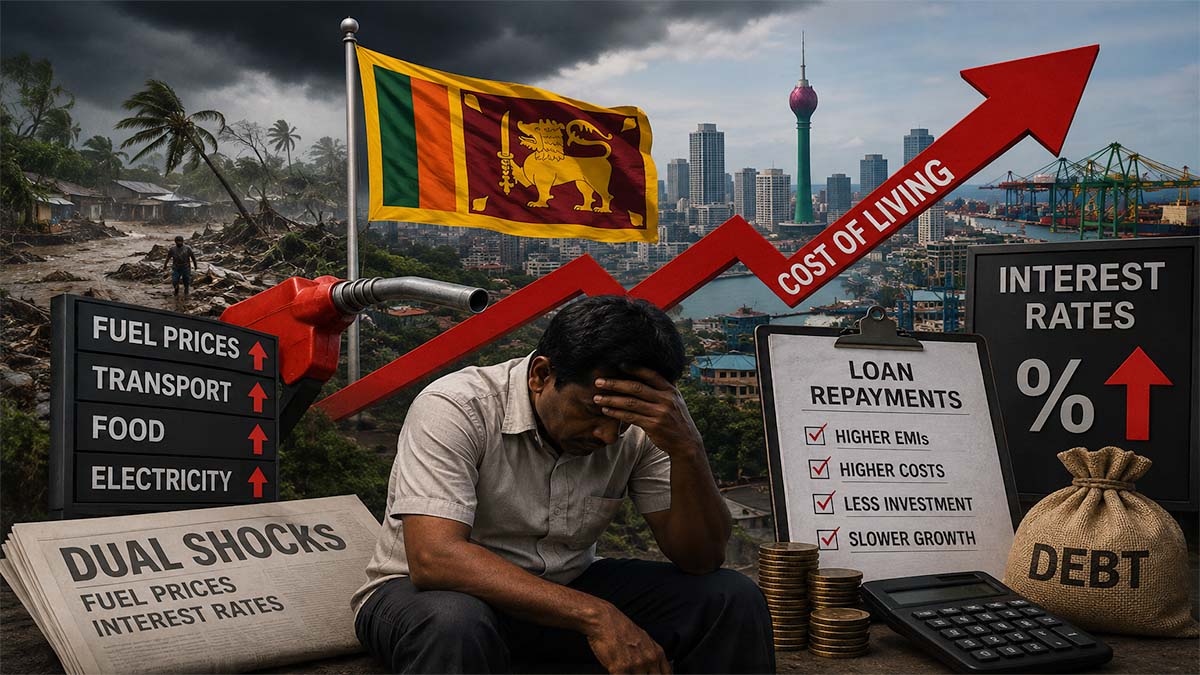
Sri Lanka’s fragile economic recovery is once again being tested by a combination of domestic and global pressures that economists describe as a “dual shock” to the economy. At a time when the country was gradually emerging from the shadow of the 2022 financial collapse, fresh increases in fuel prices and rising interest rates are now threatening to slow growth, weaken household purchasing power, and undermine investor confidence.
Senior economist and academic Professor Kennedy Gunawardena of the University of Sri Jayewardenepura warn that the current situation could become a serious obstacle to Sri Lanka’s recovery if policymakers fail to maintain fiscal discipline while protecting vulnerable communities.
Fuel Prices and the Cost-of-Living Crisis
Sri Lanka has experienced multiple fuel price hikes in recent weeks due to volatility in global oil markets. Because the country remains heavily dependent on imported petroleum, fluctuations in international crude oil prices quickly affect domestic prices.
The impact is immediate and widespread. Transport costs increase, electricity generation becomes more expensive, and food distribution costs rise across the country. Farmers face higher operating costs for machinery and transportation, while households struggle with increased expenses for cooking gas, commuting, and basic necessities.
According to Professor Gunawardena, rising fuel prices do not only affect energy consumption but ripple across the entire economy.
“When fuel costs rise, almost every sector feels the pressure. Transportation, agriculture, manufacturing, and retail prices all increase, placing enormous strain on ordinary families,” he observed.
The result is a sharp erosion of disposable income. Families are increasingly forced to cut spending on non-essential goods and services, reduce travel, and even compromise on nutrition and healthcare in order to manage rising expenses.
Higher Interest Rates Add Further Pressure
At the same time, the Central Bank’s monetary tightening measures have created another layer of economic stress. Policy interest rates were increased in an effort to contain inflation, stabilize the rupee, and preserve macroeconomic stability.
While higher interest rates may help prevent runaway inflation, they also make borrowing significantly more expensive.
Businesses now face increased costs for loans and working capital. Families with housing loans, vehicle leases, or personal debt are also experiencing higher monthly repayments.
Professor Gunawardena notes that this creates a squeeze from both sides.
“Fuel price increases push up living costs, while higher interest rates reduce the affordability of loans and investment. Together, they create a severe burden on households and businesses alike,” he explained.
The combined effect reduces consumer demand and weakens economic activity. Companies delay expansion plans, postpone recruitment, and reduce investment, while households cut spending in response to financial uncertainty.
Recovery Under Threat
Sri Lanka had shown signs of stabilization during 2025 and early 2026. Economic growth approached five percent, inflation fell sharply to around 1.6 percent, and foreign reserves gradually improved under the country’s ongoing International Monetary Fund (IMF) program.
However, economists caution that the recovery remains highly vulnerable to external shocks.
The country is currently operating under its 17th IMF-supported reform program, with a target of achieving a primary budget surplus of 2.3 percent of GDP by mid-2026. Maintaining that target while increasing relief spending and managing rising import costs has become increasingly difficult.
Professor Gunawardena argues that Sri Lanka must avoid repeating the policy mistakes that contributed to the 2022 collapse.
“The country cannot return to debt-fueled subsidies or excessive money printing. Sustainable recovery depends on structural reforms, export diversification, productivity growth, and fiscal discipline,” he emphasized.
Global Instability Adds to Economic Pressure
The ongoing instability in the Middle East has further complicated Sri Lanka’s economic outlook.
The conflict has affected tourism flows, remittance inflows, and tea exports — three of Sri Lanka’s most important sources of foreign exchange. Rising global energy prices and disruptions to shipping and logistics are also increasing costs for local businesses.
Meanwhile, the impact of Cyclone Ditwah has created additional fiscal pressure by damaging infrastructure and agricultural production, forcing the government to divert resources toward emergency relief and reconstruction.
Economists warn that these overlapping crises expose the vulnerability of Sri Lanka’s economy to external disruptions.
Impact on Businesses and Employment
Businesses are now facing a double burden: rising operational costs due to fuel increases and higher financing costs because of elevated interest rates.
Small and medium-scale enterprises are particularly vulnerable. Many businesses are delaying hiring, scaling back production, or postponing expansion plans due to uncertainty.
This slowdown threatens job creation at a time when many Sri Lankans are still struggling to recover from the economic hardships of recent years.
Professor Gunawardena cautions that prolonged high costs could create a cycle of slower growth and declining consumer confidence.
“When businesses reduce investment and families reduce spending, economic recovery naturally slows. The challenge is to stabilize the economy without suffocating growth,” he said.
Risks to Debt Sustainability
The dual shock also raises concerns over debt sustainability.
Sri Lanka continues to manage a heavy external debt burden following its sovereign default in 2022. Higher global interest rates increase borrowing costs for governments and private borrowers alike.
Domestic borrowers are also under pressure as loan repayments become more difficult. Economists warn that if inflation remains elevated and growth weakens, the risk of loan defaults could rise, threatening financial stability.
Analysts have also warned that Sri Lanka may eventually require another IMF arrangement beyond 2028 if external pressures continue and reforms lose momentum.
Social and Political Consequences
Economic stress rarely remains confined to financial indicators alone.
As living costs rise and employment opportunities weaken, public frustration can intensify. Higher fuel prices, inflation, and mounting debt burdens could increase social discontent and political instability.
Sri Lanka’s recent history demonstrates how rapidly economic grievances can evolve into broader political crises.
Professor Gunawardena stresses that maintaining public confidence will require transparent policymaking, targeted social protection, and continued economic reforms.
“The country must build resilience instead of depending on short-term fixes. Crises can also become opportunities for innovation and restructuring if handled wisely,” he noted.
A Critical Moment for Sri Lanka
Sri Lanka now stands at a delicate economic crossroads.
The country’s recovery remains possible, but the margin for policy mistakes is extremely narrow. Rising fuel prices, elevated interest rates, global uncertainty, and climate-related disruptions are collectively testing the resilience of the economy.
Whether Sri Lanka can withstand these pressures will depend largely on its ability to maintain fiscal discipline, protect vulnerable communities, diversify exports, and strengthen long-term economic productivity.
The dual shocks confronting the country serve as a reminder that economic recovery is not merely about stabilizing numbers on paper, but about building a more resilient and sustainable foundation capable of withstanding future crises.
As Professor Kennedy Gunawardena warns, the challenge ahead is not simply surviving the current shocks — but ensuring that Sri Lanka does not slide backward into another cycle of instability.