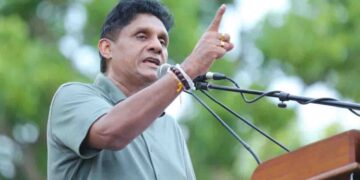
The candidate Sajith Premadasa, who was defeated in the 2019 presidential election, received 41.99% of the votes, amounting to 5,564,239 votes. In this 2024 presidential election, the winning candidate, Anura Kumara, received 42.31% of the votes, totalling 5,740,179 votes.
“So, does that mean Anura won this time with the same percentage that Sajith lost in 2019?”
Anura won with a lower percentage than any defeated candidate in Sri Lankan presidential election history, except for 2010. If you look at the vote percentages of defeated candidates in the five presidential elections since 1999, this becomes clear.
“Anura got a million votes…”
This was the campaign that the JVP started even before the 2024 presidential election was announced. Social media opinion polls indicated that Anura would receive more than 60% of the vote. Everyone, regardless of party differences, said that there was a wave of support for Anura across the country. Political analysts even claimed that this wave was bigger than the wave for Gotabaya in 2019.
Everyone who said Sajith would win believed that he could do so with the support of minority votes from the North-East and plantation areas. The truth, however, is that Ranil garnered 723,426 votes in the Northern-Eastern and plantation districts where minorities live, and the independent Tamil candidate received 226,343 votes. When these are combined, the total is 949,769 votes. When this is added to Sajith’s votes, the total becomes 5,312,804. Ranil’s votes from districts like Colombo, Kandy, and Matale, where minorities also live, were not included in this calculation. If those minority votes from Colombo, Kandy, and Matale were added, Sajith would have won.
Here, the votes Ranil received from districts where Sinhala nationalists live were not added to Sajith’s total. This is because those votes included both SLPP and UNP supporters. The votes added to Sajith’s total were only from Nuwara Eliya, Jaffna, Vanni, Batticaloa, Digamadulla, Trincomalee, Puttalam, and Badulla districts. It was Ranil who fielded an independent Tamil candidate by giving bar licenses to the Tamil National Alliance leader Sridharan and selected TNA MPs.
It was also Ranil who nominated Fonseka for the presidential election, with the aim of splitting Sajith’s vote.
“So, did Ranil defeat Sajith?”
What Ranil did was similar to the contract Ossie Abeygunasekara did in 1988. In the 1988 presidential election, if the votes of SLMP candidate Ossie Abeygunasekara were added to Madam’s total, she would have won. What Ossie did was a UNP contract.
This time too, Ranil executed Anura’s contract.
Sajith in the 2024 presidential election was not facing Anura Kumara, but a public tsunami against the SLFP, UNP, SLPP, and the factions of the 2015 Maithri-Ranil government, which had ruled the country for 76 years. This public tsunami swept away the SLFP, UNP, and SLPP.
However, the Samagi Jana Balawegaya (SJB) did not get swept away. Despite the public tsunami that rallied to elect Anura with over 60% of the vote, Sajith managed to bring it down to 42% and prevented Anura from getting the 50% needed to become Sri Lanka’s first president elected without a majority.
Sajith played this game while being surrounded by the JVP’s strong social media campaign. Meanwhile, mainstream media like Derana, Sirasa, Lankadeepa, and Swarnavahini worked day and night to help Anura win. Simultaneously, state media like National TV and Independent TV supported Ranil while continuing to attack Sajith. Derana, Lankadeepa, and Daily Mirror gave publicity to both Ranil and Anura, pushing Sajith to third place. Derana, which showed snakes in 2019 to help elect Gotabaya, hosted debates in this presidential election to attack Sajith.
The SLPP didn’t give the presidency to Ranil out of love, but rather to appoint a UNP president and sideline Sajith and the SJB. The Rajapaksas believed that by doing so, the SLPP would rise again. However, the SLPP was defeated, and the JVP rose.
Ranil became prime minister in 2001 with the support of Prabhakaran. If Prabhakaran hadn’t bombed Colombo and launched an attack on Jaffna, it wouldn’t have been possible to topple Chandrika’s government. Ranil became prime minister, but Prabhakaran was destroyed.
In 2015, the SLFP made Ranil prime minister. By 2019, the SLFP was destroyed and in disarray. In 2022, the SLPP made Ranil prime minister and then president. By 2024, the SLPP ceased to exist.
After the defeat in the 2024 presidential election, the SJB has teamed up with Ranil again. If Sajith joins Ranil for the 2024 general election, it will spell the end of the SJB.
Since its inception, the SJB has been the target of games from Ranil, the Rajapaksas, and the JVP, each trying to bring down both the party and Sajith. When Gotabaya won, Diana, a member of the SJB, was taken into the government. The Rajapaksas brought Ranil into parliament and attempted to remove Sajith from the opposition leader’s position. When that failed, they made Ranil president, hoping he would help break up the SJB. The JVP also lent a hand in this effort.
In the middle of the presidential election, Thalatha broke away from the SJB and joined Ranil. This wasn’t to help Ranil win but to ensure Anura’s victory. Ranil believed that Anura would become first and he would be second. If that didn’t happen, Ranil’s goal was to defeat Sajith, push him out, and take the SJB back to the UNP, with himself as the opposition leader again.
Today, Ranil isn’t even asking for votes. He’s not on the national list. The UNP leader, chairman, and general secretary aren’t asking for votes either. The Rajapaksas aren’t asking for votes.
However, Sajith is asking for votes. The SJB remains the country’s main opposition party. Bitter as it may be, that’s the truth. When the party faced a public tsunami and others were swept away, the SJB survived.