The village of Devnimori, located near Shamlaji in the Aravalli District of present-day Gujarat, India, has drawn special attention from the global Buddhist community due to the discovery of authentic corporeal relics of the Buddha—a fact many readers may already be aware of.
In 1957, due to the construction of a dam in the area, this village was destined to be submerged under water. Anticipating this, a team of archaeologists from The Maharaja Sayajirao University of Baroda, led by Professor S. N. Chowdhry, initiated excavations based on a well-founded assumption that the ancient ruins and mounds in the area belonged to a vihara (monastic) complex.
As a result of these excavations, archaeologists were able to uncover a great stupa and monastic complex dating back approximately 1,700 years, which had been buried several feet underground. This remarkable effort saved a priceless Buddhist heritage site that would otherwise have been permanently lost beneath water. For this achievement, they deserve immense gratitude.
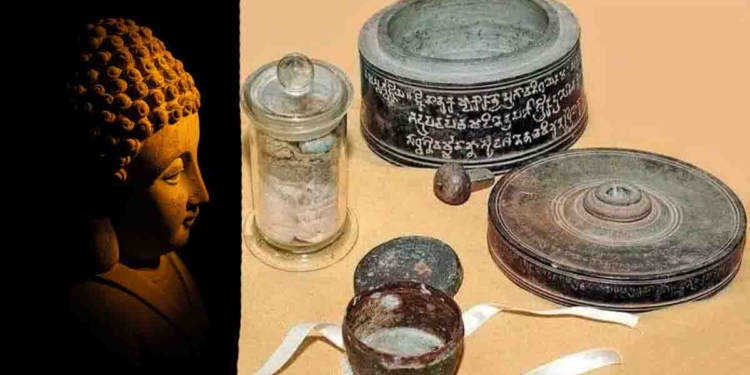
The most significant moment of the excavation occurred on January 14, 1963. On that day, at a height of 24 feet from the base of the great stupa, the reliquary that we see today was discovered. The stone inscription engraved on this reliquary astonished scholars worldwide.
The reliquary was crafted from green schist stone and bore an inscription written in Brahmi script of the Kshatrapa period, in the Sanskrit language. The core inscription reads:
“Dashabala Sharira Nilayaḥ Praśasta Ramyo Mahā Stūpaḥ, Saṃvatsare Saptaviṃśatyadhike Śate 127 Kathikānāṃ Rājñi Śrī Rudrasene…”
The Sanskrit phrase “Dashabala Sharira Nilayaḥ” mentioned at the beginning of the inscription can be broken down as follows:
Dashabala: The Buddha
Sharira: Corporeal or bodily
Nilayaḥ: Abode, residence, or resting place
Taken together, the phrase means:
“The abode in which the corporeal relics of the Dashabala (the Buddha endowed with the Ten Powers) are enshrined.”
Based on this inscription, scholars confirmed that the corporeal relics of the Buddha are indeed enshrined in this stupa. It is well known that the Buddha is often referred to as “Dashabala”, a title commonly used in Buddhist sermons—this same title appears in the Sanskrit inscription to identify the Buddha.
According to the inscription, the stupa was constructed in the 127th year of the Kathika rulers, during the reign of King Sri Rudrasena, and the construction was completed on the fifth day of the month of Bhadrapada.
During excavations, coins belonging to the Western Satrap rulers were discovered inside the reliquary, including coins of King Rudrasimha II, dating to 305–313 CE. Based on this evidence, archaeologists conclude that the stupa underwent its final renovation in the 4th century CE (around 375 CE).
To better relate this timeline to Sri Lanka: during this same period, King Sirimeghavanna (Kithsirimevan) ruled the island—this was also the era when Prince Danta and Princess Hemamala brought the Sacred Tooth Relic to Sri Lanka.
At the current exhibition in Sri Lanka, devotees can view all three sacred relic containers. When visiting, pay close attention to the glass display case, which contains the following:
Stone Reliquary:
The main green schist stone reliquary bearing the inscription mentioned above.
(Base: 6.8 inches, Height: 2.9 inches)
Copper Casket:
A copper box found inside the stone reliquary, containing a gold-plated silver–copper cylindrical vessel. Within this vessel were the sacred relics.
Glass Vessel:
For modern preservation, the relics and the small silver cylindrical container are now housed in an airtight glass vessel, placed at the center of the display case.
It was inside the second item—the copper casket—that the small cylindrical silver container holding the relics, along with fragments of silk cloth, was discovered. For their protection, all these items have been secured within the special airtight glass vessel mentioned above. (The photograph used in this post, showing all items together, was sourced from the Devnimori archaeological site.)
If you are visiting to pay homage, do not forget to observe another important detail: on the wooden base of the glass display case at Gangaramaya Temple, the inscription “Dashabala Sharira Nilaya” is written in Roman letters, just as recorded on the original reliquary.
Having the opportunity to venerate these sacred relics—preserved within the stupa for 1,700 years, and safeguarded for nearly six decades at the Maharaja Sayajirao University—is a great blessing for the Buddhist people of Sri Lanka. However, it remains deeply unfortunate that the original monastic complex itself now lies submerged underwater.
References:
Times of India: Reports on MSU relics and Prof. S. N. Chowdhry’s excavation
Archaeological Survey of India (ASI): Inscription translations and numismatic data
Mahavamsa
Maharaja Sayajirao University of Baroda: Department of Archaeology and Ancient History records
Article compiled by Venerable Udugampola Hemaratana Thero.