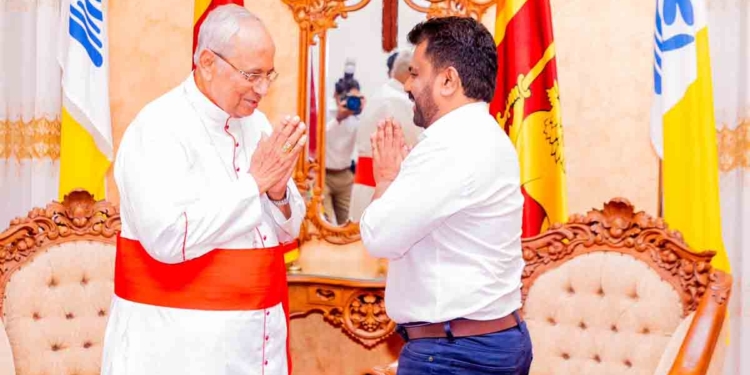
His Eminence Malcolm Cardinal Ranjith has strongly criticized the rise of authoritarianism in the country under the pretext of war, describing it as a severe blow to democracy.
Speaking at the Divine Liturgy held this morning (4th) at All Saints Church in Borella to mark the 77th Independence Day, the Cardinal urged the President and the government to immediately repeal the current constitution and introduce a new one to dismantle the existing corrupt system and restore true freedom to the nation.
He emphasized that leaders have misused the unchecked power granted under the Presidential Constitution, leading to an authoritarian regime. He further stated that this legal framework had transformed manageable ethnic tensions into prolonged conflicts, ultimately creating a climate of fear and instability in the country.
Cardinal Ranjith also highlighted that successive governments had engaged in acts of repression, including media suppression, enforced disappearances of journalists, the infamous white van culture, and the imprisonment of political opponents since the 1990s. He pointed out that the nation had suffered a severe economic downturn due to the devastating war, with the situation worsening over the past two decades.
“The government that came to power following the people’s uprising, known as the ‘struggle,’ has continued to act in the same authoritarian manner. Since 1978, governments have wielded dictatorial powers at their discretion, often applying the law selectively to serve their interests. We have witnessed the suppression of the judiciary, where court rulings unfavorable to those in power are disregarded. Under the guise of war, a dangerous pattern has emerged, where those in power exploit their authority in Parliament without accountability,” he remarked.
He went on to describe the existing constitution as the root cause of the country’s current crises, branding it as a “death blow” to democracy. According to the Cardinal, this legal structure has fostered a culture of terror, bloodshed, and lawlessness, ultimately eroding justice and governance.
He firmly called for the immediate abolition of the current constitution and the establishment of a new one that unites all citizens as equals, eliminating space for corruption, violence, and lawlessness. The Cardinal expressed hope that such a reform would pave the way for a religious, cultural, and social renaissance in Sri Lanka.