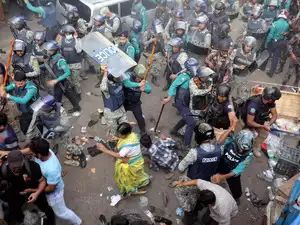
The arrest of ISKCON priest Chinmoy Krishna Das Brahmachari in Bangladesh has sparked significant controversy, with calls for banning the Vaishnava sect, globally renowned for its peaceful principles and widespread presence. Reports indicate that a petition has been filed in the Bangladesh High Court labeling ISKCON as a fundamentalist organization. Additionally, the country’s attorney general has suggested that the government is scrutinizing the organization. In response to India’s Ministry of External Affairs criticizing the arrest, Bangladesh dismissed the matter as an “internal affair.” The priest was reportedly mobilizing Hindus to protest against the atrocities they face.
Meanwhile, Nobel laureate and interim government head Muhammad Yunus has downplayed escalating attacks on Hindus in Bangladesh, claiming the violence is exaggerated and limited to isolated incidents. This stance comes amidst reports suggesting a broader cycle of violence targeting the Hindu minority, painting a troubling picture of a nation potentially reverting to a regressive state—ironically resembling the Pakistan it broke away from in 1971 with India’s assistance.
A Tilt Towards Pakistan?
Recent developments signal Bangladesh’s attempts to strengthen ties with Pakistan under Yunus’ interim government. Notably, a cargo vessel from Karachi docked at Chattogram port for the first time in over five decades, symbolizing a direct maritime connection between the two nations. Pakistani High Commissioner Syed Ahmed Maroof lauded this as a “major step” to boost bilateral trade and economic collaboration. Moreover, Yunus met Pakistan Prime Minister Shehbaz Sharif in September at the UN General Assembly, advocating for the revival of SAARC, the South Asian regional cooperation platform that has stagnated due to India-Pakistan tensions.
Bangladesh’s foreign affairs adviser Md Touhid Hossain hinted at a reconciliatory approach, stating that improved relations with Pakistan would be easier if Islamabad apologized for the atrocities committed during the 1971 Liberation War. However, the shifting regional dynamics and rekindled Bangladesh-Pakistan relations raise significant concerns for India, particularly regarding security and strategic implications.
Rising Extremism and Shrinking Minority Rights
Simultaneously, Bangladesh faces rising extremism, with calls to declare the nation an Islamic state gaining traction. The release of Mufti Jashimuddin Rahmani, leader of the Ansarullah Bangla Team (ABT)—an al-Qaeda affiliate—soon after Yunus’ government assumed power further highlights the growing influence of radical groups. Rahmani, convicted in the murder of secular blogger Rajib Haider, represents a broader resurgence of Islamist extremism under the current administration. Furthermore, the mass prison break following Sheikh Hasina’s ouster, involving over 700 inmates, including terror suspects, adds to the growing instability.
Writer-activist Taslima Nasreen has warned of the country’s descent into radicalism, describing a generation being indoctrinated with anti-Hindu, anti-India, and pro-Pakistan ideologies. She likened the situation to Bangladesh becoming another Afghanistan, driven by Islamist propaganda and extremism.
Implications for India
The evolving Bangladesh-Pakistan relations and rising extremism pose strategic challenges for India. The new shipping route between Karachi and Chattogram, though less economical, carries potential geopolitical significance. These developments demand close monitoring, as they could alter regional power dynamics, heighten security risks, and complicate India’s bilateral relations with Bangladesh.
India must navigate this shifting landscape, balancing diplomatic efforts with vigilance against potential threats arising from the convergence of extremism and renewed Pakistan-Bangladesh ties.