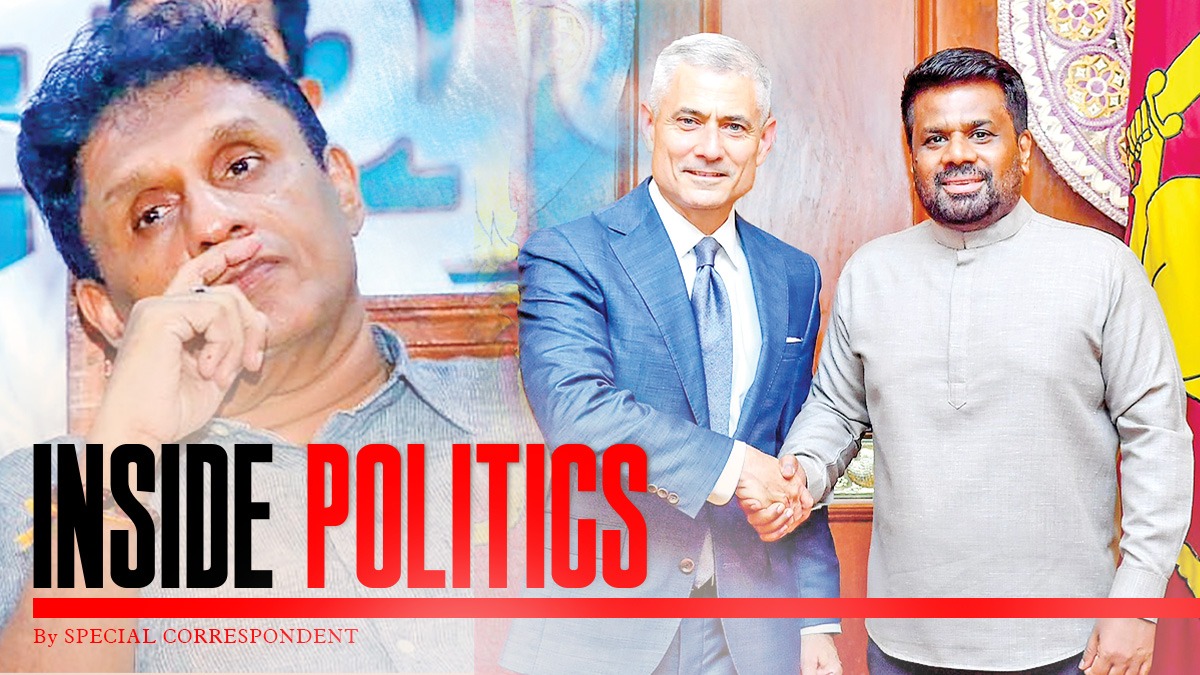
Port Unions Rally with Sajith
French Ties Deepen at Colombo Port
U.S. Eyes Trinco Oil Tanks
Cricket Elections Loom Ahead
Americans are coming
Amid the political turmoil in Sri Lanka—ranging from multi-million bribery allegations and arrests to protests inside Parliament and attempts to seize the Speaker’s mace—several important political developments have been taking place quietly behind the scenes.
While public attention remains focused on these dramatic events, little interest has been shown in the significant developments unfolding out of public view. Yet these behind-the-scenes events could have major consequences for the country’s future.
As always, the ‘Inside Politics’ column brings readers information that has not been reported elsewhere.
Previously, we revealed that the United States was planning to invest in several of Sri Lanka’s most strategically important economic assets. We reported that Sergio Gor, US President Donald Trump’s special envoy for South and Central Asia and the US Ambassador to India, visited Sri Lanka a few months ago, met with the President, and then travelled directly to inspect the Colombo Port West Container Terminal.
Also, we reported in February that Paul Kapur, the US Assistant Secretary of State for South and Central Asian Affairs, had presented the US Senate with a detailed assessment of Sri Lanka’s strategic importance.
First to reveal
At a meeting of the US Senate Foreign Relations Committee, Paul Kapur discussed America’s foreign policy strategy in South Asia.
During the discussion, Kapur made several striking observations about Sri Lanka.
He explained that Sri Lanka had become one of the most strategically important countries in both the Indian Ocean and South Asia because many of the world’s key shipping lanes—including those carrying Middle Eastern oil and global imports and exports—pass close to the island.
He noted that although Washington had not paid much attention to Sri Lanka in the past, the current geopolitical situation meant it could no longer be viewed as just another South Asian country.
According to Kapur, China had already recognised Sri Lanka’s importance and had been working aggressively to strengthen its influence there. He cited China’s control of the Hambantota Port and the controversial visit of a Chinese research vessel in 2022 as evidence of Beijing’s growing strategic presence.
He argued that these developments served as a warning to both the United States and India, and that both countries would need to monitor Sri Lanka much more closely in the future.
Kapur also stressed that the United States should closely watch China’s activities throughout the Indo-Pacific region.
What should be done?
Members of the Senate committee then asked Kapur what the United States should do to bring Sri Lanka closer to Washington.
He replied that although Sri Lanka was gradually recovering from its severe economic crisis, it still lacked a proper long-term economic plan.
Therefore, he said, the United States should help Sri Lanka develop a sound economic strategy while continuing to support the country’s programme with the International Monetary Fund (IMF).
He also pointed out that Sri Lanka was still struggling with foreign debt restructuring and attracting foreign investment.
According to Kapur, the United States should help Sri Lanka strengthen its relationship with India, while also reducing its dependence on China.
He observed that Sri Lanka had accumulated large amounts of Chinese debt, particularly for infrastructure projects, making it difficult for the country to free itself from Beijing’s influence.
Kapur further argued that military cooperation between Sri Lanka and the United States should be expanded.
However, instead of establishing a permanent US military base in Sri Lanka, he suggested increasing joint naval operations with India, supplying Sri Lanka with defence equipment, expanding intelligence cooperation, and strengthening military training programmes.
He also recommended establishing better systems to combat drug trafficking across the Indian Ocean.
Taken together, Kapur’s remarks suggested that Sri Lanka could benefit significantly if it successfully attracted greater Western investment and assistance to support its economic recovery.
General’s visit
Last week, ‘Inside Politics’ revealed that Paul Kapur was scheduled to visit Sri Lanka, meet the President, and later inspect the Colombo Port.
Kapur has a naval background and is well-versed in maritime security and naval operations, making his visit particularly significant.
However, just two or three days before Kapur arrived, another senior American official quietly visited Sri Lanka. He was General Kevin Schneider, Commander of the US Air Force component under the US Indo-Pacific Command (INDOPACOM).
Before arriving in Sri Lanka, General Schneider had spent several days in India. It is, therefore, widely believed that he held discussions with Sergio Gor, the US Special Envoy based in India.
Notably, all these visits took place shortly after the recent US-Iran conflict had come to an end.
France enters the picture.
During his visit, Sergio Gor inspected the West Container Terminal at Colombo Port.
Earlier indications suggested that the United States was interested in supporting the development of another terminal there as an American investment project.
However, the situation appears to have changed after a major French company expressed interest in investing in Colombo Port.
Last week, the French shipping and logistics giant CMA CGM announced that it was ready to invest in Sri Lanka’s main port.
The announcement followed discussions between Ports Minister Anura Karunatilaka and the French Ambassador to Sri Lanka.
During those talks, French Ambassador Rémi Lambert said that Rodolphe Saadé, Chairman and Chief Executive Officer of CMA CGM, was expected to meet the Sri Lankan President.
The President is also scheduled to make an official visit to France on the 13th, while the French government has indicated its strong interest in encouraging more French investment in Sri Lanka.
Leading the visiting investment delegation, Christine Cabau, Executive Vice President of CMA CGM, explained that her company operates more than 65 container terminals at major ports around the world.
She said Colombo’s strategic location offers tremendous potential to expand transhipment operations and that the company is interested in increasing cargo volumes through joint investment projects.
She also confirmed that CMA CGM is studying the second phase of the Colombo Port West Container Terminal project.
Port unions meet Sajith
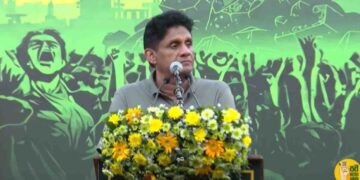
Against this backdrop, several representatives of the Colombo Port trade unions met Opposition Leader Sajith Premadasa last week and made what they described as a major disclosure.
After explaining their concerns, they said that work on the East Container Terminal (ECT)—considered the port’s most valuable asset—was nearing completion and operations were expected to begin next year.
However, they claimed that the government was now preparing to hand the terminal over to a foreign company.
Traditionally, port trade unions have played a decisive role in Sri Lankan politics. Several governments have faced serious political crises after opposition campaigns that initially began within the port sector.
The union representatives told Sajith Premadasa that if the government attempted to privatise or sell the East Container Terminal, they were prepared to resist it at any cost.
Following the meeting, Premadasa raised the issue in Parliament, accusing the government of planning to sell the terminal.
US attention
When all these developments are viewed together, one conclusion becomes increasingly apparent.
Following its recent two-month conflict with Iran, the United States appears to be placing much greater strategic importance on Colombo Port, Sri Lanka’s other ports, and several key economic assets.
At the same time, China’s strong economic recovery has encouraged Washington to step up efforts to establish a greater economic presence in Sri Lanka through major investments.
According to information available, the American company Merck has expressed interest in developing a new harbour facility with a breakwater at the Colombo Port West Terminal.
Some observers, therefore, believe that, since direct American involvement in the East Container Terminal could prove politically difficult, the United States may be encouraging allies such as France to take the lead instead.
Oil tank farm
Earlier, the inside politics column also revealed that during Sergio Gor’s visit to Sri Lanka, the United States proposed helping develop the Trincomalee Oil Tank Farm.
A portion of the tank farm has already been leased to India, leaving around sixty old and unused tanks under Sri Lankan control.
Although the proposal received little attention at the time, reports indicate that General Kevin Schneider raised the matter again during his recent visit.
According to sources, the Americans argued that using these oil tanks would significantly improve logistical support for the US Navy operating in the Indian Ocean.
However, they reportedly pointed out that the remaining sixty tanks alone would not be sufficient for their long-term requirements and therefore proposed gaining access to the entire oil tank complex.
The United States is also said to have expressed its willingness to make substantial investments in the project.
Sri Lanka has not yet responded officially. If such a proposal is formally considered, it remains unclear how India and China would react.
Proposal for Mattala Airport
The United States is also said to have proposed another major investment project involving Mattala Rajapaksa International Airport.
The proposal is to establish a Boeing pilot training centre at the airport.
Taken together, these developments have led many observers to believe that Washington is attempting to establish a long-term presence at several of Sri Lanka’s most strategically important locations through large-scale investments.
This assessment appears to support the observations Paul Kapur made earlier before the US Senate.
Although similar proposals had surfaced in the past, they have gained fresh momentum following the recent US-Iran conflict.
President Meets JVP Lawyers
While these geopolitical developments were unfolding, the government was simultaneously facing growing political pressure at home.
One major criticism concerned the President’s failure to appoint judges to eight vacant Supreme Court positions, some of which have remained vacant for six months.
The opposition also strongly criticised the government’s reported plan to extend the retirement age of the Chief Justice and Supreme Court judges.
Last week, all opposition parties led by the Samagi Jana Balawegaya (SJB) signed a letter requesting a parliamentary debate on the issue.
The criticism became significant enough to create concern within the government itself.
According to reports, the President recently met a group of lawyers affiliated with the Janatha Vimukthi Peramuna (JVP) to discuss the matter.
These lawyers had long requested such a meeting through the party headquarters at Pelawatte.
Their main objective was to express opposition to the proposed extension of judges’ retirement age.
Although many prominent JVP lawyers had privately opposed the proposal within the party, they had avoided criticising it publicly.
President’s Explanation?
During the meeting, the JVP lawyers directly told the President that they opposed the proposal to extend the retirement age of Supreme Court judges.
In response, the President explained why the government was considering such a move.
He stressed that the decision was not intended to gain political advantage, publicity, or electoral benefit, but was based on other practical considerations.
The President then asked the lawyers a question of his own.
He wanted to know why they opposed the proposal.
Most of the lawyers replied that extending the retirement age would disrupt the long-standing system under which court hearing dates are allocated.
The President smiled and responded:
“Isn’t it better if cases are heard and completed quickly instead of being postponed for six months, seven months, or even a year? Isn’t that what the public wants? Are you saying that isn’t a good thing?”
Harsha de Silva Afraid?
Last week, Inside Politics reported comments made by SJB MP Ajith P. Perera, who claimed that US$2.5 million had gone missing from the Treasury.
According to Perera, the Ministry of Finance had prepared a report on the matter, but government ministers allegedly threatened Harsha de Silva, Chairman of Parliament’s Committee on Public Finance (COPF), warning that he would lose his position if he released the report to the public.
However, Perera did not identify the ministers who allegedly made those threats.
The bigger question, however, is why the opposition did not lodge a formal complaint if such serious intimidation had actually taken place.
When Parliament resumed last week, even SJB MPs gathered in the opposition lobby questioned why the party had remained silent.
Many were also puzzled that Harsha de Silva himself had made no public statement.
He neither confirmed nor denied Perera’s allegations.
If, as Harsha has repeatedly argued, Parliament alone has authority over public finances, then any attempt to interfere with that authority should concern both Parliament and the Chairman of the Committee on Public Finance.
Yet, so far, no one has publicly addressed the issue.
Even within the SJB, questions are now being raised.
COPF Under Pressure
Unlike most parliamentary committees, the chairmanship of the Committee on Public Finance traditionally belongs to the opposition.
Harsha de Silva has held that position for several years.
When Ranil Wickremesinghe became President, there was an attempt to remove Harsha from the post.
At that time, the strongest defence of Harsha came not from anyone else, but from Opposition Leader Sajith Premadasa.
Sajith continued fighting until Harsha was reinstated as Chairman.
During that period, the government even appointed ruling party MPs to chair the committee temporarily in order to pass several financial bills—a move that many critics described as an abuse of parliamentary practice.
However, despite Sajith’s support at the time, the article claims that Harsha has not shown the same loyalty in return.
It alleges that Harsha privately met with officials at several foreign embassies and engaged in activities that undermined his own party leadership.
Committee Room Reassigned
Following Ajith Perera’s allegations, the government dealt another blow to the Committee on Public Finance.
It reassigned Committee Room No. 5, which had long been used by the Finance Committee, to the Committee on Public Enterprises (COPE).
Harsha de Silva protested the decision in Parliament.
He said:
“From now on, Committee Room No. 5 has been allocated exclusively to COPE from Tuesday to Friday, from 8 a.m. to 5 p.m. No written explanation has been given. Until now, we shared the room without any problems. Yesterday, someone even claimed in Parliament that the Committee on Public Finance wasn’t really necessary. During the Tenth Parliament, our committee has met 87 times, while COPE has met only 33 times. Yet suddenly a new order has been issued.”
Is the Finance Committee Still Needed?
Last week, Leader of the House Bimal Rathnayake also commented on the issue in Parliament.
He argued that parliamentary Standing Orders do not require every financial bill to be referred to the Committee on Public Finance.
Harsha de Silva responded bluntly.
“If that’s the case,” he said, “then there is no purpose in having the Committee on Public Finance at all. It might as well be abolished.”
Farmers’ Protests Grow
Another major challenge facing the government is the growing wave of protests by farmers across the country.
Farmers have been demonstrating in several districts, demanding a fair price for their paddy harvest.
The protests have attracted large numbers of participants.
The situation became even more tense because of comments made by senior government figures.
Agriculture Minister K.D. Lalkantha and Deputy Minister Namal Karunaratne both made public statements on paddy prices that angered many farmers.
The government also invited several farmer organisations believed to be close to the JVP to discussions at the Ministry of Agriculture.
Meanwhile, Deputy Minister T.B. Sarath from Polonnaruwa reportedly referred to protesting farmers as “kasippu farmers”—a term implying they were involved in the illegal liquor trade.
Another government MP, Aruna Panagoda, claimed the demonstrators were not “genuine” farmers but “artificial farmers.”
These remarks further fuelled public anger.
Can Anura Rein in Lalkantha?
Agriculture Minister K.D. Lalkantha is widely known as a politician who speaks his mind without hesitation or concern for criticism.
Despite the growing farmers’ protests, he has shown little interest in softening or clarifying his controversial remarks.
However, the President and several senior government figures now appear to recognise that comments made by Lalkantha and some other ministers have worsened the situation.
According to Inside Politics, the President has decided to summon both Lalkantha and Deputy Minister Namal Karunaratne for discussions on the issue.
Although bringing Lalkantha into line is considered a difficult task, the President has reportedly begun efforts to resolve the matter.
Daily Mirror’s Falsehood
When the President dissolved the cricket board and appointed an interim committee under Mr Iran Wickramaratne, we reported each development step by step in our inside politics column over the past several months. Last week, we noted that ICC Chairman Jay Shah was scheduled to visit Sri Lanka to meet the President, and that two weeks earlier, the ICC had sent a letter whose contents were not favourable to Sri Lanka. That letter stated the government must hold cricket elections within three months—by July 31—or risk sanctions similar to those imposed on Bangladesh. Rumours spread widely in cricketing circles at the time.
Jay Shah arrived
Against this backdrop, Jay Shah arrived last week and met both the President and the interim committee. Normally, such a visit would be major news, yet the government and media gave it little publicity. Only a photograph of the meeting was released, with no official statement on what was discussed.
Despite this silence, the Daily Mirror published a sensational front-page story on Monday, the 22nd, headlined: “Hold elections or face suspension—ICC warns President”. Within hours, the President’s Media Division issued a strong denial, calling the report baseless and misleading. The statement clarified that the meeting focused on cricket development, grassroots programs, and opportunities for youth, as confirmed by both the President and Jay Shah on their official X accounts. No ultimatum, suspension threat, or election demand was discussed. The government demanded that the Daily Mirror retract the false story from both print and online editions.
What Really Happened?
What was actually discussed between the President and Jay Shah? After verifying information from multiple sources, we can state clearly: the meeting was not a pleasant one for the President. Over 17 minutes, Jay Shah spoke in careful diplomatic language, but firmly reminded the President that all ICC member nations must abide by its rules. He cited Bangladesh’s case, where an interim committee was allowed only three months before elections had to be held. He warned that failure to comply would mean Sri Lanka could participate only as an observer, not as a full member.
The President responded that three months was insufficient to resolve the current crisis and draft a new constitution for cricket; he argued that at least a year was needed. Shah did not give a direct answer but reiterated that, without elections by July 31, Sri Lanka would be excluded from ICC committees.
Two Plans in Hand
As we previously revealed, the President has two strategies. First, he hopes to extend the interim committee’s tenure to one year with ICC approval. Second, if that fails, he plans to field a strong, clean slate of candidates in elections. In the meeting, he told Shah he was ready to hold elections if necessary and would present a corruption‑free team.
This, in truth, is what transpired during those 17 minutes. All other stories circulating outside are fabrications. We report this with full responsibility under inside politics.
No Money Even for Salaries
Meanwhile, reports reaching inside politics reveal that the cricket board is now facing a severe financial crisis. According to information we have, the situation has deteriorated to the point where even paying staff salaries next month may be impossible. Confirming this, interim committee member Prakash Shafter stated at last week’s media briefing that the board lacks funds even to continue construction of the international cricket stadium in Jaffna, a project inaugurated by the President last year.
Against this backdrop, the ICC has indicated that holding elections before July 31 is essential to restore financial stability. The President, therefore, is preparing to field a government‑backed team under the leadership of Iran Wickramaratne in the upcoming elections.
Messages Crossing Both Ways
Former cricket board president Shammi Silva cannot contest again under the constitution, but many expect his faction to present another slate of candidates. Since most cricket associations remain loyal to Shammi’s camp, regaining control of the board would not be difficult for them.
However, inside politics has learned that a message has already been conveyed to Shammi’s side: the government intends to put forward Iran’s team. In response, Shammi’s faction has reportedly sent word that they are willing to accept Iran’s leadership, provided they can nominate several other committee members. Yet, the President’s camp has shown no sign of agreement.
Thus, messages are now being exchanged between both sides over the composition of the next committee. From what we know, the government is preparing—by fair means or foul—to cleanse cricket administration and impose its own plan.