When Ranil became President and was striving to secure approval for the first IMF tranche, the head of the U.S. CIA secretly visited Sri Lanka. After meeting him, Ranil instructed the intelligence services to brief the CIA chief on the situation in the country. The heads of the intelligence agencies explained that there was a possibility of the JVP, a left-wing party, coming to power at the next national election. They must have done so at Ranil’s request. Ranil probably thought that if he frightened the CIA chief with the prospect of the JVP coming to power, the United States would help him win.
“Wijeweera was a CIA agent…”
When the Communist Party’s official newspaper, ‘Aththa’, published this headline in the 1970s, Ranil was Deputy Foreign Minister in J.R.’s government.
The Communist Party and the Lanka Sama Samaja Party accused Wijeweera of being a CIA agent during the 1971 insurrection. They claimed that Wijeweera launched the rebellion at the CIA’s behest to overthrow Sri Lanka’s first democratically elected left-wing coalition government.
Even during Wijeweera’s uprising against the 1987 Indo-Lanka Accord, not only the Lanka Sama Samaja Party and the Communist Party, but also Vijaya Kumaratunga’s Mahajana Party claimed that the CIA could not tolerate the intervention of Soviet-aligned India and had entrusted Wijeweera with the task of sabotaging the agreement.
Whether there was any truth in these claims or not, Wijeweera publicly stood against American imperialism. He attracted young people to the 1971 insurrection by invoking Che Guevara. At the time, Che Guevara was the hero of the JVP.
After being released from prison, Wijeweera used Iran’s spiritual leader Ayatollah Khomeini to attract young people to his second revolution. In his speeches, he spoke of a revolution modelled on Khomeini’s uprising against the Shah’s pro-American puppet government.
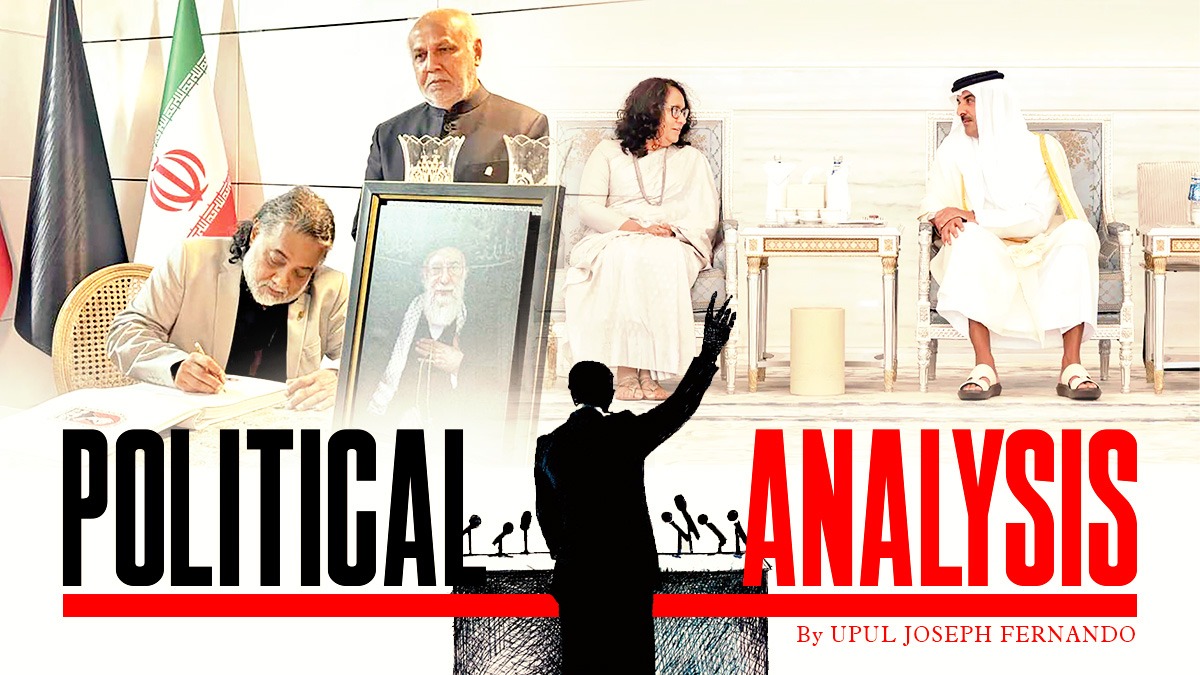
Although Wijeweera’s revolutions failed, the JVP governs Sri Lanka today. Recently, Iran’s second spiritual leader, Ali Khamenei, was killed in U.S. and Israeli attacks. His funeral was held with great ceremony. Sri Lanka’s JVP-led government was represented at the funeral by the Deputy Speaker.
Recently, the Emir of Qatar passed away. Qatar is widely known as a pro-American country in the Middle East. Prime Minister Harini represented Sri Lanka at the Emir’s funeral.
“Is the JVP that afraid of America?”
There is no reason to be. This is the longest period Sri Lanka has been without a U.S. Ambassador. Yet Sri Lanka has no problem, and neither does the United States. The reason is that America no longer has anything to fear about Sri Lanka.
“Does that mean America approves of the JVP government?”
The United States closely watched Sri Lanka when the Rajapaksas were in power. The main reason was that the Rajapaksas were aligned with China and had become partners in the anti-American geopolitical bloc. The United States did not tolerate this. That is why Mahinda publicly said after his defeat in 2015 that foreign powers had brought about his downfall.
The United States had a strong desire to defeat Mahinda in 2015. Its biggest obstacle was Ranil because he could not win elections, and he had destroyed the pro-American UNP. At that point, the JVP came to America’s aid. By not fielding its own presidential candidate, the JVP played a major role in defeating the Rajapaksas in 2015. It travelled across the country from stage to stage attacking the Rajapaksas while indirectly helping the opposition’s common candidate, Maithripala Sirisena, to win.
“So, was it surprising that America aligned itself with the JVP in 2024?”
No. In fact, it was Mangala who built the bridge between the JVP and the United States. It was Mangala who persuaded the JVP not to field a candidate at the 2015 presidential election.
After Anura became President, the United States put him to the test. The test was whether he would lift the ban imposed by Ranil on Chinese research vessels entering Sri Lanka. Despite pressure from China, Anura did not remove the ban. He passed the test.
The next test came during the Iran war. Anura’s government did not condemn the attacks on Iran. He passed the second test as well.
Now, Sergio, the U.S. Ambassador to India and President Trump’s special envoy for South Asia, including Sri Lanka and India, is a friend of Anura. When Sergio visited Sri Lanka, he toured the Port of Colombo, climbed the cranes, and observed the Indian Ocean from inside the port, knowing that Sri Lanka is an indispensable strategic security location for the United States.
“Seventy-five percent of the world’s oil passes close to Sri Lanka’s southern coast. About half of the world’s containers travel along Sri Lanka’s sea lanes. Sri Lanka is a strategic location vital not only to the global economy but also to America’s security…”
These were the remarks made by Kapoor, the U.S. Assistant Secretary of State for Central and South Asia, during his recent visit to Sri Lanka, before the U.S. Senate Foreign Relations Committee.
The truth is that America’s renewed interest in Sri Lanka has grown with the Iran war. Previously, it was mainly interested in countering China’s influence. But now, in the context of a Middle East conflict, the United States views Sri Lanka as a strategic security asset in the Indian Ocean.
Thus, America does not want to antagonize Anura. It is no longer particularly concerned about democracy, human rights, or media freedom in Sri Lanka.
Thus, would Anura have sent only the Deputy Speaker to Iran’s funeral while refraining from sending Harini to Qatar’s funeral?