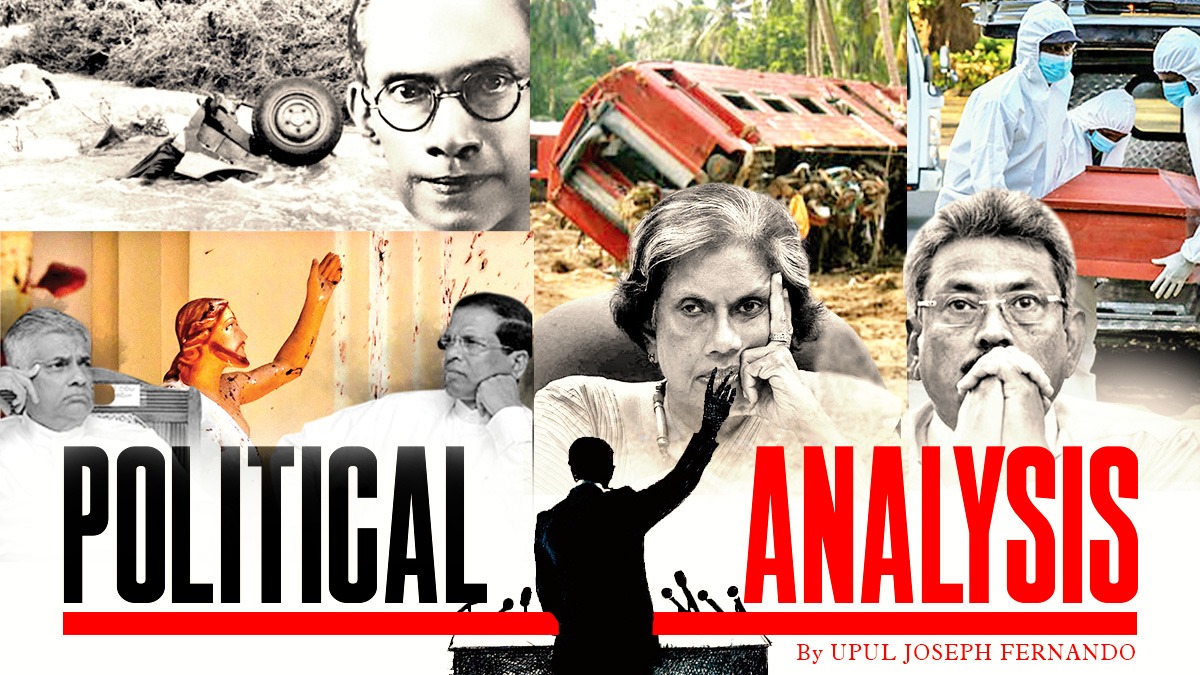
The 1956 general election was a political deluge. That deluge swept away the UNP, which was then the largest political party in Sri Lanka, the way a flood sweeps away a mansion. Riding the crest of that political wave was Bandaranaike. He became Prime Minister with an overwhelming public mandate by claiming that the UNP had been broken, the elite class humbled, and the non-elite had risen to rule.
Years passed. In attempting to fulfill his main election promise—the Sinhala Only Act—racial tensions flared. Later, when he tried to calm those tensions by signing the Bandaranaike–Chelvanayakam Pact, the country became unsettled again, and then a great flood struck. As a man kicked by a cow after falling from a tree, Bandaranaike’s government suffered further ruin.
His cabinet, lacking experience and administrative skill, could not manage the disaster. The flood, which claimed 200 lives, was the first great tragedy faced by newly independent Sri Lanka. People placed the blame squarely on the government. Submerged by the 1957 flood, the government struggled on amid two years of public hostility until Bandaranaike’s assassination brought it to an end.
The next calamity of that scale came with the 2004 tsunami. Before the tsunami struck, President Chandrika, in alliance with the JVP, had established a strong government, imprisoning one of the strongest figures in the Opposition, S.B., for contempt of court, leaving the Opposition helpless.
The JVP was the dominant force in Chandrika’s administration. The current President, Anura, was then the Minister of Agriculture. Vijitha Herath was Minister of Culture. Lal Kantha, Bimal Ratnayake, and Sunil Handunnetti were deputy ministers. At that time, Chandrika and the JVP were discussing constitutional changes that would allow Chandrika to govern for a third term as Executive Prime Minister. They planned to cancel the 2005 presidential election and, through a coalition between the two parties, call for a general election. The UNP and its leader, Opposition Leader Ranil, were in a weak position.
The December 2004 tsunami struck at a moment no one expected. When it hit, Chandrika was abroad. Her carefully constructed image—polished to near invincibility—was shattered by the tsunami. The main accusation against her was that she failed to warn the public in time. After the tsunami, she clashed with her strongest partner, the JVP. Ignoring the JVP’s viewpoint, she created a joint tsunami relief mechanism with the LTTE.
The JVP realized that Chandrika’s popularity had collapsed. Seeking an excuse to leave the government, they eventually walked out in protest of the joint LTTE-government relief mechanism she signed with Prabhakaran. Several ministers close to Chandrika, including Mangala, sided with the JVP. Chandrika became utterly vulnerable. Mangala and the JVP removed her from the center of power and brought Mahinda forward for the 2005 presidential election. That marked the end of Chandrika and her administration.
The next disaster was the 2019 Easter Sunday bombings. Before the bombings, President Maithripala had removed Prime Minister Ranil and installed Mahinda as Prime Minister—but the extraordinary victory Mahinda had secured in the 2018 local elections had already faded. With the Supreme Court restoring Ranil as Prime Minister, the defeated UNP was given new life. Mahinda, having stepped down from the premiership and returned home, was politically stranded. It was during this time that the Easter bombings exploded. It was a bomb dropped squarely on the government. After the bombings, neither Maithripala nor Ranil could salvage their political futures. Rising out of the smoke was Gotabaya. National security became the country’s central issue. A massive public wave formed around him. Both Maithripala and Ranil were forced into political retreat.
The next calamity was the 2020 COVID-19 pandemic. When COVID struck, Gotabaya was ruling the country with unparalleled authority, almost like a monarch. The Rajapaksa family functioned like a royal household. Not even a fly seemed to fly over Gotabaya’s head. Though he suppressed COVID, the grief of families who lost loved ones, and the collapse of businesses due to the pandemic, left his government paralyzed.
The Opposition, which had been in a weakened position, gained new life. At a time when political parties were afraid to organize protests against Gotabaya, the Samagi Jana Balawegaya surrounded his presidential office in the aftermath of COVID. By then his administration was already incapable of functioning. His successful handling of the pandemic was forgotten as the post-COVID economic crisis erupted. COVID-weakened Gotabaya and his government were pushed to the brink of collapse by the economic catastrophe.
“So you’re saying a natural disaster leads to a change of government…?”
That’s what it appears.
“So then, will the 2025 flood disaster topple the JVP government…?”
That cannot be predicted. But Sri Lanka’s three major disasters all occurred under either a JVP government or a government supported by the JVP.
The 2004 tsunami struck when an SLFP–JVP government was in power. Though Chandrika was the Executive President, she governed the country according to the JVP’s preferences.
When the 2019 Easter bombings occurred, the JVP was secretly assisting the Maithri–Ranil government. In the 2015 presidential election, the JVP did not field a candidate but indirectly supported Maithri. Anura, the JVP leader, was a central figure in the anti-corruption program of the Maithri–Ranil administration.
When President Maithri removed Ranil from the premiership before the Easter attacks, the JVP supported Ranil’s reinstatement by going to the Supreme Court, arguing that his removal was unlawful. They also gave covert advice to the Maithri–Ranil government about postponing provincial council elections. Thus, the Easter bombings struck a government that received the JVP’s backing. The bombings also hurt the JVP, as the party’s main slogan— “defeat corruption”—was replaced by national security as the country’s foremost issue.
Unlike earlier disasters, the 2025 flood disaster struck a bankrupt nation. The charge faced by this government—that it failed to issue timely warnings and minimize damage—is the same charge leveled against the governments of 1957, 2004, 2019, and 2020. The pattern is the same. But unlike in 1957, 2004, 2019, and 2020, the outcome could be far worse, because a bankrupt economy cannot withstand a calamity of this scale.