

IMF Clashes with Opposition in High-Stakes Economic Showdown
USD 30B Ultimatum: World Bank Tightens Noose on Sri Lanka
PM Modi’s Invitation to Sajith Signals New Regional Power Play
Sri Lanka at the Crossroads — Will U.S. and China Wage Proxy War Here?
Modi and Harini to Share Spotlight as Keynote Speakers at NDTV World Summit
IMF Discussions Heated
Last week concluded with a series of highly decisive discussions held in Sri Lanka by representatives of the International Monetary Fund (IMF). Alongside these IMF talks, the World Bank also issued a special statement regarding Sri Lanka. Notably, both the IMF discussions and the World Bank’s statement came just days after a highly critical announcement from the U.S. State Department concerning Sri Lanka.
Traditionally, when an IMF delegation visits Sri Lanka, it has been customary for them to meet with opposition representatives. However, during the most recent visit, the IMF representatives only met with the President and officials of the ruling Malima government, without engaging with any opposition members.
This break from tradition prompted the main opposition party, the Samagi Jana Balawegaya (SJB), to express strong disapproval toward the IMF. As a result, this time the IMF delegation decided to meet with opposition representatives before meeting President Anura Kumara Dissanayake.
Following the notification, opposition leader Sajith Premadasa and a group of opposition MPs participated in the discussions, determined to rigorously question the IMF’s stance and Sri Lanka’s current situation. Due to this, the meeting between IMF representatives and the opposition was reportedly somewhat heated.
IMF policies
The tension in the meeting stemmed from continuous questioning of IMF policies by Dr. Harsha de Silva on one side and opposition leader Sajith Premadasa on the other. At one point, Sajith asked the IMF representatives whether Sri Lanka must achieve a 5% economic growth rate by 2028 in order to begin repaying foreign debt. The IMF officials did not give a direct answer but stated that such details were included in the agreement signed between the government and the IMF.
Dissatisfied with the response, Sajith repeatedly pressed the question, but the officials continued to refer to the signed document without explicitly confirming the requirement. Their reluctance to officially state this was seen as a notable development.
Additionally, opposition representatives strongly questioned the IMF officials about direct foreign investments and the conditions proposed by the IMF. After the opposition meeting, the IMF met with the President, where they reportedly exerted more pressure than usual, based on the terms of the agreement signed between both parties.
IMF statements
They directly informed the President that many of the economic reforms proposed by the IMF had not yet been implemented by the Sri Lankan government. In response, the President stated that the government hopes to meet the IMF’s targets swiftly within a certain timeframe next year.
Following the meeting with the President, the IMF issued several special statements regarding Sri Lanka. One of the key points was their stance on restructuring the Ceylon Electricity Board, emphasizing that it must be done urgently and that the IMF is closely monitoring the matter.
Three Successive Blows
The IMF’s recent statement regarding Sri Lanka is notable because it came shortly after two highly critical announcements—one from the World Bank and another from the U.S. State Department, as mentioned at the beginning of this column.
The World Bank’s statement issued a serious warning, noting that although Sri Lanka’s direct foreign investment rate should be around 1.5%, it currently stands at a mere 0.5%. Therefore, the World Bank emphasized that the government must urgently implement structural reforms to boost direct foreign investment in order to meet its economic targets.
Richard Fokker, Senior Economist for Sri Lanka and the Maldives, stated to the media that to reach the government’s goal of attracting USD 36 billion in direct foreign investment by 2030, Sri Lanka must undertake a sweeping series of economic reforms. He pointed out that although the investment rate was previously around 1%, it has now declined further. Fokker stressed that the rate should be at least 1.5%, and highlighted that countries like Malaysia and Vietnam currently maintain rates around 3%.
Fokker also identified several key issues affecting investment. One major obstacle is the difficulty foreign investors face in acquiring land in Sri Lanka. He noted that bureaucratic hurdles and control by multiple ministries discourage potential investors. Additionally, Sri Lanka’s labor laws—over six decades old—limit flexibility for businesses and restrict job opportunities for women, posing a significant barrier to economic growth.
Fokker’s warning
Fokker warned that unless these structural issues are swiftly addressed, Sri Lanka will struggle to remain competitive in attracting foreign investment.
The World Bank’s statement followed a highly controversial report from the U.S. State Department, which criticized Sri Lanka’s foreign investment policy. The 2025 report noted that while high-level political bribery appears to have declined under the new administration, institutional corruption persists in sectors protected by privileged groups.
Despite the Malima government’s cooperation with the IMF and assurances to investors, lingering Marxist-influenced, anti-Western ideologies have left many investors uncertain about investing in Sri Lanka.
The State Department also highlighted inconsistencies in Sri Lanka’s foreign investment policy, stating that even the country’s main investment board struggles to maintain stable and open dialogue with investors. Furthermore, it pointed out that India’s Adani Group withdrew from a USD 400 million renewable energy project in Sri Lanka’s Northern Province, reportedly due to the current government’s attempt to renegotiate a previously awarded contract.
Chung’s Game plan
As the U.S. State Department continues to issue controversial statements regarding Sri Lanka, it is evident that U.S. Ambassador to Sri Lanka, Julie Chung, has intensified her activities related to the country. Julie Chung is currently in the final phase of her official tenure in Sri Lanka and is expected to conclude her duties and depart either in December or early January. Accordingly, in recent days, she has been frequently engaging with Washington, accelerating matters concerning Sri Lanka.
Notably, behind the scenes, she appears to be making significant efforts to halt the commencement of operations on the Chinese-built oil refinery at the Hambantota Port. The Chinese company Sinopec is expected to invest USD 3.7 billion to begin construction of the refinery, which would be considered one of the largest foreign investments Sri Lanka has received in recent times.
Oil refinery
Initially, after the current government came to power, Sinopec informed that the previously granted 20% fuel distribution quota was insufficient and requested it be increased to 40%. This delay in meeting their request caused the investment process to stall. However, the government has now decided to raise Sinopec’s fuel distribution quota in Sri Lanka to 40%, as requested. As a result, Sinopec is expected to begin construction of the Hambantota oil refinery in the near future.
Nevertheless, it is observed that Ambassador Julie Chung has been personally making considerable efforts to prevent the construction of this Chinese refinery. This becomes especially clear when examining the details in the U.S. State Department’s statement targeting Sri Lanka, which evidently reflects input from the U.S. Embassy in Colombo. Furthermore, the State Department’s report was released while Julie Chung was in Washington.
Although Julie Chung is of Korean descent, she is generally regarded as a staunch critic of China.
Four Mysterious Containers
Against this backdrop, a new and little-known development has emerged in the ongoing China–U.S. tensions unfolding within Sri Lanka. This incident centers around four shipping containers that arrived at the Port of Colombo. These containers, which arrived under highly secretive circumstances, have reportedly triggered a serious diplomatic crisis that has now reached the President’s attention, according to sources.
Currently, several wars are underway around the world, with Israel at the center of many. One such conflict involves Israeli strikes against Houthi guerrillas in Yemen, with the United States supporting Israel in this effort. However, on July 14, a ship carrying containers under the Liberian flag arrived at the Port of Colombo and was docked at the CICT terminal. On July 15, steps were taken to transfer the four questionable containers to the JCT terminal for re-export. The plan was to load these containers onto a Liberian vessel on August 5.
Military Materials
Suddenly, Sri Lankan authorities received intelligence suggesting that the four containers contained a large quantity of supplies intended for the war being waged by the Houthi guerrillas in Yemen. Many now suspect that this intelligence was provided by a U.S.-affiliated intelligence service. This suspicion stems from allegations that China is supplying the Houthis with military materials to attack Israel, and that the containers arrived via a Chinese shipping company.
Thus, in addition to the China–U.S. tensions surrounding the Hambantota oil refinery, the presence of these four containers at the Port of Colombo appears to have sparked a new front in the geopolitical conflict. According to U.S. intelligence reports, the containers allegedly contain raw materials used to manufacture explosives, and therefore must be immediately inspected.
The U.S. has reportedly offered full support from its intelligence services to assist in the inspection. Following this intelligence alert, Sri Lankan port authorities took steps to conduct a full inspection of the containers. Upon examination, it was revealed that the containers held large quantities of nitric acid, a key ingredient in the production of explosives. It was also reported that the containers were originally destined for the Port of Djibouti in the Red Sea.
The Government in a Tight Spot
With the revelation of this information, the current dilemma revolves around whether to release the four controversial shipping containers. The United States has informed Sri Lanka that the containers should either be destroyed or handed over to them. Meanwhile, other parties are exerting strong pressure to have the containers released. According to sources, the issue has now reached the President.
Sri Lanka Customs is reportedly awaiting a decision from the President on whether to release, destroy, or hand over the containers to U.S. representatives. Under the current circumstances, the government appears unable to make a decision and is caught in a state of paralysis.
U.S demand
If Sri Lanka does not comply with the U.S. request to withhold the release of the containers, America may adopt a hardline stance against the country. The U.S. alleges that the containers are linked to China. If the containers are indeed connected to China and are not released, then China, too, may take a strong retaliatory stance against Sri Lanka.
As a result, the government now finds itself in a situation where it is unable to act either way—caught between two powerful forces.
Meanwhile, confirming a previous revelation made by our classified sources weeks ago, Minister of Power and Energy Kumara Jayakody told Reuters that the government has made a final decision to award the Hambantota oil refinery project to China’s Sinopec. Although the minister made this statement to foreign media, it appears that the President has yet to activate the decision due to the ongoing China–U.S. tensions within the country.
While the President is reportedly prepared to proceed, the mounting pressure from the U.S. side has prompted him to reconsider the decision. Last week, we also revealed that U.S. Ambassador Julie Chung made a strong effort to halt the refinery project while the President was in the United States attending the UN General Assembly.
Meeting with the US secretary of state
We reported that Julie Chung had planned a special meeting between the President and the U.S. Secretary of State. However, the President declined the invitation, and Foreign Minister Wijitha Herath attended in his place. During the meeting, the U.S. Secretary of State urged Wijitha to suspend the Hambantota refinery project. Wijitha rejected the request, stating that the investment was not a decision made by the current government but by the previous administration, and that the project was already in its final phase.
Wijitha also pointed out that the Malima government has yet to receive any major investments, and even from the U.S., only minor investments have materialised. Based on current signs, it appears that this behind-the-scenes battle may soon erupt publicly, with the U.S. and China openly declaring a proxy war within Sri Lanka.
Provincial Council elections
Against this backdrop, about two weeks ago, both the government and Pelawatte jointly made a special decision: to hold the long-delayed Provincial Council elections. Earlier, soon after winning the presidential election, the government had announced to the country that it would quickly hold the general election, the local government election, and the provincial council election in order to consolidate its power across all. Marking the first step, Malima managed to secure a two-thirds majority in the general election victory.
However, just five months later, when the local government election was held, the government was confronted with something completely unexpected. Within five months, Malima lost nearly 2 million votes it had previously gained. With that result, the election timetable was altered, delimitation was set aside, and the provincial council elections were left hanging.
Malima and JVP decide
Yet, about two weeks ago, this situation completely turned around. In discussions held between Malima and the JVP, it was decided that the provincial council elections must be held immediately and concluded, and that they should be held before the next Sinhala New Year. Accordingly, the government has now indicated that most likely the elections will be held this coming March.
There are several reasons behind the sudden decision to hold the long-delayed provincial council elections in March. The main one is that, although there has been some criticism within the country, the government’s own assessment is that the opposition has not yet managed to gain a level of popularity greater than the government.
The second reason is that, according to proposals presented by the IMF and the World Bank, by the middle of next year the government will be compelled to implement highly unpopular, tough decisions. In particular, the government will be forced to privatize several state enterprises, shut down some others, and drastically cut state expenditure. It believes that implementing these policies will inevitably trigger strong public opposition.
Therefore, the government has now planned to hold the provincial council elections before the Sinhala New Year, secure some form of victory, and then move ahead with the tough economic reforms required under the IMF and World Bank conditions.
Doubts about Kabir
Last week, through our “Inside Politics” column, we revealed that during the SJB management committee meeting, several important decisions were taken regarding a possible merger between the SJB and the UNP. We reported that Sajith had entrusted Kabir Hashim with the task of preparing a report on how the two parties could unite, while Mujibur Rahuman and S.M. Marikkar were also appointed to the committee.
However, SJB MPs have taken a firm stand that if the two parties are to unite, some strict conditions must be enforced. The first condition: leadership of the alliance must remain with the SJB. The second: no one with corruption allegations should be brought into the alliance.
Merge of parties
Following our revelation, last week it became clear that Kabir had fully engaged himself in the mission of merging the two parties. Generally, Kabir is considered within the SJB to be a pro-Ranil figure, acting as Ranil’s proxy inside the party. Accordingly, last week Kabir was observed frequently calling both senior and junior UNP leaders, exchanging views with them and gathering information. He also contacted certain SJB representatives and even arranged several discussions where members of both parties participated.
However, instead of supporting the proposal that leadership of the united alliance should go to the SJB, Kabir seemed to favor a joint leadership model, or even an arrangement where the UNP would take the lead. Sajith too received several phone calls regarding this matter. In some of those calls, he was told that Kabir had been saying things like: “If Ranil is being pushed out, then Sajith should also be pushed out…” and “If the two parties unite, it should be the UNP, not the SJB, that emerges stronger.”
One caller even reminded Sajith of a past JVP disclosure—that during Ranil’s presidency, Kabir had written a letter asking for land in Hanthana in exchange for land his family had surrendered to the state—arguing that this showed an ongoing Ranil–Kabir deal.
The working committee decides
Despite this, Sajith was not shaken. He responded with one clear action: to immediately summon the party’s highest body, the Working Committee, to take the final decision on the matter.
Accordingly, last Thursday (9), under Sajith’s leadership, the Working Committee met with large participation. From the beginning, the main focus was the issue of uniting the two parties. Although Kabir had expressed other views outside, in the meeting he stressed the importance of unity. After listening to all views, Sajith made a firm statement reflecting the management committee’s earlier stance:
“There’s no problem with uniting the two parties. That’s our party’s stance, and much of the UNP also shares that stance. The people too are in that position. But as we clearly discussed in the management committee, we unanimously decided that the SJB is the main party, and the merger must happen under SJB’s leadership, guidance, and direction. Since we were originally from the UNP, we must bring it in under us. But no one should try to play different games inside this process. I appointed Kabir to head a committee to prepare a report on how the unification should happen. We will study that report, propose amendments, and only then give approval. At this stage too, I want your approval for me to lead and direct this unification under the SJB’s leadership…”
When Sajith said this, the vast majority immediately raised their hands in agreement. Kabir raised his hand a little late, and a few others hesitated before raising theirs.
Majority support
Afterward, Sajith said: “Alright, so that is the decision of the Working Committee as well. Now, the media is waiting outside. Not all of us need to speak about this. Only the General Secretary and I will explain the party’s stance to the media. When speaking, don’t make mistakes. Don’t give unnecessary statements. Just clearly say the decision the party has taken.”
Sajith then ended the meeting and went home, where he recorded a special video announcing the decision. The party’s General Secretary, Maddumabandara, also briefed the media about the SJB–UNP unification stance.
Ranga is attacked
Meanwhile, last week we revealed information about a meeting between opposition parties held at the Colombo Swimming Club in Kollupitiya under the leadership of Ranil. At that meeting, we disclosed how Namal Rajapaksa, Udaya Gammanpila, G.L. Peiris, Thalatha Athukorale, Tiran Alles, Harin Fernando and others had participated. We also stated that it was decided at that gathering to hold a rally in Nugegoda on November 11 under the leadership of Namal and Ranil.
Accordingly, after this meeting, Namal has been seen to be working on the task with full commitment. His plan is to bring party supporters from across the country to Nugegoda on that day in about 100 buses. It is still not clear how many buses the UNP will bring, but it is Harin Fernando from the UNP who has taken charge of this effort.
Meanwhile, last week, a major attack was suddenly launched targeting the Director General of the Commission to Investigate Allegations of Bribery or Corruption, Ranga Dissanayake. This attack came at a time when the Commission was taking tough action against leading figures in both the UNP and the SLPP, making it a significant development.
But the most notable point here is that 99% of the complaints currently being investigated before the Commission are against the leaders of the SLPP and the UNP. Not a single complaint has so far been lodged against any MP of the SJB, which is also a remarkable fact. Therefore, although the UNP and SLPP have launched strong attacks against Ranga Dissanayake, the SJB has never been involved in such actions.
SJB’s stance
The SJB’s clear stance has been that investigations must begin against anyone who has committed wrongdoing, and all those found guilty must be punished according to the law.
Because the SJB was not involved in the operation to attack Ranga Dissanayake, Ranil seems to have used a special tactic to make it appear otherwise. He entrusted the task of attacking Ranga Dissanayake inside Parliament to Dayasiri Jayasekara, who, although from another party, entered Parliament contesting the last election under the SJB.
After assigning this, Ranil, through his “News Plant” group, ensured that the very next day the news was published in his family-owned newspapers and websites, claiming that the SJB was preparing to strongly question Ranga Dissanayake in Parliament. Through this, what Ranil wanted was to show the country that the SJB too was behind the attack on Ranga Dissanayake.
However, although Dayasiri, following Ranil’s instructions, attacked by raising questions about Ranga Dissanayake’s appointment, not a single member of the SJB participated in it.
At the same time, the Bribery Commission has already launched several major investigations against key UNP figures close to Ranil, including Sagala, Harin, Manusha, and Vajira. In addition, investigations have been started concerning Namal and several others in the SLPP as well. Many observers point out that this is why such a massive attack is now being launched against Ranga Dissanayake from both camps, as a reaction.
Furthermore, many political analysts friendly to Malimawa (the government) believe that a huge operation has been launched behind the scenes to remove Ranga Dissanayake from the Bribery Commission, and that an unexpectedly large sum of money is being spent on it. In any case, reports reaching the inside politics Column indicate that these attacks targeting Ranga Dissanayake may intensify in the coming weeks.
Harini to Meet Modi
Meanwhile, Prime Minister Harini Amarasuriya is scheduled to leave the island to participate in the NDTV World Summit to be held in New Delhi on the 17th and 18th. This visit is considered very special because Harini is scheduled to meet Indian Prime Minister Narendra Modi there.
This year’s summit has two main keynote invitees: Modi and Harini. In addition, former UK Prime Minister Rishi Sunak and former Australian Prime Minister Tony Abbott are also scheduled to address the summit. Powerful regional policymakers, leading businessmen, intellectuals, and cultural figures are expected to attend, while the keynote speeches will be delivered by Modi and Harini.
However, with the first reports emerging about Harini’s visit to India, further inquiry revealed to the inside politics Column that she had informed the President that she was planning to visit New Delhi to attend a convocation of an Indian university, which is preparing to confer upon her an honorary doctorate.
NDTV Summit
But when government sources checked further, they were informed that Harini is in fact preparing to travel to New Delhi to attend the NDTV World Summit, in which Modi will also participate. It is not yet clear whether Harini officially informed the government about this matter.
Furthermore, according to Inside Politics Column reports, Harini is also scheduled to undertake a visit to China after her India trip. During that visit, she is expected to meet Chinese President Xi Jinping and hold bilateral talks.
At the same time, we are ready to report another special piece of information this week. Opposition Leader Sajith Premadasa has also now received an official invitation from Modi to visit India. When Modi last visited Sri Lanka, Sajith met him, and at that time Modi personally invited Sajith to visit India. Accordingly, Sajith has now received Modi’s official invitation.
Although Ranil too had made visits to India in the past, he never received any official invitation from the Indian government. Instead, he had travelled based on personal invitations from his friends. By contrast, Anura (Dissanayake) received an official invitation from the Indian government to visit before announcing his presidential candidacy.
As a result, when Anura and a JVP delegation visited India amid heavy criticism, it reinforced the public perception that India supported the JVP. India’s role in shaping Anura’s international image was a major factor that contributed to his victory in the presidential election.
Therefore, many believe that when the Indian government extends an official invitation to a country’s President, Prime Minister, or Opposition Leader, there is always a deeper meaning behind such an invitation.
Minority Parties Rally Around Sajith
Meanwhile, MP Ravi Karunanayake had recently taken steps to present a Private Member’s Motion in Parliament, calling for a ban on naming political parties based on ethnicity or religion. A similar proposal had once been tabled in 2009 by Mahinda Rajapaksa’s government, but then-Minister Mangala Samaraweera filed a fundamental rights petition in the Supreme Court against it, which resulted in several related rulings.
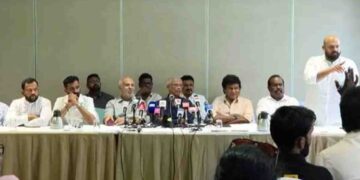
This time too, with Ravi Karunanayake bringing forward such a motion, all minority party leaders and representatives in Parliament convened a discussion to oppose it. Among those present were TNA MPs Sridharan, Adaikkalanathan, Shanakiyan Rasamanickam, Gajendrakumar Ponnambalam, Rauff Hakeem, Rishad Bathiudeen, Jeevan Thondaman, Palani Digambaram, and several others. They decided to strongly oppose Ravi’s proposal and to act collectively against it as part of the Opposition. They also resolved to meet Opposition Leader Sajith Premadasa to discuss the matter.
At that meeting with Sajith, the minority representatives voiced their firm opposition. Sajith, after carefully listening, told them he was ready to sign a petition against the motion himself:
“As a matter of principle, we accept the existence of minority parties. These parties emerged because of the mistakes made by major parties. When big parties operated on nationalist lines, it gave rise to minority-based parties. So, prepare a letter—I will also sign it.”
Sajith Call Ravi
Right then, Sajith even called Ravi Karunanayake directly, kindly requesting him to withdraw the Private Member’s Motion. Ravi, unexpectedly replying in English, simply said: “I won’t.” Sajith responded that in that case, he would openly stand with all the minorities in opposing Ravi’s proposal. Because Sajith took such a direct stand with the minority MPs against Ravi’s motion, he earned their praise and appreciation.
Subsequently, the minority MPs handed their petition to the Speaker, also reminding him of the Supreme Court’s earlier ruling on the matter. The Speaker then referred the letter to his officials, informing the MPs that he would seek the opinion of the Attorney General’s Department on it. However, by Friday evening, inside information revealed that the Speaker had already moved to withdraw Ravi Karunanayake’s Private Member’s Motion from Parliament’s Order Book.
Minority MPs accused that the government had been behind Ravi’s proposal. On the same Friday, Sajith too made a special statement in Parliament, standing firmly for the rights of minority parties.