

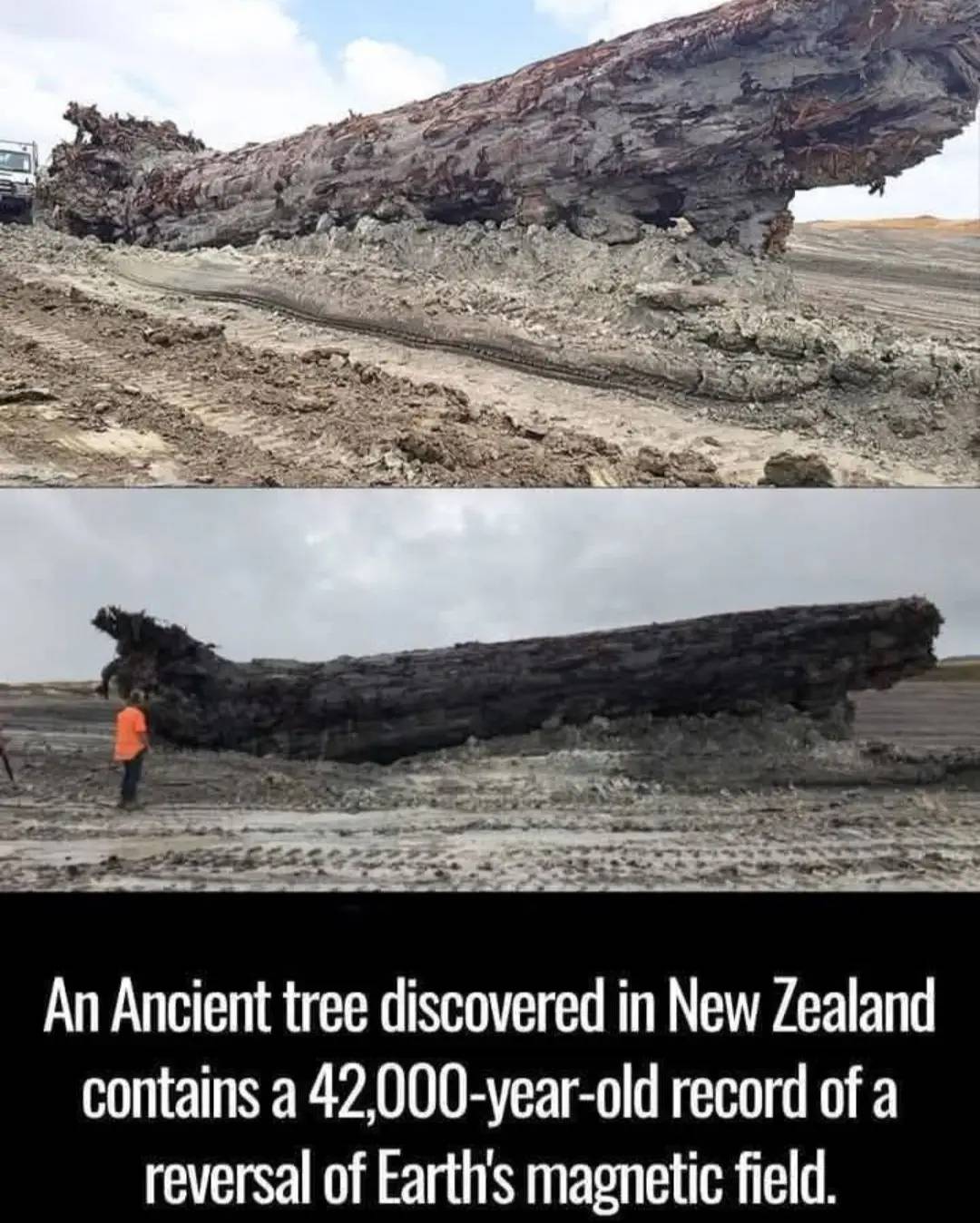
A remarkable discovery in New Zealand has unveiled a 42,000-year-old record of a major shift in Earth’s magnetic field. The ancient kauri tree, found in wetlands in northern New Zealand, provides crucial evidence of the Laschamp excursion—the most recent geomagnetic reversal, which occurred approximately 41,000 to 42,000 years ago.
During this event, the north magnetic pole moved to the southern hemisphere before returning to the north. Scientists analyzed the tree’s growth rings and identified a significant spike in atmospheric radiocarbon levels, indicating a weakening of Earth’s magnetic field at that time. This breakthrough allowed researchers to construct a highly detailed timeline of the changes.
Previous studies primarily focused on the period when the magnetic poles were fully reversed, during which Earth’s magnetic field strength dropped to just 28% of its current level. However, this new research reveals that the most dramatic environmental changes took place during a transitional phase known as the Adams Event. During this period, the magnetic field weakened even further—down to just 0-6% of its present strength.
By comparing data from other Pacific sites and utilizing climate models, researchers demonstrated that the Adams Event triggered significant environmental shifts. These included the expansion of ice sheets in North America, alterations in wind patterns, and changes in tropical storm systems.
Professor Anthony Dosseto from the University of Wollongong highlighted that this event had severe climatic consequences. In Australia, for instance, conditions became significantly drier, which may have contributed to the extinction of megafauna. Furthermore, the Adams Event is believed to have played a role in the disappearance of Neanderthals in Europe.
One particularly intriguing theory suggests that the surge in cave art during this period was a direct result of increased cosmic radiation. With the Earth’s weakened magnetic field offering little protection, early humans may have sought refuge in caves, where they created the striking cave paintings that still exist today.
The study also issues a stark warning: if a similar magnetic field shift were to occur in the present day, the consequences could be catastrophic. Increased cosmic radiation could severely disrupt power grids and satellite systems while also triggering rapid climate changes with potentially devastating global impacts.