“If the UNP is to win again, the UNP must change. In the Bible, Jesus says that sinners can enter heaven only if they change so completely that it would be like a camel passing through the eye of a needle. If we are to come to power, we too must change as drastically as a camel squeezing through the eye of a needle.”
This is what J.R. Jayewardene told a group of UNP leaders who came to meet him after the party suffered a crushing defeat in the 1970 General Election.
J.R. then proceeded to transform the UNP exactly as he had described. He realized that the party could no longer win elections by relying solely on the village elite. The UNP had acquired the image of an elitist capitalist party. People believed that to become a UNP electorate organizer or even a municipal council candidate, one had to be a wealthy and influential and notable. J.R. sought to change that perception and opened the doors of Siri kotha to ordinary people.
One of the clearest examples of this was his decision to elevate Ranasinghe Premadasa. J.R. wanted to prove that the UNP was no longer merely a party of the privileged and wealthy.
After the death of Dudley Senanayake, when J.R. became party leader, he appointed young men from humble village families as electorate organisers. The first election he faced after reshaping the party was the Ja-Ela by-election. While party elites were trying to nominate a young man from a prominent Ja-Ela family, Premadasa came to see J.R.
“Sir, this young man works at Rathnawali film Hall in Ja-Ela. He comes from a modest family. Let’s nominate him,” Premadasa suggested.
The young man was Joseph Michael.
“This is the perfect opportunity to demonstrate the party’s transformation. Let us nominate this young man and show the country that the UNP is now the party of the common man,” J.R. replied, wholeheartedly accepting Premadasa’s proposal.
The UNP’s landslide victory in 1977, winning a five-sixths majority in Parliament, was achieved by combining J.R.’s support among the elite classes with Premadasa’s support among the poor.
In fact, D.S. Senanayake had originally built the UNP by bringing together Sri Lanka’s wealthiest elite and its poorest citizens. The poor were drawn to the UNP largely because they depended economically and socially on the village elite. S.W.R.D. Bandaranaike, however, built the SLFP around the middle class.
Later, when the Lanka Sama Samaja Party (LSSP) and the Communist Party allied themselves with the SLFP, many poor people in both urban and rural areas gravitated toward this SLFP-leftist alliance. D.S. had attracted poor voters to the UNP by fielding influential village elites as candidates. In contrast, the SLFP-left alliance increasingly nominated schoolteachers, indigenous physicians, and other ordinary people, making poor voters more receptive to leadership from people like themselves.
At the same time, reforms such as changes to land laws, the nationalisation of plantations, and the nationalisation of bus companies weakened the dominance that village elites had exercised over poorer communities. This was another reason why the UNP gradually lost the support of poorer voters.
J.R. and Premadasa understood these realities well when they opened the party to ordinary people. Until 1977, the SLFP and the left had branded the UNP as a party of wealthy elites. After 1977, J.R. used Premadasa to counterattack, portraying the SLFP as a party of aristocratic families.
Premadasa successfully built a massive support base among the poor for the UNP. Programmes such as Gam Udawa, the Foster Parents Scheme, and Janasaviya were designed specifically to uplift the poor. By the time Premadasa was assassinated, he had firmly secured this voter base for the UNP.
Even after his assassination, the strength of that support was evident. In the 1993 Provincial Council elections, the UNP won majorities in every provincial council except the Western Province, largely because Premadasa’s voter base remained intact.
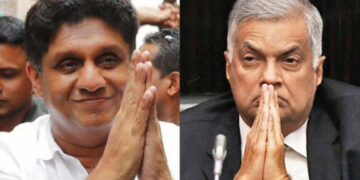
However, after D.B. Wijetunga became President and undermined Premadasa’s image, and after Ranil Wickremesinghe became party leader and brought back the English-speaking elite into the party, the poor voter base that Premadasa had built began to weaken.
The rise of Sajith Premadasa within the party helped revive and strengthen that support base. Ranil and Sajith worked together, and in 2014 Sajith was appointed Deputy Leader and led the UNP campaign in the Uva Provincial Council election, helping to rebuild the party’s grassroots strength.
The opposition’s success in defeating the Rajapaksa family in the 2015 presidential election by fielding Maithripala Sirisena, a man from a social background similar to Premadasa’s, was also made possible by the revival of this support base among ordinary voters.
When Sajith formed the Samagi Jana Balawegaya (SJB) and contested the 2020 General Election, many UNP leaders realised that the party was facing electoral disaster. They went to see Ranil, expressing their concerns. Ranil’s response was surprising:
“When powerful leaders like Lalith and Gamini left the UNP, they managed to take only about one million votes with them. How many can Sajith take? At best, perhaps half a million.”
That was Ranil’s assessment.
In reality, the UNP ended up receiving only about 250,000 votes, while Sajith secured around 2.7 million votes.
The obvious question then is:
“What happened to the 2.5 million votes that D.S., Dudley, and J.R. had built up for the UNP?”
Ranil failed to preserve that voter base. Sajith, on the other hand, appears to have successfully retained the 2 to 2.5 million votes that Ranasinghe Premadasa had built for the party.
This raises another question:
“If the SJB and the UNP reunite, can they bring together the voter bases created by D.S., Dudley, and J.R.?”
Despite the powerful Gotabaya Rajapaksa wave in 2020, the SJB secured 2.7 million votes. During the Anura Kumara Dissanayake wave in 2024, Sajith increased his tally to 4.3 million votes at the presidential election, despite Ranil contesting separately and dividing the traditional UNP-SJB vote.
Looking ahead to a future presidential election, the SJB would not find it difficult to add another two million votes to the 2.2 million votes it received at the local government elections, which were the party’s most recent electoral test. Those additional votes would likely come from minority communities and floating voters. In a closely contested presidential or parliamentary election where the winner is uncertain, securing those two million votes would not be an impossible task.
Yet the central question remains:
What happened to the votes that D.S. Senanayake, Dudley Senanayake, and J.R. Jayewardene built for the UNP over decades?