SLFP and UNP sail into parallel crises, trapped in the same storm
Ranil fights a losing battle as UNP leadership slips from his grasp
Sajith emerges as the centre of gravity, commanding respect from UNP seniors
Anura’s responsibility
The ‘Ditwa’ cyclone that swept across the country claimed the lives of nearly a thousand people in a single night. Hundreds of thousands were displaced, and property worth billions was destroyed. Now that the floods have receded and two weeks have passed, the government faces the most difficult phase of this natural disaster.
When the floods struck, everyone’s attention was on the rising waters, but few realized the extent of the damage at that moment. The true impact of the floods on the nation is only visible now. Many say this is the greatest natural disaster in Sri Lanka’s history. In such a catastrophe, the responsibilities of the government are immense.
However, due to the government’s lack of experience, planning, foresight, and preparedness, shortcomings in post-disaster management are already being highlighted by various parties. Although the opposition has criticised the government, it is also evident that at times the government has allowed politics to take precedence over disaster response.
Traditionally, in times of such calamities, it is the opposition that seeks political advantage. Yet, a clear difference between the traditional opposition of the past and the current opposition can be seen. Despite opportunities to exploit the situation politically, the present opposition has not rushed to do so. Instead, as a progressive opposition, it has moved beyond the role of mere critic and has shown patience and sincerity in supporting the government to rebuild the lives of the people.
Still, many question whether the President properly understood and accepted the hand of peace and unity extended by the opposition. Instead, the President rejected this gesture, saying “Please, no,” in a manner that was not cordial but insulting to the opposition. As a result, many point out that through this statement, the President himself shattered a golden opportunity to rise above the disaster. They believe the full responsibility for this lies with the President.
Sajith–Anura Meeting
Against this backdrop, last Monday the President convened the Disaster Management Committee once again. This came after the President had earlier rejected the assistance offered by the Opposition Leader, the Samagi Jana Balawegaya (SJB), and the opposition in general, saying “Please, no.” In that context, many within the SJB advised Opposition Leader Sajith Premadasa to refrain from attending.
However, Sajith emphasized to those who spoke with him that, regardless of what the President had said, the opposition had a duty to act responsibly. He therefore canceled all welfare programs scheduled for that day and decided to attend the meeting. At the same time, the Bribery Commission informed Sajith that he was required to appear and give a statement regarding the leasing of the well-known “Sabitha Building” in Rajagiriya to the Ministry of Agriculture during the Yahapalana government. Sajith had been a Cabinet Minister at the time of that transaction.
Since the Disaster Management meeting was scheduled for the same time, Sajith immediately contacted the Commission officials, explained why he could not attend that day, and requested another date. The Commission then informed him to appear the following Monday to provide his statement.
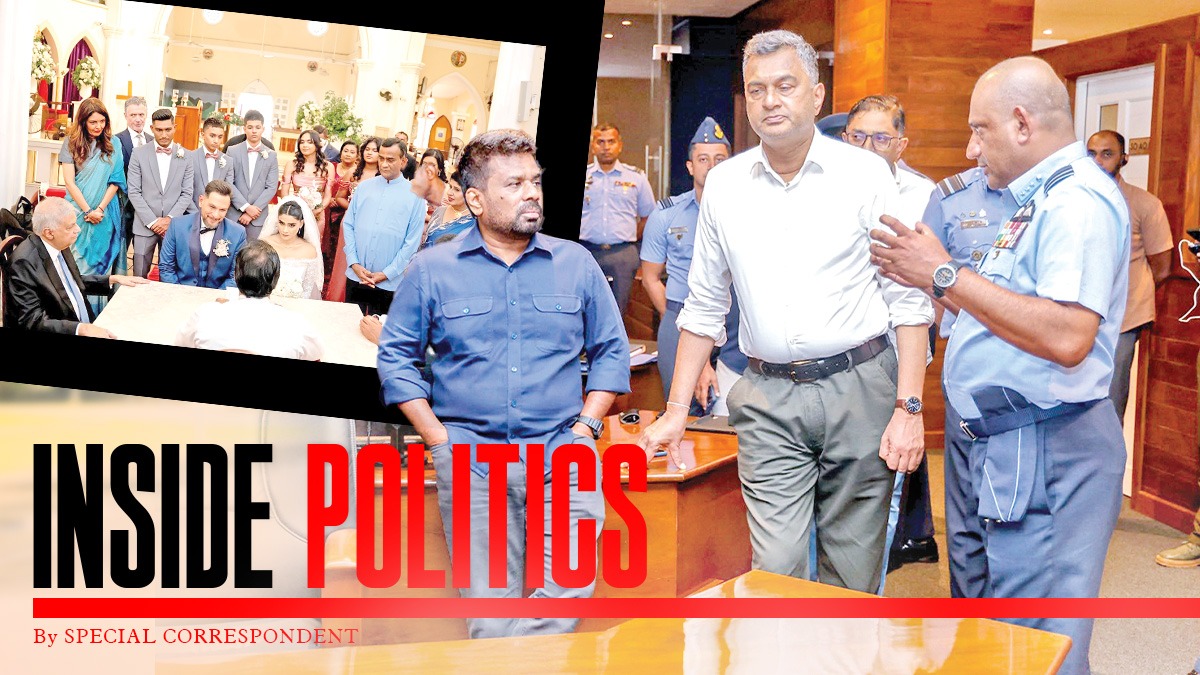
This meeting was the first face-to-face encounter between the President and Sajith after the President’s insulting “Please, no” remark in Parliament. In addition to Sajith, the Prime Minister, Bimal Ratnayake, several senior government ministers, and a number of opposition MPs also attended. Sajith came well-prepared, particularly to raise concerns about the lack of a proper mechanism to deliver relief quickly to the people in the post-disaster phase.
He questioned the President directly about whether such a mechanism existed, but no clear answer was forthcoming from the government side. Sajith also pointed out inconsistencies in the data provided by the responsible institutions regarding post-disaster matters. While some perceived Sajith’s comments as contradictory—speaking both of what should and should not be done—he clarified that if false information was confirmed to have been presented, it could severely undermine the relief program.
Wait til January?
Amidst all these developments, the government is now facing criticism from many quarters for leaving the post of Auditor General vacant for eight months. Since this is the key position responsible for auditing all government expenditures, critics argue that the President’s promise during the election campaign to create a corruption-free country is being undermined.
For the past eight months, the Auditor General’s post has remained vacant. Initially, the President proposed the name of H.T.P. Chandana, a former director of the Petroleum Corporation. The opposition objected, claiming he was a close associate and university contemporary of the President, and that such an appointment was unacceptable when there were experienced and qualified senior officers within the Auditor General’s Department. Professional associations within the department also issued statements opposing the nomination. Consequently, the Constitutional Council rejected the proposal, and the President appointed an Acting Auditor General.
Later, the President nominated senior Deputy Auditor General L.S.I. Jayaratne, but the Constitutional Council rejected that name as well. The most recent rejection occurred last Wednesday, when the President proposed O.R. Ranasinghe, an audit officer from the military. This raises the question: why does the President continue to nominate individuals whose names are likely to be rejected? Why are junior officials being proposed when qualified senior officers are available within the department? Many suspect that the President is deliberately dragging the process until January, when the term of the current Constitutional Council expires.
The Constitutional Council was established during the Yahapalana government to ensure transparency in high-level appointments made by the President and to prevent political interference in the civil service. It included representatives of the President, the Opposition Leader, and three independent members from civil society. With the Council’s official term ending in January, many believe the President is stalling until then, so that once the government gains majority control of the Council, he can appoint an Auditor General of his choice.
Ranil’s tactics
During past governments, former presidents such as Mahinda Rajapaksa and Ranil Wickremesinghe implemented similar corrupt political strategies that undermined democracy in the country. For example, former President Ranil Wickremesinghe engaged in such practices during the appointment of the Inspector General of Police (IGP).
On several occasions, the Constitutional Council rejected the nomination of Deshabandu Tennakoon, whom Ranil repeatedly proposed for the post. Instead of putting forward an acceptable alternative, Ranil appointed Tennakoon as Acting IGP. Even after repeated rejections, Ranil continued to resubmit Tennakoon’s name, determined to appoint him permanently. Eventually, when the Council’s vote was tied, Ranil claimed that the Speaker’s casting vote had been given in favour, and Tennakoon was appointed as IGP. A court case against this appointment is still ongoing.
This example is cited to suggest that the current government, too, may follow such precedents.
In the Constitutional Council, one independent representative must be appointed with the agreement of both the Prime Minister and the Opposition Leader. This requirement for mutual consent is significant. During the previous government, then-Prime Minister Dinesh Gunawardena proposed the name of Anula Wijesundara. Opposition Leader Sajith Premadasa agreed, trusting that she would act independently. Although nominated by the Prime Minister, Wijesundara never acted in favour of the government and consistently maintained independence.
Her refusal to bend to government pressure, especially during the IGP appointment process, was considered remarkable. Now, once again, the Prime Minister has the opportunity to nominate such an independent civil figure. Many are watching closely to see who the Prime Minister will propose to the Constitutional Council this time.
“Please, No” for Ranil Too
When the opposition extended a hand of peace, the President rejected it with the words “Please, no,” thereby discarding what many believed was a golden opportunity to rise above the great disaster. Had the President accepted the opposition’s support in providing relief to those affected, the government could have secured significant international assistance. In that case, the credit for overcoming the calamity would have gone entirely to the President and his administration. Instead, short-sighted political maneuvering—or perhaps external advice—led the President to miss this opportunity.
Similarly, another leader once missed such a golden chance: former President Ranil Wickremesinghe. When Ranil was arrested by the Criminal Investigation Department over allegations of misusing public funds during a foreign trip, he too had an opportunity to rise politically. Just as the current President rejected his chance with “Please, no,” Ranil lost his moment through a single planted news story. As a result, Ranil fell politically, hitting rock bottom. At that time, Opposition Leader Sajith Premadasa played a sincere political role, setting aside differences to support Ranil. Sajith visited him daily in prison and hospital, rallied public support, and mobilized lawyers to fight for Ranil’s release. Many believe that Sajith’s efforts and the public power he built were decisive in securing Ranil’s freedom.
Yet, how did Ranil repay Sajith? Instead of embracing Sajith’s goodwill and forming a united front, Ranil reverted to his familiar political games. While still hospitalized, Ranil’s family-owned newspapers, run by Ruwan Wijewardene, published false reports claiming Sajith was about to be arrested by the Bribery Commission. This news plant shattered the possibility of a Ranil–Sajith alliance.Afterward, Ranil’s focus shifted to undermining Sajith—both during the presidential election and in opposition—while elevating Namal Rajapaksa. The November 21 rally in Nugegoda, organized jointly by the UNP and the SLPP, was part of this plan. Although many senior SLPP figures once aligned with Ranil, after his defeat they returned to politics with Namal. Ranil’s position became clear: he saw greater advantage in aligning with Namal and the SLPP than in journeying politically with Sajith.
At the Nugegoda rally, Ranil intended to bring both Sajith and Namal together to present himself as leader of them both. But because Ranil’s political maneuvers were repeatedly exposed through the “Inside politics” column, and because the SJB had learned from experience, they ultimately boycotted the rally at the last moment.
Game Over
Afterward, Ranil sought to appear on stage in Nugegoda alongside Namal, signaling to the country that he was prepared to move forward politically with the SLPP. But Namal did not accept Ranil’s invitation. Claiming sole ownership of the Nugegoda rally, Namal announced that no former president would be allowed on that stage, effectively banning Ranil from participating. Thus, although the UNP had organized several meetings in preparation for the rally, Namal succeeded in registering its ownership under his name, leaving the UNP politically flattened.
During the preparations, the UNP held executive committee and management committee meetings, assuring that all senior members would participate. Yet, young leader Navin Dissanayake publicly opposed the move, declaring that the UNP had no future political journey with the SLPP and that he would never again engage in politics with the Rajapaksas. Consequently, Navin did not attend the rally, nor did senior figures such as Akila and Ruwan.
Ranil has now realized that he cannot continue playing political games while remaining leader of the UNP for much longer. Even his closest senior allies may soon stage a rebellion. To prevent this, Ranil turned to his usual tactics, involving Kabir Hashim, his ally within the SJB. Sajith had tasked Kabir with reporting on possible cooperation between the SJB and the UNP. Ranil exploited this by directing Kabir to prepare a report favorable to the UNP.
However, once Ranil’s maneuver was exposed through the “Inside Politics” column, Kabir’s report was discarded by the SJB. At subsequent management and executive committee meetings, Sajith announced that he himself would lead discussions on uniting the SJB and the UNP. He emphasized that he knew clearly what should and should not be done, and that he would personally manage any alliance.
According to “Inside Politics,” Sajith has since held several highly secret discussions with three senior UNP figures. Details of where these meetings took place, what was discussed regarding a possible merger, and which UNP seniors participated are known to the column. Yet, at this stage, those names are not being revealed, since the editorial stance supports the idea that the two parties should unite.
Is Ranil stepping down?
After falling to the ground at the Nugegoda rally, Ranil engaged in an official visit to India. Following that visit, the UNP’s Executive Committee met for the first time last Wednesday. The most notable development at this meeting was the way Ranil, who previously supported Anura to defeat Sajith at the last presidential election, now acted to further weaken Sajith—currently in the opposition—by elevating Namal. The Executive Committee meeting began with two minutes of silence in memory of the late Daya Pelpola, who had served as the UNP’s Legal Secretary for 31 years. Afterwards, there was a brief discussion about those affected by the floods, including K.K. Piyadasa and Champika Premadasa. Political matters were taken up only after that.
The first to speak was former Gampaha MP Ajith Mannapperuma. He said that the flood disaster has now become a crisis for the government itself, and that a serious situation could arise in the future. Therefore, he stressed that the party must be immediately strengthened at the grassroots level. Responding, Ranil said that such work had already begun, and that since some had proposed joining forces with the SJB, a committee had been appointed under the leadership of Thalatha, Sagala, and Ruwan. However, Ranil also noted that Sajith’s response so far had been inadequate.
Ranil remarked: “We have already set up a committee. But Sajith’s response to it has been insufficient. By now, these matters should have been concluded. Sajith abandoned it. Even during the floods, Sajith has let it go. Because Sajith did not handle it properly, Namal has now taken it up…” Thus, Ranil’s comments clearly elevated Namal.
Range returns
Next to speak was former UNP General Secretary Range Bandara. He began by noting that he himself was a victim of the floods, and highlighted the weaknesses in the government’s disaster management efforts. He also recalled his own experience as Disaster Management Minister during the 2016 floods under the Yahapalana government. Range then turned to party reorganization, warning that if such work was not completed immediately, others might seize power at the last moment.
Range said: “Right now, we have lost the power of mobilization. We saw this during the last presidential election. At the very first rally in Kandy, all we were allowed to do was give a vote of thanks. Even though we organized the entire rally, all the speakers were arranged according to Mahindananda Aluthgamage’s wishes. Thirteen speakers spoke that day, but none of us were given a chance. Later, I spoke with Mahindananda and managed to secure just one speaker slot for us, which I gave to Shanthini Kongahage in Kandy. This shows that when we are weak, we lose the power to mobilize. Therefore, we must immediately rebuild our organizational strength. We need to regain the power of mobilization…”
After Range’s remarks, Navin Dissanayake spoke. In a notable moment, Navin once again publicly reaffirmed his unchanged position: that the UNP must immediately join forces with the SJB.
Navin is the Man
Navin said: “What we must do now is unite with the SJB and move forward politically. We have already appointed a committee for this. The SJB and UNP are not two separate groups—they are one team. Those people are our own. We have no enmity with them, any anger. We talk well with them, and we can work together. If the UNP is to have a future, it can only be with the SJB. There is no future with the SLPP. SLPP members will always vote for their own candidates, never for ours. That only benefits the SLPP. Moreover, the Rajapaksas are not just a family, they are an institution. I will never agree to continue politics with the Rajapaksas. Society will not accept it either. Therefore, I am not prepared to bring Namal into leadership. We cannot follow Namal. If that happens, I will quit politics and go home…” Navin’s firm stance appeared to anger Ranil somewhat. Raising his voice, Ranil insisted that he had no dealings with the Rajapaksas.
Ranil said: “I have no politics with the Rajapaksas. I did not go to save them. I did not go to give them positions. I did not become President because of the Rajapaksas. After becoming President, I did not even give Namal a single post. The only ministerial post I gave was to Shashindra, because Monaragala needed representation. I did not govern with the Rajapaksas. So I have no problem…”As usual, Ranil subtly elevated Namal, presenting him to the Executive Committee in a low-key manner. He said that the current political wave was moving towards both the SLPP and Namal.
Ranil explained: “What we must look at now is where the wave is heading. Sajith did not take this up. Therefore, Namal has now moved ahead by defeating Sajith. If we are to defeat the Malima government, we must decide with whom to unite. Strategies must be chosen. I have no objection to the UNP and SJB joining together. The reason I set up a separate group for discussions was because Sajith and I are not on good terms. If Sajith now wants to join, he must say so. He must present his proposals. If he wants UNP leadership, that must be discussed at the Working Committee. If there is an obstacle to the two parties uniting, I will step aside. One thing we must remember is that by 2030 there will be a change in leadership. By then, I may no longer be in this chair…” Ranil’s remarks likely stemmed from the fact that at the last party convention, he extended his UNP leadership until 2030.
Ajith backs Ranil
At that point, Ajith Mannapperuma spoke in support of Ranil’s position. Ajith said that a group from the SJB was preparing to join the UNP. He claimed that several senior members of the SJB were unwilling to continue politics with Sajith, and since they were ready to align with the UNP in the future, the UNP must be strengthened immediately at the grassroots level. Ranil agreed, saying that indeed a group from the SJB was preparing to join the UNP: “Another group is waiting to join us. They don’t like Sajith. They are just waiting until an election comes. At the right time, they will join us…”
But as soon as Ranil said this, Range Bandara spoke again, smiling. Range reminded everyone that he had heard similar claims during the last presidential election, when promises were made that 30 or 40 members from the SJB would cross over. In the end, only Thalatha, Rajitha, Ishak Rahuman, and Ajith Mannapperuma joined. “So first we must strengthen our own party. Otherwise, all these discussions mean nothing,” Range said. Rajitha added that if the UNP did not strengthen itself, it would end up as a mere appendage of another party. Range replied: “Even if we become an appendage, at least that’s attached to the body. But if we don’t strengthen the party, we’ll fall like curry leaves scattered to the ground.”
UNP seniors silant
As discussions about a UNP–SJB merger continued, it was notable that none of the senior UNPers present spoke on the matter. Although Thalatha, Akila, Vajira, and Ruwan attended the meeting, none expressed any opinion about joining with the SJB. Sagala Ratnayake was absent, and when some asked where he was, they learned he had gone to Kandy to attend a funeral as Ranil’s special representative. But since none of the UNP’s local organizers in Kandy had been informed of Sagala’s visit, they looked at each other in surprise.
A Hidden Warning?
This raised questions: Was Ranil sincere when he said he was ready to step aside if he became an obstacle to a UNP–SJB merger? Many who know Ranil’s history believe his remarks were part of a political game. Observers noted his tone, his anger, and his mannerisms, and later that night many called each other saying Ranil was not being truthful. According to the “Inside politics” column, Ranil’s maneuvers were part of a calculated political strategy. None of their past revelations about Ranil’s behavior have proven false, and his pattern of conduct confirms them. So why did Ranil make such a statement at the Executive Committee meeting?
Political circles suggest several reasons. One is that Ranil had learned that some senior UNPers had secretly met Sajith for discussions. Another is that, amid the major natural disaster affecting the country, Ranil wanted to disrupt those talks by amplifying Harin’s statement that another economic crisis would emerge by April. Ranil ensured this was widely publicized through friendly media, aiming to show both the public and UNP seniors that he would again be called upon for leadership. However, Ranil knows well that this time the SLPP has no power in Parliament, meaning there is no chance of him becoming President through parliamentary maneuvering.
Diplomatic Discussions
“Inside politics” further revealed that a few days before the UNP Executive Committee meeting, Ranil and his wife Maithree Wickramasinghe held several special discussions with some of the most powerful ambassadors in the country. While details of the location and participants are known, they are not yet being disclosed. What can be said is that several ambassadors who have played decisive roles in recent times were present.
Reports suggest that the discussions focused on the looming crisis in Sri Lanka, including the risk that nationalist and extremist forces could rise unexpectedly if such a crisis unfolded. This would challenge democratic governance and could even lead to international isolation. Therefore, the ambassadors emphasized that power should be transferred to an opposition group that operates within the constitutional and democratic framework.The unspoken message was clear: if a crisis emerges, the international community would recognize the SJB as the legitimate democratic group in Parliament. The only problem is that the SJB lacks a majority and refuses to unite with the SLPP. Thus, if the UNP joins with the SJB, a major breakthrough could occur—but the main obstacle is Ranil himself.
UNP Seniors Lean Toward Sajith
The majority of UNP seniors now believe that the only obstacle to uniting the UNP and SJB is Ranil. They have expressed willingness to merge the two parties under Sajith’s leadership. Accordingly, ambassadors have informed Ranil that discussions should be concluded quickly so that a strong alliance can be built to face the current crisis. But Ranil, known never to relinquish power or the UNP leadership, has instead begun a media campaign. He has told allies that if he becomes an obstacle to unity, he is ready to step aside, while simultaneously planting stories in family-owned newspapers and friendly outlets.
He plans to create the impression that he might step down, so that supporters across the country will demand he remain as leader. A large social media campaign has already begun, visible on Facebook accounts of Ranil’s loyalists and allied networks.Meanwhile, Sajith is preparing sincerely for party unification. Reports say that in the coming days, Sajith will hold another special discussion with UNP General Secretary Thalatha Athukorala. The SJB has also decided what position Ranil would be offered in a merged party: Senior Advisor. Future talks are expected to proceed on that basis.
SLFP in Turmoil
Sri Lanka’s two oldest parties—the UNP and SLFP—now face similar fates. The UNP, once dominant, began to decline after Ranil Wickremesinghe took leadership in 1994. After 32 years under him, the party today holds no parliamentary seats. The SLFP suffered a comparable collapse when the Rajapaksas left to form the SLPP, leaving the SLFP without strong leadership. Today, the SLFP is entangled in numerous court cases, unable to even hold official meetings. Its de facto leader is Nimal Siripala de Silva, though he is not widely accepted as a national leader.
Recently, SLFP representatives at party headquarters appointed Wijeyadasa Rajapakshe as Senior Vice President and Colombo District Leader, and Chamara Sampath Dissanayake as National Organizer.Trouble arose immediately when Chamara attacked Dayasiri Jayasekara, saying he had no right to hold SLFP positions since he entered Parliament from another party. Chamara’s statement was quickly publicized by the media. At the time, Dayasiri was in Dubai. He responded by sending Chamara a WhatsApp copy of a letter from SJB General Secretary Ranjith Madduma Bandara to the Election Commissioner. The letter confirmed that in the 2024 general election, Dayasiri contested Kurunegala under the SJB symbol based on a formal agreement, but was still recognized as representing the SLFP.
Dayasiri then called Chamara and said: “I’ve sent you the letter from the SJB General Secretary to the Election Commissioner. It clearly shows I am recognized as an SLFP MP. So I have no issue holding SLFP positions. You contested under the gas cylinder symbol. By your logic, you too shouldn’t hold SLFP posts. So speak with facts in mind.” Chamara replied: “Let’s meet and discuss this once you return to Sri Lanka.”