

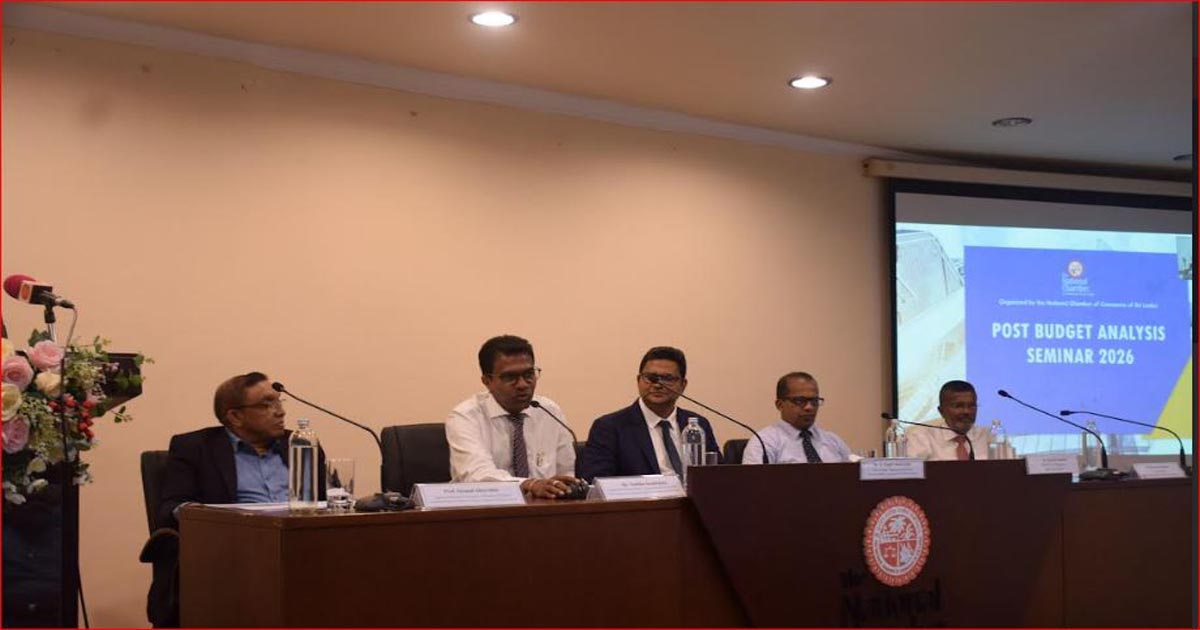
The National Chamber of Commerce of Sri Lanka, in collaboration with its Knowledge Partner KPMG Sri Lanka, hosted the Post-Budget Seminar 2026, bringing together leading economists, policymakers, and business leaders to analyze the implications of the 2026 National Budget.
The forum featured a distinguished panel comprising Dr. M. Kapila Senanayake, Director General – Department of Fiscal Policy, Ministry of Finance, Planning and Economic Development; Prof. Sirimal Abeyratne, Emeritus Professor of Economics, University of Colombo, and Executive Director, Centre for Poverty Analysis (CEPA); Mr. Hasitha Raddella, Partner – Tax & Regulatory, KPMG in Sri Lanka; Mr. Ruwan Fernando, Council Member, National Chamber; and Mr. Nandika Buddhipala, Former Chief Financial Officer, Commercial Bank of Ceylon PLC and Past President of the National Chamber.
The seminar explored key budget proposals relating to taxation, digitalization, and governance.
Commenting on the government’s fiscal stance, Mr. Hasitha Raddella noted that no new tax proposals were introduced this year, though revenue expectations have increased. “The VAT threshold has been brought down to Rs. 36 million per annum. The government is also planning to streamline processes to ease the burden on businesses,” he observed.
In his presentation, Dr. M. Kapila Senanayake emphasized that the 2026 Budget reflects policy consistency and a strong commitment to fiscal discipline under the IMF framework. “Our budget is really a development budget. You can see that government development is the key here,” he stated, highlighting the focus on sustainable growth, export diversification, and digital transformation.
Prof. Sirimal Abeyratne underscored the importance of long-term structural reforms to achieve the desired growth targets. He drew attention to the connection between economic growth and social well-being, noting that Sri Lanka faces both visible and hidden poverty. “Out of 22 million people in this country, 6 to 8 million are below the poverty line according to available studies and simulations. In addition, there is hidden poverty among middle-class professionals poverty that exists within their homes,” he remarked. Prof. Abeyratne further emphasized the need to empower SMEs, expand exports, and attract greater foreign direct investment.
Addressing the seminar, Mr. Nandika Buddhipala highlighted the critical link between public investment, governance, and economic growth. “In emerging markets, positive public investment shocks increase output in both the short and medium term,”
The Post-Budget Seminar 2026 served as a vital platform for open dialogue on fiscal policy, governance, and economic strategy, reaffirming the National Chamber’s pivotal role as a catalyst for economic dialogue and private sector development in Sri Lanka.