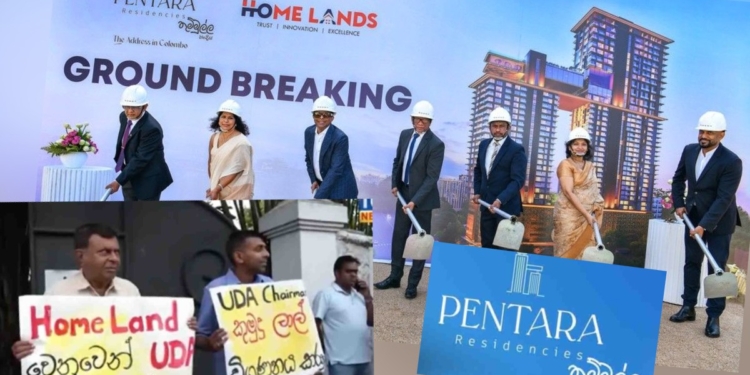
A group of residents recently took to the streets in Colombo’s Thummulla area to protest against the construction of a massive 40-storey building planned by the Homeland company.
They stated that while the Urban Development Authority (UDA) has denied ordinary citizens permission to construct buildings higher than three stories, the decision to allow Homeland to proceed with a 40-storey housing complex raises serious concerns.
Social media activist Jinath Premaratne shared his views on this issue through a video post, which is summarized below:
“Homeland company has begun constructing a 40-storey building in Thummulla. When the project began earlier this year, residents from the nearby Clason’s area and Tickell’s area filed complaints with the Urban Development Authority, stating that this type of construction was not permissible within that zone.
That is because the Thummulla area is designated as a green zone—a specially protected environmental area. There are strict restrictions on the height of buildings that can be constructed there.
As everyone knows, Colombo already has very few green areas left with trees and natural coverage. Therefore, people are alleging that the company is proceeding with this construction in violation of legal and environmental restrictions.
According to the legal zoning system, each area has a specified height limit. For this particular zone, the permitted maximum height is believed to be five or six stories. Anything beyond that is not allowed. Building such a large structure could severely affect the underlying ecosystem and the environmental balance in the area.”
“This is not just a personal objection or a matter of opinion—it’s a matter of law. The residents wanted the authorities to investigate this illegal construction.
Therefore, complaints were submitted to the Road Development Authority, as well as to the President and the Prime Minister.
As a result, the Presidential Secretariat sent an official letter to the Chairman of the Road Development Authority, acknowledging that residents had raised these concerns and instructing that the matter be immediately investigated.
Similarly, the Prime Minister’s Office also sent a letter to the Ministry of Urban Development, directing that the issue be looked into.
The residents had emphasized in their complaints that this building, being constructed by the Homeland company, is not a legally approved structure.
The project has been named the ‘Pentara Residences.’”
“The company has appointed Jacqueline Fernandez as the brand ambassador for the project’s advertisements and promotional campaigns.
As many of you may know, Ranga Srilal shared a message at that time pointing out that Jacqueline Fernandez was then facing money-laundering charges in India under the Prevention of Money Laundering Act (PMLA).
She had appealed to have those charges dismissed, but her appeal was rejected by the Delhi High Court.
Even though she remains accused in that case (though not convicted), Homeland has continued to use her as the face and brand ambassador of the Pentara Residences housing complex.”
“Meanwhile, the residents of the area have held public demonstrations about this issue and have also written letters to the President, Prime Minister, and Road Development Authority.
After those letters were sent, both the Presidential Office and the Prime Minister’s Office forwarded written instructions to the Road Development Authority and the Ministry of Urban Development, requesting them to look into the matter.
Despite this, Minister Anura Karunathilaka attended the launch ceremony of the project in September and participated in the groundbreaking event to officially start construction—even though major concerns had already been raised about the legality of the project.
This has led to widespread questions about why senior figures in the government ignored these directives and proceeded with the event.
People are now asking: under whose influence or pressure did this happen? What was the motive behind allowing this project to go ahead in a protected green zone?”
“It was later learned that this issue was one of the reasons behind the decision to remove the minister from his position.
However, despite the seriousness of the matter, it has not been widely reported in the mainstream media.”