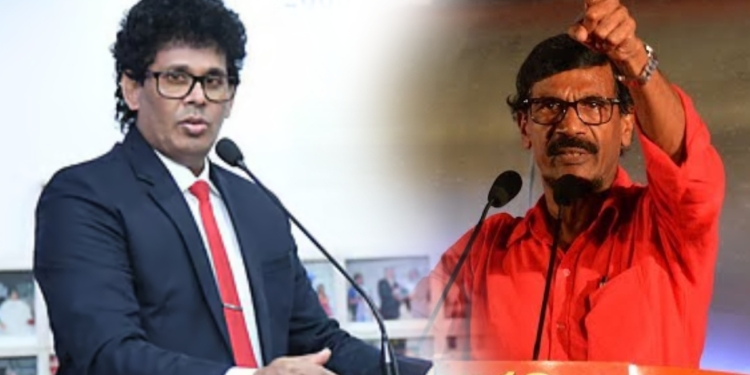
It was recently revealed that Minister Wasantha Samarasinghe possesses cryptocurrency, as stated in his declaration of assets and liabilities. Regarding this matter, journalist Kulashri Kariyawasam from the Lanka Voice YouTube channel questioned Tilvin Silva, the General Secretary of the Janatha Vimukthi Peramuna (JVP), who responded as follows:
Question:
It is said that Minister Wasantha Samarasinghe has money earned through cryptocurrencies. Are cryptocurrencies legal in Sri Lanka?
Answer:
Many people in Sri Lanka are involved in that. So, it’s not something that is prohibited by law. If it were banned, then of course, people wouldn’t be allowed to do it. Now the question is whether Brother Wasantha or any of us have hidden any of our assets — even a cent. Some people may have chosen not to include certain things, but as for us, we have nothing to hide. Cryptocurrency and things like that — we don’t need to conceal them. There’s nothing to hide, so we’ve declared everything.
If there’s anything illegal, then it’s the responsibility of the law to take action. Writing about it on Facebook won’t achieve anything. If someone believes these assets are illegal, what should they do? They should immediately make a complaint to the Criminal Investigation Department (CID). The authorities will investigate. But simply posting on Facebook has no real meaning, in my view.
Question:
As the General Secretary of your party, can you tell us about your assets — for the public to know?
Answer:
I have already declared my assets.
Question:
To the Election Commission?
Answer:
No, no. We’ve given them to the Commission as well — we’ve sent copies too. Everything is properly submitted.
Question:
To the Bribery Commission?
Answer:
Not to the Bribery Commission, but to the Commission to Investigate Allegations of Corruption and Fraud. So, mine too would have been made public. People can check. I don’t personally have assets. What I have is the responsibility of managing the party’s assets.
Question:
Next, there’s a question about the party’s assets. Ever since this building was constructed, there have been questions — where did the JVP get the money for this? How did the party acquire so much property? Where did it all come from?
Answer:
Here’s what I have to say. We have explained this clearly many times. This building wasn’t constructed under a government led by us. It was built during Mahinda Rajapaksa’s government. It existed during Ranil Wickremesinghe’s government too, and even under Gotabaya Rajapaksa’s government. If there had been any issue, all of them could have investigated it. But they didn’t — which means there was no problem.
Other party leaders and members built houses for themselves — but they didn’t build buildings for their parties. What did we do? We all came together, raised funds, and built a building for our party. We are proud of that. Everyone in Sri Lanka says that the JVP has the most beautiful and best party building in the country — and we take pride in that.
We used to rent places for years, up until around 2008. It was hard to even find rental properties, and the rent was high. We didn’t have a place of our own, and we couldn’t operate properly without one. So, we took a plot of land, our comrades from various districts contributed, we gathered materials, and our own masons and members volunteered their labor to build this place. It’s a unique building — built through collective effort. That’s how we believe a country should also be built — by everyone working together.
There’s no point in repeatedly explaining this. If anyone has a problem about this building, about the JVP’s assets, or about our personal assets — please go to the CID or the Bribery Commission and file a complaint. Let them investigate. We have no objections. If anything wrong is found, punishments will be accepted.
Question:
Yes, you say to go to the CID or the Bribery Commission and that the law applies equally to everyone. But it seems that when it comes to certain government figures, the law acts a bit slowly. For example, there’s a court case involving Minister Wasantha, and now there’s also an allegation against the Minister of Power and Energy, but the Bribery Commission hasn’t taken any action yet. Why?
Answer:
Brother Wasantha’s case is a false case. Since it is being heard in court, I won’t comment further — the court is handling it, and it hasn’t been stopped.
As for the Minister of Power and Energy — if we wanted to hide something, we could have. But how did it become public? It came out under our government. If we had interfered, it wouldn’t have come to light. But we didn’t do that. So, there was an allegation, but it was false. We said, “Let it be investigated properly.” That’s it.
Question:
But the allegation against the Minister of Power and Energy isn’t false. When he was a government officer…?
Answer:
There’s a difference between personal responsibility and responsibility tied to a position. So, he may have to answer under the law for the latter. We didn’t interfere at all. Because if we had, you wouldn’t even know about it — it would have been hidden. We didn’t do that. So, if anyone has done something wrong, they must bear that responsibility before the law. That’s not a problem for us. We don’t protect anyone.
You know that even when we weren’t in government — as a party — if anyone in the party committed serious wrongdoings, we have removed them, regardless of the harm it caused us. That’s the kind of party we are — that’s our political culture. Therefore, we believe that the accusations made against us or our members have no logical or factual basis.