
S.W.R.D. Bandaranaike was not made by D.S. Senanayake. Bandaranaike was a leader who emerged from the SinRonnie a Sabha. D.S. got Bandaranaike to win the 1947 general election by getting him to get Sinhala Maha Sabha votes. When D.S. won and became Prime Minister and gave Bandaranaike the leadership of the House, he created a new set of leaders to cut Bandaranaike.
The first was his son Dudley Senanayake. He gave Dudley the post of Minister of Agriculture that he had held before 1947. Then he created Sir John Kotelawala to clash with Bandaranaike. The biggest fight to be the second in the D.S. government was between Bandaranaike and Sir John. Also, a young, educated MP, J.R. Jayewardene, was appointed Finance Minister, making him a prominent leader. D.S. appointed Sir Oliver Gunathilaka as Foreign Minister. He played the international political game well at that time. Later, Sir Oliver Gunathilaka became the first Sinhala governor of Sri Lanka.
Of the leaders who were made by D.S., Sir John became Prime Minister. Dudley became prime minister. J.R. became prime minister and president. Sir Oliver became the Governor-General. That is how D.S. made leaders for the United National Party or for the South. From 1947 to 1970, the UNP survived because of that line of leaders.
When Dudley died and J.R. took over the UNP, J.R. saw that there were no leaders for the UNP or to the South. Most of the leaders under Dudley were old. JR decided to form a leadership line while he was still in opposition to keep the UNP alive for many more years. JR did not appoint a deputy leader of the party. But once the working committee convened, JR held a secret ballot to select a leader who would lead the election campaign in his support. What he tried to do through that was to form a leadership line for the UNP. Premadasa became the no one from that secret ballot. Gamini, Lalith, and Ronnie emerged.
After winning in 1977, JR gave the most powerful ministerial positions to these four in the government. Premadasa made him Prime Minister. Gamini was given the Mahaweli, Lalith the Trade and State Security Minister, and Ronnie the Finance Minister. The proportional representation system was introduced by JR not only because it was beneficial to the UNP but also to produce popular leaders by obtaining the highest number of votes from each district. When the proportional representation system was adopted, Lalith Athulathmudali said that from now on, due to the proportional representation of the SLFP, new leaders would emerge from the districts instead of the Bandaranaikes as leaders. J.R. thought that if Gamini after Premadasa, Lalith after Gamini, and Ronnie after Lalit became leaders, the UNP would hold power in the country for many more decades.
But Prabhakaran changed all that. J.R. says in his autobiography that he could not bear the assassination of the leaders he had produced one after another. J.R. faced the terror of 1988. Ranjan Wijeratne, who emerged as a leader under Premadasa, who brought him into politics, was assassinated.
Before Premadasa became president, Ronnie de Mal left the party. Premadasa became president and did not give a place to Lalith and Gamini. But he created three leaders. The first was Ranjan Wijeratne. The second was Ranil. The third was Gamini Athukoralaya.
After Ranjan, Premadasa, Lalith, and Gamini were killed by Prabhakaran’s bomb, Ranil and Gamini Athukoralaya were left. Ranil made Gamini the party’s general secretary. But Ranil did not create leaders for the UNP or for the right. He created leaders for the left, or the SLFP, to help him win.
Without Ranil, Chandrika would never have become Prime Minister in 1994. Chandrika did not get a majority in the 1994 general election. The decisive factor in forming the government was Afrosh’s Muslim Congress. Then Gamini left the ‘Rajalia’ party and joined the UNP and contested the 1994 general election and was reincarnated as a leader of the UNP for the second time.
With the support of Ashraf, Gamini played all the games he knew to form a UNP government. He told the then President Wijetunga to invite the SLFP leader Mrs. Bandaranaike to the post of Prime Minister and create a problem between her and Chandrika. In the meantime, a chopper was sent to Ashraf who was in the East, and he was brought there, and the UNP was discussing the formation of the government.
At that time, Ranil and Gamini were hostile towards each other. The reason was that Gamini had joined the UNP and Ranil had pressured the National List MPs not to resign. But Gamini sent a message to Ranil through President Wijetunga telling him not to step down as prime minister until he formed a majority.
Ranil knew that Gamini would not give him the prime minister’s post even if he formed a majority. He met Chandrika at Ravi Karunanayake’s house and made a deal and stepped down as prime minister. At that time, Ravi was a National List MP in Chandrika’s UPFA. When Ranil stepped down as prime minister, Wijetunga had to call Chandrika. Ashraf told Gamini that he would now have to support Chandrika. Gamini was helpless.
After Ranil became the leader of the UNP, Chandrika was afraid of Ranil. She appointed the Batalanda Commission and chased Ranil away. At this time, Ranil found a leader from within the government to attack Chandrika. That was Mahinda Rajapaksa. When Mahinda clashed with Chandrika, Mahinda fell in Hambantota. When Mahinda fell, Sajith Premadasa, a newcomer to politics, raised his head in Hambantota.
Ranil suppressed Sajith and allowed Mahinda to establish a monopolistic leadership in Hambantota. When Ranil became Prime Minister in 2002, the then President Chandrika appointed Ratnasiri Wickramanayake as the Leader of the Opposition. However, Ranil supported Mahinda-Jayaraj conspiracy to remove Ratnasiri and become the Leader of the Opposition and accepted Mahinda as the Leader of the Opposition.
Ranil did not allow the UNP MPs to say a word against Mahinda. In the end, Mahinda emerged victorious over Ranil and became the President of the country.
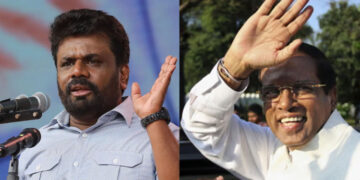
In 2015, Ranil created another leader in the SLFP to defeat Mahinda. He was Maithripala Sirisena. Maithri’s candidature was because of the condition that no other candidate in the SLFP should come forward except him. At that time, if Sajith had been made the candidate, Sajith would have won.
In 2022, Ranil became President with the help of Mahinda and contested the presidential election to defeat Sajith. Anura won because of Ranil. After Ranil lost the seat in the 2020 general election, he inflated Anura to beat Sajith. After becoming president, he did the same thing. In the end, a new leader was created for the left or the SLFP-United Front force. That was Anura.
If Ranil had not created leaders for the left and created leaders for the right like D.S., J.R., there would have been no characters like Chandrika, Mahinda, Maithri, Anura. If that were the case, the South, or the UNP, would have ruled the country for more than half of the 30 years from 1994 to 2024.