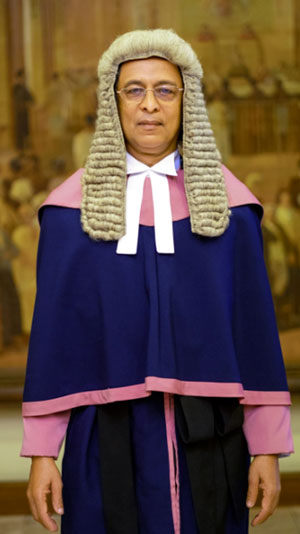


In a recent statement, newly-appointed Court of Appeal Judge Damith Thotawatte emphasized the importance of judges safeguarding their decisions from personal biases while also standing firm against external influences.
During a ceremonial sitting on Thursday, September 26, held to welcome him and three other justices to the Court of Appeal, Justice Thotawatte remarked, “As a judge, it’s impossible to satisfy everyone regarding a particular outcome, and one must never strive to do so. I have always believed in providing counsel who appear before me with a patient hearing and an open mind. There have been numerous occasions where listening attentively to an argument has benefited me.”
Reflecting on his previous role as a High Court judge, he stated, “A judge should allow the evidence presented to guide him to the ultimate conclusion and should only intervene if the evidence is inadmissible or irrelevant.”
Justice Thotawatte also shared his commitment to efficiency, noting that he consistently left fewer cases for his successors than he inherited. He expressed gratitude to all the counsel, state attorneys, and court staff who collaborated with him in achieving this goal.
Recalling his journey into the legal profession, Justice Thotawatte noted that he does not come from a legal family. “When I sat for the law entrance examination all those years ago, I did so more out of curiosity than a desire to pursue a legal career. However, as I found the study of law far more engaging than my previous endeavors, what began as a passing distraction evolved into a lifelong commitment,” he shared with the gathering.

“Efficient and Effective Administration of Justice”
During the ceremonial sitting, Attorney General Parinda Ranasinghe acknowledged that the four justices welcomed to the Court of Appeal have followed two distinct career paths, each representing vital institutions integral to the administration of justice.
He stated, “These two institutions, the judiciary and the Attorney-General’s Department, share the inherent duty to perform their functions while upholding the highest standards to ensure an efficient and effective administration of justice.”
Attorney General Ranasinghe also highlighted the legacy that these justices leave behind in their respective institutions, noting that “present and future generations can take pride in the commitment and dedication with which Your Lordships have fulfilled your duties and responsibilities.”
Acting President of the Bar Association of Sri Lanka, Anura Meddegoda, PC, also addressed the gathering.
“Integrity and Independence”
The most crucial qualities of a judge are integrity and independence, which are essential for upholding the rule of law, stated newly appointed Court of Appeal Judge Gihan Kulatunga.
Speaking at the ceremonial sitting to welcome him and three other justices on Thursday, Justice Kulatunga emphasized that his late father, Justice K M M B Kulatunga PC, instilled in him the importance of acting independently and treating everyone equally.
“For him, right and wrong were clearly defined; there was no gray area. The law applied equally to everyone, whether it was his own mother or son, a friend or a stranger,” he recalled.
Justice Kulatunga expressed his awareness of the significant duty and responsibility bestowed upon him to administer justice. “I will strive to act impartially, fairly, and independently. In this pursuit, I recognize the importance of hearing courteously, considering soberly, responding wisely, and deciding impartially. It is the discipline in life, habits, and outlook that enables a judge to uphold integrity and impartiality. To my mind, the primary objective of a judge’s role is to administer and deliver justice,” he emphasized.
Reflecting on his career, he noted, “I have served in public service and the judiciary for 30 years, including 12 years as a High Court judge. Destiny has brought me this far, despite facing challenges for doing what was right and maintaining my integrity and independence.”