
Justin Wolfers is a professor of public policy and economics at the University of Michigan. Speaking to Srijana Mitra Das, he discusses forms of inequality and their redressal.
Q. What is the core of your research?
A. I would outline my work as arbitrage between several fields. Hence, I work at the intersection between macroeconomics and labour economics. I’m also particularly interested in the intersections of economics with other fields — I study family, marriage and divorce, for instance, which have historically been researched in sociology but we can bring economics to this. I’ve studied elections, usually analysed in political science, but economics can play a role here. Similarly, I study issues in criminal law, normally subjects of legal scholarship, but economics can be applied there too. I find topics economists haven’t devoted much attention to and apply economic methods to these.
Q. What do you consider the world’s greatest economic challenge today?
A. The most immediate one encompasses the tremendous disruptions of global warming and trying to transition to a greener economy. These have huge implications over the next couple of decades. Also, too often in developed economies like the United States, when we say we care about inequality, we are thinking about the problems of the middle class. But if you want to raise total human well-being, the real challenges we face are of economic development or empowering those who simply have too little. The optimist in me sees the world’s greatest anti-poverty program being China’s adoption of markets which took millions out of poverty — today, India’s emerging economy is doing something very similar. Figuring out how to adapt economic models to regions which have seen the most suffering is a key challenge.
Q. It’s said money doesn’t buy happiness — your work suggests it does. Can you tell us about this?
A. In any country, richer people tend to be happier than poorer people. Some decades ago, it was claimed that people in richer countries were not on average happier than people in poorer countries. My partner and I went through all the available data on this and found it to be overwhelmingly the case that richer countries like the US tend to have populations that are happier than poorer countries. Nations with greater economic development seem to foster more happiness as they offer better healthcare systems, more educational opportunities, the rule of law, the absence of hunger, a social welfare net, etc. If poorer countries could adopt these features, it would likely make their populations happier.
It was also claimed earlier that as countries get richer, they don’t necessarily grow happier — but our research has found that as nations became more developed, their happiness levels rose. The one exception has been the US where the pie got larger but so did inequality — the resources of a middle-class family thus didn’t grow considerably, which can correspond to why such families didn’t become much happier.
Q. The world is seeing record economic inequality now — what explains this?
A. In my view, economists can often focus too little on good news. That applies to this area as well. It is very difficult to obtain statistics on the distribution of income around the world.
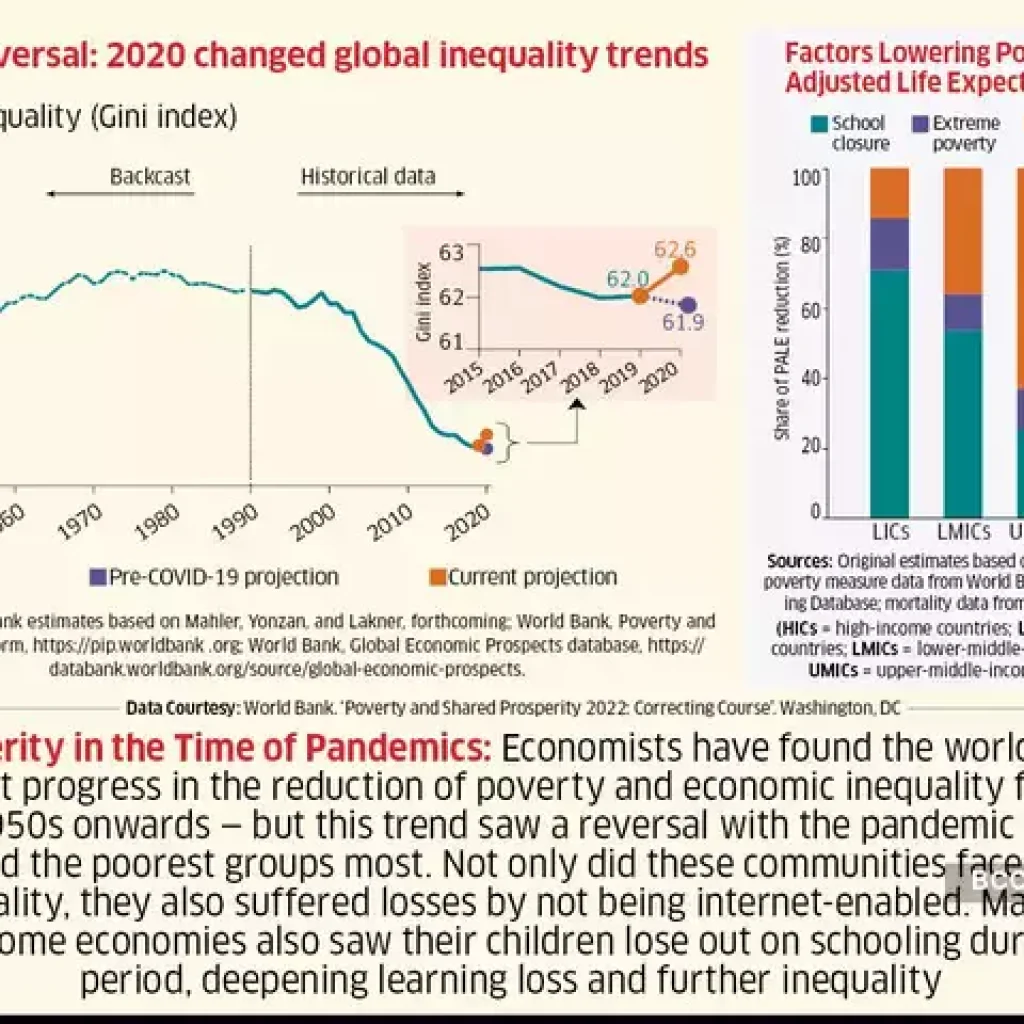
But to the extent that we can make educated guesses, it actually appears global income inequality is declining. Many of the world’s very poor were in China — its growth lifted hundreds of millions to better living circumstances.
We are now seeing the same happen with India. The biggest low-income nations have moved closer to becoming middle-income — that itself helps to reduce global income inequality. Regarding inequality within countries, consider the US. Here, income inequality grew for four decades — you could put that on Reagan, globalisation, automation, etc.
But enormous government assistance was offered during the pandemic — this really served people at the bottom. Inequality fell — and it has continued to decline in the US. Importantly, this progress has not involved bringing the extremely rich down — for the first time in decades, economic growth lifted the wages of lower-income workers and reduced unemployment.
Q. Is there an inherent tension between ensuring equity and economic growth?
A. No. Historically, economists did think there was a trade-off — more equity was seen to come at the expense of efficiency. But that is not the case. Consider greater commitments made to diversity, inclusion and ending racism, sexism or homophobia — this means an employer will now hire more people based on their skills and abilities rather than their demographic characteristics. The outcomes will be fairer and more efficient.
Economic studies in fact suggest a big chunk of our growth over recent decades could be attributable to the fact that our economy now welcomes diverse human beings. An economy which insists, for instance, that women stay at home and only men can work is wasting half its population’s abilities — that is a huge misallocation. Fixing this makes an economy both more equitable and more efficient.
Views expressed are personal
Source: m.economictimes.com