

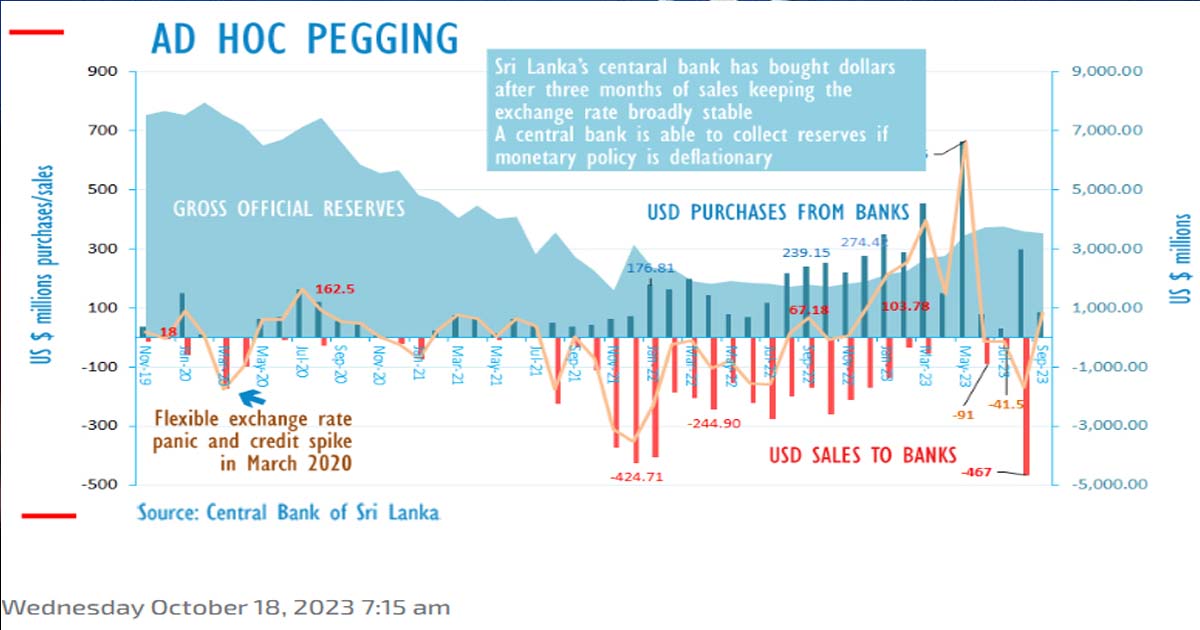
Sri Lanka’s central bank has bought 83 million US dollars from commercial banks through its peg, resuming net dollar purchases after three months, official data show .
There were no sales in September.
Under an International Monetary Fund program, the central bank has to collect foreign reserves by intervening in the forex market (effectively pegging), which requires deflationary open market operations.
A reserve-collecting central bank which cuts rates and enforces them with liquidity injections (inflationary open market operations) triggers a balance of payments deficit.
In order to collect reserves and maintain upward pressure on the currency, a pegged central bank has to operate deflationary open market operations by withdrawing liquidity.
In order to collect reserves (which is the same as repaying debt) domestic investments have to be curtailed by keeping interest rates higher than it requires to keep the balance of payments neutral.
The central bank sold dollars in the previous three months to help banks cover their short positions after a debt exchange, keeping the exchange rate broadly stable.
Analysts have warned that an IMF-prone central bank that cuts rates as inflation falls, will miss reserve targets and trigger external instability as the economy recovers if the rate cuts are enforced with inflationary open market operations.
Due to mistaken ideas about the balance of payments and note-issue banks that emerged in the US and UK in the second quarter of the last century, countries started to suffer BOP deficits and repeated stabilization programs, especially after the 1960s.
Source : economy next