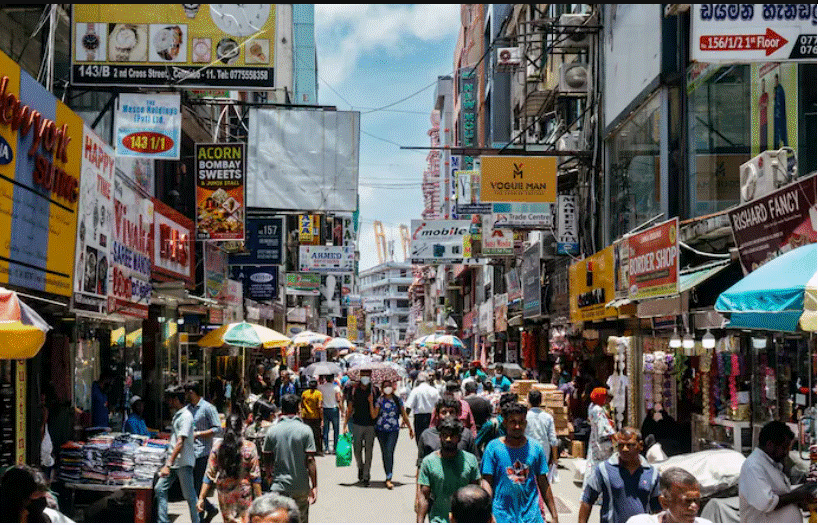
In May, Sri Lanka defaulted on its overseas debt. Amid political upheaval and human suffering, the Indian Ocean island is still awaiting a $2.9 billion rescue by the International Monetary Fund. Lacking resources to buy even essentials like fuel, the economy is falling into an ever-deepening abyss. The poverty rate has doubled in one year; output has cratered and inflation soared. A decade of welfare gains has been eroded. All of this raises a question: When did sovereign debt restructuring become so hard?
In a less complex world, poor economies defaulted to rich nations. The Paris Club, comprising the US, Japan, UK, and other advanced nations, coordinated rescheduling efforts among its members and with the IMF. Nobody gained much by prolonging the misery of a sovereign debtor that couldn’t be liquidated anyway.
But Sri Lanka’s is a 21st-century insolvency with several competing interests. Big-bulge institutions like BlackRock Inc. and Morgan Stanley Investment Management have formed their own group to pursue $12.6 billion in claims, or half of the government’s foreign-currency debt. In addition, Sri Lanka’s bilateral creditors include China and India. Neither Beijing nor New Delhi wants the other to extract more financial or geopolitical mileage out of the crisis.
To speed things along, the besieged debtor has broached the idea of a Most Favored Creditor: Once India has that status, it will get any sweetheart deal offered to China, which holds 52% of the bilateral debt. Such assurances haven’t managed to break the logjam. If anything, there’s reason to fear that Colombo’s ordeal will continue even after the IMF deal. In a move reminiscent of the hedge-fund boss Paul Singer’s campaign against Argentina, Hamilton Reserve Bank Ltd. has sued Sri Lanka in New York.
The delay in resolution of sovereign crises is increasingly a norm. For 15 years after its 2001 default, Argentina had to worry about its presidential plane or naval fleet being seized by Singer’s lawyers. It was only in 2016 that the billionaire’s Elliott Management got what it wanted and went away. That was hardly a one-time affair. Until the early 1990s, less than 10% of crisis-hit countries ended up in litigation; now half do. The 3% of restructured debt governments typically get sued for is unusual even for corporate borrowings, according to the European Central Bank’s Julian Schumacher and other researchers. “We are not aware of many fields of law in which such a high share of disputed claims end up in court,” they say.
The chance that some minority investors would try to arm-twist Sri Lanka for better terms is high. The bigger the loss that’s imposed on bondholders, the more likely that some of them will hold out. On the other hand, if it kept the punishment low for all, then Sri Lanka would find it hard to convince the IMF that it won’t be back for a second rescue. After a 50% haircut on international bonds, and a 25% write-down in the money owed to bilateral and multilateral creditors, the government’s debt load in 10 years will still exceed 130% of gross domestic product at current bond yields, higher than 121% of GDP at present, according to Verité Research. The think tank’s Sri Lanka policy group estimates that a 10-year extension of maturities on current domestic debt could bring the burden down to 101% of GDP.
Touching local-currency debt would be tricky. A Sri Lankan bank that lent money to the government in 2021 has lost most of it to 60%-plus inflation. Its investors — and depositors — could balk at holding on to those low-yielding notes for another 10 years. However, it’s also possible that the domestic bond market will see the pain as an unavoidable side-effect of lifesaving surgery. With a little luck, the near-12% contraction in output may reverse, boosted by tea, textiles and tourism services. As the pressure from a strong dollar and the war in Ukraine begin to fade, an end to shortages could slay inflation; the 28% yield on three-year, local-currency bonds may start sliding toward last year’s 9% level.
That return of confidence will need a spark, though. The new President Ranil Wickremesinghe isn’t wrong when he says there’s no point in reform when his country doesn’t have an economy. But it does have a financial system, which could be put on a surer footing by changing the mandate of the central bank to a Hong Kong-style currency board operating a fixed exchange rate.
The new central bank law, which the IMF insisted on, repeats the usual homilies: freedom from political interference, and a commitment to independent monetary policy. The messy politics of this formerly civil war-torn country is unlikely to respect those lofty ideals once the current storm has passed. Besides, there’s no reason why a small, open economy should want its own monetary policy. For all the warnings routinely repeated about the impending demise of Hong Kong’s dollar peg, the link survives as an important anchor. The Indian counterparts of the wealthy Chinese could do with a similar hard-currency enclave at their doorstep.
It might still be something to consider once the IMF rescue is underway. The disastrous policies of former President Gotabaya Rajapaksa and his powerful family ruined this tropical idyll. Untangling the knots of creditors’ claims has delayed Sri Lanka’s rescue and stalled its recovery. Hopefully, 2023 will bring the island of 22 million people better luck, more money, and fresher ideas.
(Source : Washington post)