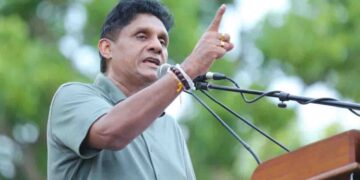
President Ranil Wickramasinghe attended the Nikkei Asia conference in Japan, where he declared Sri Lanka’s aspiration to become a member of the Regional Comprehensive Economic Partnership (RCEP). Subsequently, during his visit to Singapore, an RCEP member country, he sought Singapore’s support in joining the membership.
In a diplomatic outreach, President Ranil engaged with the Malaysian Prime Minister at the UN, appealing for Malaysia’s assistance in Sri Lanka’s bid to join the RCEP. Similarly, during the negotiation for a free trade agreement with Thailand, an RCEP member country, Ranil’s government sought Thailand’s backing for Sri Lanka’s RCEP membership. At the UN, Ranil also approached the President of South Korea, another RCEP member country, seeking support for Sri Lanka.
Even Prime Minister Dinesh Gunawardena, in a meeting with the Deputy Prime Minister of Vietnam in China, requested Vietnam’s support for Sri Lanka’s entry into the RCEP. Ranil spearheaded an extensive diplomatic campaign over the past few months, culminating in a significant visit to China, where he aimed to secure Chinese support for Sri Lanka’s RCEP membership.
India, an RCEP member, withdrew from the organisation citing China’s dominance. Meanwhile, Bangladesh expressed interest in joining RCEP but deferred the decision until after the general election. Bangladesh Media speculation that this move aims to appease anti-Indian sentiments and strengthen ties with China. The sensitivity of South Asian countries aligning with the RCEP, led by China, has become a delicate matter for India.
The implications of Ranil’s efforts to join RCEP are uncertain from India’s perspective. Bangladesh opted to delay its decision due to India’s sensitivity, but Sri Lanka appears less concerned about India’s reservation on RCEP. Despite economic Challenges, President Ranil pursued RCEP membership, as highlighted by a University professor in Tasmania in an Interview with China Daily.
Professor James Chin, a professor of Asian Studies at the University of Tasmania, agrees that “joining the RCEP will give Sri Lanka benefits, as this means it will be easier for the country to gain market access to help rebuild its economy”.
Chin said the “challenge for Sri Lanka is that not all member countries want it to join at present, as they find that Sri Lanka’s economy is still in recovery mode and is considered weak as it takes loans from the International Monetary Fund.
So some hope the country can wait a little while to further stabilize itself before it joins the RCEP”, he added