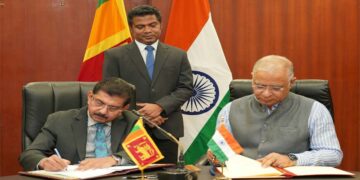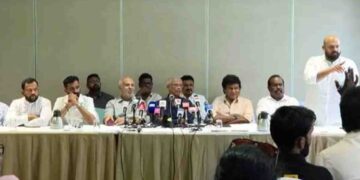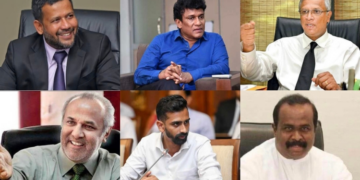

Last week, the United States Indo-Pacific Command’s commanding officer met with President Anura, marking the officer’s inaugural visit to Sri Lanka after President Anura assumed office. This visit occurred amidst concerns raised by experts about the potential economic impact on Sri Lanka following the implementation of the new tariff policies under the Trump administration.
During the visit, discussions reportedly focused on security in the Indian Ocean region, with speculation about whether the topic of the Chinese research ship was addressed. While the US Indo-Pacific commander does not have direct oversight of tariff policies, it remains unclear whether the Sri Lankan government has formulated a comprehensive strategy to address any resulting economic challenges.
Following the meeting, President Anura’s administration decided to hold the operations of Elon Musk’s Starlink services, citing concerns about national security. Notably, Starlink negotiations had been initiated by former President Ranil Wickramasinghe, who met Elon Musk during a visit to Indonesia and invited him to Sri Lanka. Wickramasinghe had expressed hopes that Musk would visit Sri Lanka by the end of 2024 to launch Starlink services, ideally before the presidential elections—an aspiration that ultimately did not materialize.
The hold of Starlink services raises questions about its implications for Sri Lanka–US relations and the potential impact on Trump’s tariff policies. A historical parallel can be drawn to the economic repercussions Sri Lanka faced under the US PL 480 scheme during Mrs. Bandaranaike’s administration from 1970 to 1977. When the US withdrew the subsidized food program in 1973, Sri Lanka experienced a severe food crisis, prompting Prime Minister Bandaranaike to formally appeal to President Richard Nixon for reconsideration.
Below is the American president’s letter to Mrs. Bandaranayake
Washington, August 3, 1973
Dear Madame Prime Minister,
Your letter of July 10 was a very persuasive description of Sri Lanka’s urgent need for food assistance. You can be sure that we appreciate the problems you face in this area and will try to be as responsive as we can. Since we are not in a position to provide a precise answer just yet, I want you to have this prompt explanation of how your government’s request is being handled.
Your letter recalls the February AID Group meeting, at which the U.S. representative expressed our hope that we would be able to provide $15–18 million worth of wheat flour to Sri Lanka under Title I of Public Law 480. As you know, the intervening months have seen very serious questions of food availability develop on a worldwide basis, greatly complicating our tasks in making allocations under PL 480.
These matters are currently under very active examination within our government. Our ambassador will keep in close contact with your government as this process continues. Meanwhile, you may be sure that we want to be as helpful as we can and that the points raised in your letter will be taken carefully into account.
With warm personal regards,
Sincerely, Richard Nixon
Despite her government’s anti-American stance, Mrs. Bandaranaike managed a diplomatic effort to restore PL 480 benefits. In contrast, it remains uncertain whether President Anura’s administration has any plans to seek relief from the economic challenges posed by the Trump administration’s tariff policies.