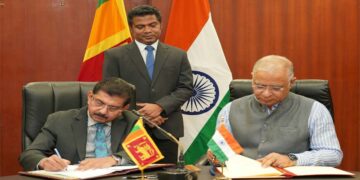
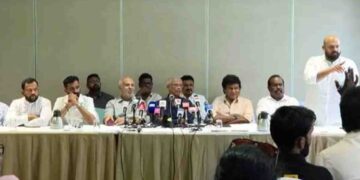
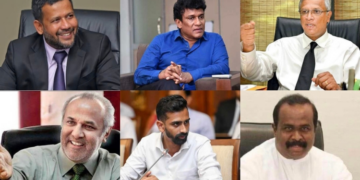
There has been considerable controversy within political circles over Tilvin Silva’s visit to India. The controversy stems from the JVP’s strong anti-Indian policy during the 1987–88 period. At that time, the JVP launched a major campaign calling for a boycott of Indian goods and even threatened to kill those who purchased them. On September 12, 1989, Dr. Gladys Jayawardena, Chairperson of the State Pharmaceuticals Corporation, was assassinated by the JVP on allegations that she had approved the import of Indian medicinal drugs. Likewise, Indian businessmen who imported Indian goods were also killed by the JVP.
However, Somawansa Amarasinghe, a former leader of the JVP who held such a strong anti-Indian stance, survived with the help of India, as the book ‘Indian Intervention in Sri Lanka’ states. Having fled to Europe via India, Somawansa, upon returning to Sri Lanka in 2001, publicly thanked former Indian Prime Minister V. P. Singh, stating that the Indian government had saved his life.
India resumed relations with the JVP after Somawansa Amarasinghe returned to Sri Lanka and joined an alliance with then-President Chandrika in 2004. The Indian High Commissioner to Sri Lanka, during the period Nirupan Sen, became the first High Commissioner in the country to establish close ties with JVP leaders. Thereafter, cordial relations existed between the JVP and India. Although the JVP organized public protests against the proposed ETCA agreement with India, the handing over of the Trincomalee oil tanks to India, the leasing of the Eastern Terminal of the Colombo Port to India, Adani’s power project, and the Amul–Milco agreement, JVP leader Anura and Vijitha Herath maintained close relations with India. Anura and Vijitha did not maintain these ties without Tilvin’s knowledge. Tilvin was aware. It is possible that Anura and Vijitha had a hand behind the planning of Tilvin’s visit to India.
At first glance, Tilvin’s visit to India appeared advantageous to India. Political commentators viewed it as a U-turn by Tilvin. However, immediately upon his return to Sri Lanka, Tilvin stated in his first media interview that the government’s decision to annulled the Amul–Milco lease agreement signed by former President Ranil not changed despite his visit to Amul.
He also said that the Indian Foreign Minister had not discussed even a single word with him about Provincial Council elections or Provincial Councils. Yet, following Tilvin’s visit to India, the government appointed a Parliamentary Select Committee to expedite the holding of Provincial Council elections. Through his interviews, Tilvin appears to be conveying that his position regarding India has not changed as a result of his visit. The truth or otherwise of this will become clear in the days ahead.