

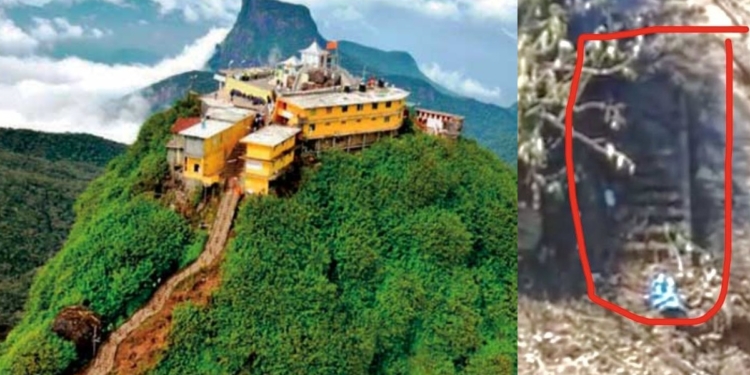
Following the recent landslide near Ahela Kanuwa on the Adam’s Peak–Hatton road, an old iron staircase—believed to have been used in ancient times by pilgrims climbing Adam’s Peak—has re-emerged. On the 30th, we published photos and details about this structure. It is now quite clear that this staircase belongs to a long-forgotten route once used by pilgrims.
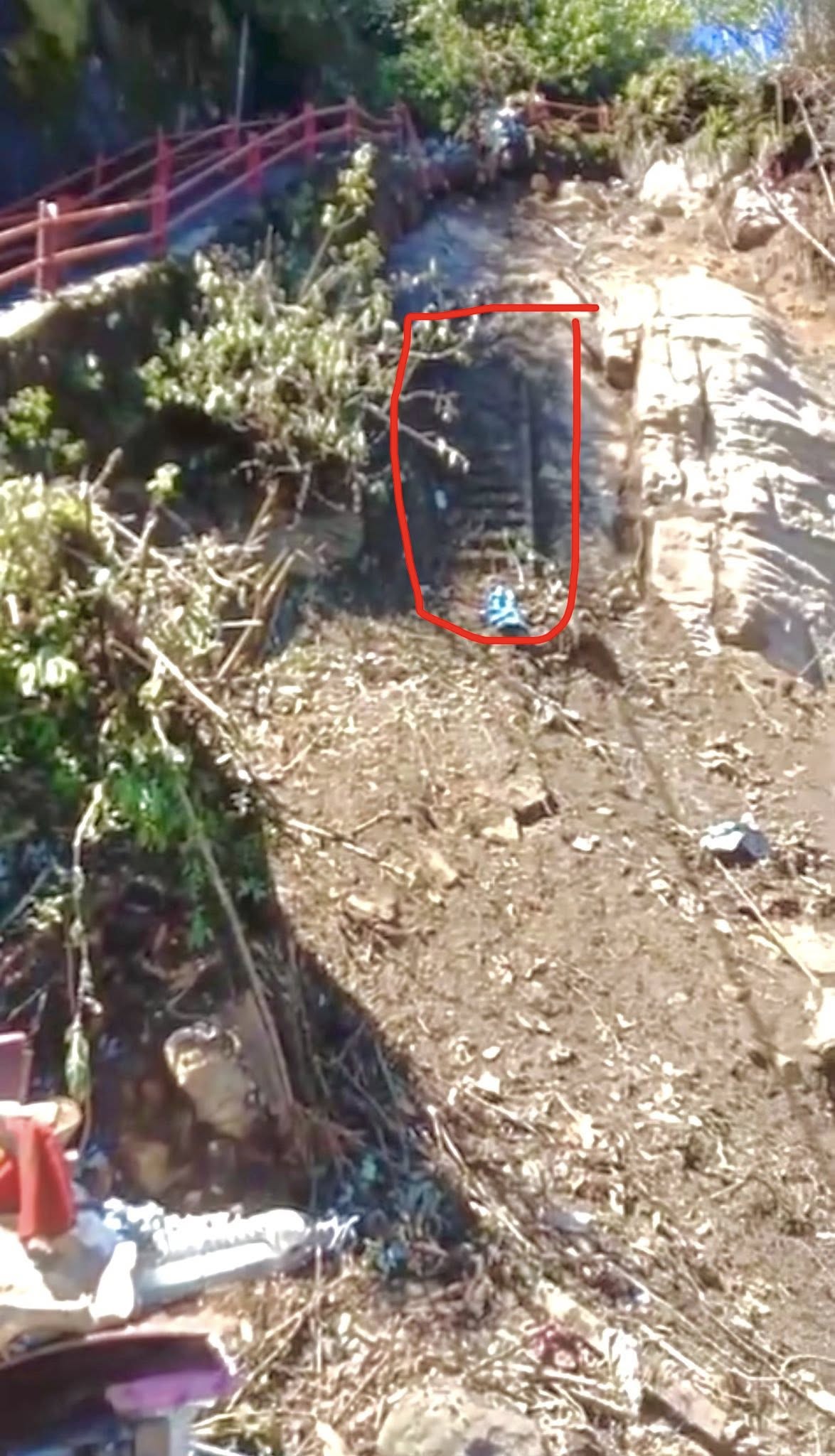
From the photographs captured (which are stills from a video), it is evident how far below the present-day official path this staircase lies. Based on these images, the steps appear to be located roughly 8–10 feet below the current pilgrim trail.
It is also clear that this staircase had long been buried under a thick layer of soil, overgrown with trees, roots, and rocks. Even after the landslide, the staircase has not detached or come loose, suggesting that it may have been very firmly fixed to the rock. However, no one has yet carried out a proper study to confirm this.
We have therefore formally informed the Department of Archaeology, requesting an investigation. At this point, we do not know whether this is a creation of ancient Sri Lankan metallurgical technology from the era of the kings, or a structure from the British colonial period. Old photographs taken in the year 1900 show that the present Adam’s Peak pathway existed even then. Back in that time too, pilgrims appear to have used the modern route, bypassing this staircase—implying that the old staircase may be even older, possibly dating back to a royal period. But this is still unconfirmed.
Judging by the appearance, it is obvious that several feet of soil had covered this structure for a very long time. The surrounding area had dense vegetation with large trees whose roots had grown into the soil layer that covered the rock on which these steps were fixed. This explains why the staircase remained hidden until now. In the first two photos, this is clearly visible.
Although there are remnants of another 3–4-foot staircase near Ahela Kanuwa on the Ratnapura road, this newly revealed staircase is entirely different. The steps are neatly aligned, consistently parallel, and appear firmly connected to the rock surface—again shown by the fact that they did not detach even after such a significant landslide.
We hope that the Department of Archaeology will investigate the matter and inform the public. Until then, there is no need to rush to see the staircase, or to climb fences and take selfies at the site. This fascinating creation, buried under the earth for so long, must be properly dated and studied before conclusions can be drawn.
Additionally, near Nallathanniya inside the Samanala Reserve, another landslide has occurred. Water from the Seetha Gangula stream has flowed from the Aligoda mountain area through a residential zone, all the way down to the water pathway. Such landslides have never occurred just 3–4 days before the beginning of the Adam’s Peak pilgrimage season in previous years.
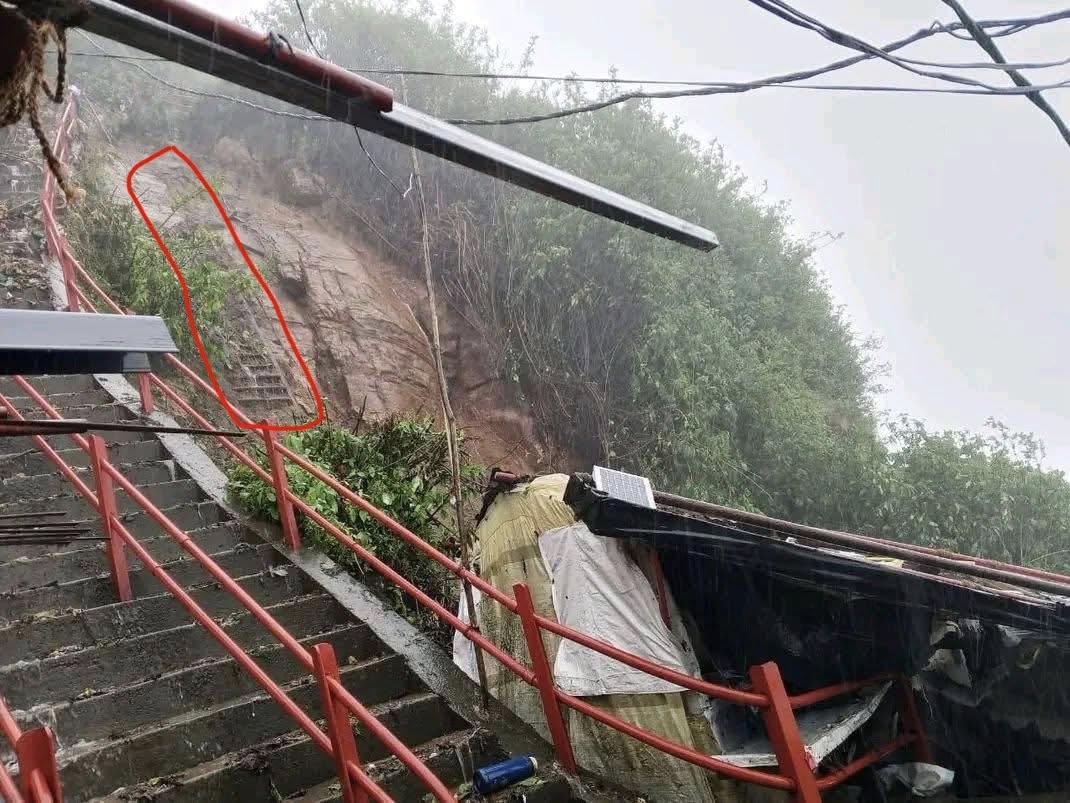
The Department of Meteorology has also announced that the Northeast Monsoon will be active for several days starting from December 4. Therefore, before rushing to climb Adam’s Peak as soon as the season opens, please think carefully. The environment is still wet, and the stability of the soil layers is unknown. No geological assessments have yet been completed. So please consider the safety of human lives.
There is time to climb Adam’s Peak until May 30, 2026. In these risky conditions, be wise and make informed decisions.
(Adapted from a Facebook post by Shaminda Ranshan.)