

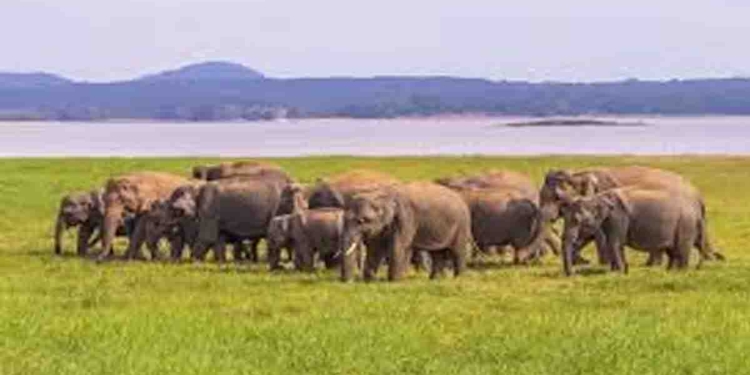
Today, we intend to speak from the “Kele Kolama” (Jungle Talk) segment about the current wave of elephant killings in the country, who is responsible, and what solutions can be provided.
Sri Lanka is currently experiencing an environmental tragedy that has reached a critical stage. It reflects a deeply sorrowful aspect of our society. A wave of elephant killings is unfolding, agitating the sensitive segment of society, especially in the aftermath of the unnatural death of the well-known elephant Bhathiya.
Is there really a wave of elephant killings?
At first glance, it seems so. Several killings have occurred within just one month. Reports say that on Monday, July 21 alone, ten elephants were killed.

These days, we often hear about the human-elephant conflict or the breakdown of coexistence between humans and elephants. One of the strongest triggers for renewed attention on this topic was the tragic injury and death of Bhathiya the elephant.
Although many people discuss this issue in society, about 80% of them lack a proper understanding of it.
How did this problem begin? Who should be held accountable? Are there solutions? Many people don’t know the answers.
For over 3,000 years, elephants have shared this land with us, connected to our civilization, culture, and religion. So how has a conflict developed between us now? We believe the primary reasons are:
Unregulated development
Land distribution issues
Deforestation
Unregulated and outdated agricultural practices
The spread of makeshift housing colonies
Why are elephants so important to our country?
How do elephants contribute to Sri Lanka’s foreign income? It is to answer such questions that we appoint governments, ministers, and officials—maintained using taxpayers’ money. Yet, a major concern is the failure of those in power to fulfill their duties properly, and this has become another dark aspect of the ongoing tragedy.
What steps have the authorities taken?
It appears they are doing nothing meaningful—like a dog sleeping in a smithy, indifferent to the noise. The minister seems completely unaware of his subject area. He’s known for depending on others to write his statements and blindly parroting them. This is not what the public expects. It is the duty of officials to find answers to problems. If there is a conspiracy, it is the responsibility of the government—not the people—to investigate it properly. The public’s role is only to offer suggestions and help implement them.
According to reports, by July 20, the number of elephant deaths in Sri Lanka this year had reached 238. If this trend continues, it could exceed 500 by the end of the year.
As the country’s President once said, we must now seriously consider what a “mass grave of 500 elephants” might look like. There’s an old saying, “covering a yam with your mouth”—pretending it’s not there. That’s what’s happening today.
There are many issues in the wildlife sector, and it’s the responsibility of officials to solve them. Ironically, the Department of Wildlife Conservation is one of the most profitable government departments in Sri Lanka. Yet, they do not even have an ambulance for emergency use.
We are now in the elephant migration season. Parks like Minneriya, Kaudulla, Udawalawe, and Yala are full of tourists. These visits bring in millions of rupees, but only a drop of that revenue goes to actual conservation efforts. When an incident occurs, the common response is to deflect blame, which has now become a style of operation among officials and ministers in charge.
If Sri Lanka gains a reputation as a country that slaughters elephants, tourists will stop visiting. Therefore, the armed forces, intelligence units, wildlife officers, and special task forces must work together under a proper plan and methodology to stop this. We at “Kele Kolama” firmly believe this action is urgently necessary.
It must not be done in a lethargic manner. The minister and high-ranking officials must be reminded of this.
We are sharing these facts to inform the public, purely for the protection of wildlife, the environment, and the progress of this country. We stress that we have no hidden agendas or personal gain behind this effort.
By Saman Haloluwa