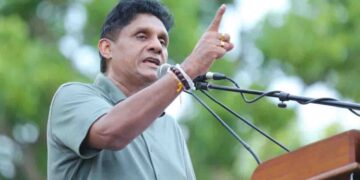
Sajith Rejects Extremes, Advocates a Shift Toward Humane Capitalism
Sri Lanka’s Policy Direction Perceived to Be Tilting Toward US Alignment
President Appears Visibly Disturbed, Sidesteps Questions on YouTubers’ HR Concerns
International Relations or International Illusions?
Throughout history, successive governments have largely managed to shield Sri Lanka and its people from the adverse effects of global crises. This was made possible by the foreign policies they pursued and the international relationships they cultivated.
In particular, during the 1970–77 United Front government, the non-aligned foreign policy adopted by then Prime Minister Sirimavo Bandaranaike gained significant international recognition. By maintaining a balanced approach without aligning with any major power, she earned both respect and admiration on the global stage.
After 1977, J. R. Jayewardene, who assumed leadership of the country, built strong ties with countries such as United States and Japan, successfully attracting major development projects to Sri Lanka.
Subsequently, President Ranasinghe Premadasa expanded diplomatic relations not only with China but also with nations like the United States and Japan, bringing in numerous large-scale development initiatives.
Thereafter, President Chandrika Bandaranaike Kumaratunga continued to follow a non-aligned approach while also fostering closer ties with India.
Later, Mahinda Rajapaksa strengthened relations significantly with China, securing several massive development projects for the country.
This historical trajectory demonstrates that through effective foreign policy and personal diplomatic relationships, a country can secure substantial investments and benefits from the international community. Conversely, a weak foreign policy can inevitably lead to serious consequences for a nation’s development and future in its international engagements.
Diplomatic Predicament
It is against this backdrop that we briefly revisited how past leaders managed foreign policy—because, in recent days, Sri Lanka appears to have been drawn into a serious diplomatic predicament, largely due to a weak foreign policy response amid the ongoing conflict in the Middle East.
When two major global powers are engaged in military action, the responses of other countries inevitably reveal their foreign policy orientations. In this context, many Middle Eastern nations have openly aligned themselves with the United States and Israel. Meanwhile, several countries, including those in Europe, appear to be maintaining more independent positions. At the same time, countries such as Russia and China seem to be acting in a manner supportive of Iran.
In light of this, it is worth examining the nature of the foreign policy being pursued by the government of Anura Kumara Dissanayake in relation to the ongoing conflict in the Middle East.
Tilting Towards the United States?
The current “Malima” government is widely perceived as a left-leaning administration. Accordingly, many expected that strongly leftist policies would be implemented domestically. However, judging by the programs and actions now unfolding within the country, it has become increasingly difficult to determine whether the government is truly leftist, right-leaning, or even veering toward an extreme pro-market stance.
From the very outset of the conflict, when the United States and Israel launched attacks on Iran, the Malima government maintained that it was pursuing a neutral foreign policy, not aligning with any side.
However, developments that unfolded a few weeks ago—particularly following an attack on an Iranian vessel within Sri Lanka’s exclusive economic zone—have raised serious questions about whether the country has in fact adhered to a neutral stance. In the immediate aftermath, the Navy held a special media briefing, claiming that the vessel had not sunk due to an attack. Yet, within 24 hours, the U.S. Defense Secretary issued a statement asserting that an American submarine had launched a torpedo strike, sinking the Iranian ship.
Following this incident, intensified U.S. attacks prompted Iran to close the Strait of Hormuz, plunging the global economy into a severe crisis. Sri Lanka, too, felt the impact—fuel queues re-emerged, and the government was forced to impose restrictions and raise prices. The pressing issue, however, is that due to the foreign policy pursued during the conflict, Sri Lanka now appears unable to secure even an emergency fuel shipment at short notice.
At the same time, developments over the past week have led many observers to conclude that Sri Lanka, in practice, has leaned toward a pro-U.S. position in this conflict. Even so, questions remain as to whether this alignment—if it exists—has been managed effectively.
Diplomatic misstep
This became particularly evident following a special statement by President Anura Kumara Dissanayake in Parliament regarding the Middle East conflict. Critics argue that the President made several remarks that should not have been disclosed publicly, amounting to a serious diplomatic misstep. As a result, Sri Lanka now appears to be under pressure from both the United States and Iran.
At one point, seemingly addressing his political base, the President stated that permission had been requested for two U.S. military aircraft to land at Mattala Airport, but that approval had been denied. In another instance, he claimed that the government had no prior knowledge of Iranian vessels entering Sri Lankan waters.
Subsequent developments suggest that both statements may have had significant repercussions for Sri Lanka’s foreign policy standing. Notably, the President’s claim regarding the denial of access to U.S. aircraft has reportedly been taken very seriously by Washington. According to information reaching “Inside Politics,” U.S. officials have interpreted the remark as a slight or an act of disregard.
Although there has been no official response yet from the United States Department of State, it is understood that the matter is under close scrutiny. While a formal reaction has not yet been issued, indications suggest that an official expression of dissatisfaction could emerge in the near future. Such a response may ultimately clarify the accuracy—or inaccuracy—of the President’s claims.
Requests Made
Through last week’s “Inside Politics” column, we revealed another special development involving the United States, stating that two of Donald Trump’s special envoys arrived in Sri Lanka on the same day. One of them was Sergio Gore, the Deputy Secretary in charge of Central and Asian Affairs, who also serves as the U.S. Ambassador to India. It is well known that Sergio Gore maintains close ties with Donald Trump.
We reported that while Gore travelled from India to Sri Lanka, another special envoy, Michael Jeremiah, arrived quietly and discreetly from Washington. According to our findings, during Gore’s meeting with the President, discussions focused on how the United States could be involved in maintaining security at Sri Lanka’s ports, including the Colombo Port.
Discreet arrival of Michael Jeremiah
The United States’ sensitivity regarding Sri Lanka’s ports is not new. For a long time, Washington has made proposals to gain access to strategically sensitive locations within these ports. The “Inside Politics” column has learned that these matters were also discussed between Gore and the President. It is said that Gore proposed granting the United States the opportunity to develop the Trincomalee oil tank farm, a project currently assigned to India. However, it is understood that the President did not respond to this request.
In addition, discussions reportedly covered providing Sri Lanka’s national airline with modern Boeing aircraft and undertaking a complete restructuring of SriLankan Airlines. It appears that Gore conducted these talks from a position aimed at securing advantages for the United States.
But in reality, does the President have the ability to fulfill these requests? The United States also holds leverage in this regard. A clear example is the tariff imposed on Sri Lanka by Trump. The government managed to reduce the initial 40% tariff to 20% within about two months, largely by agreeing to meet several conditions set by the United States. However, according to our information, the government has yet to fully meet those conditions.
As a result, there is now a greater likelihood that the United States could use such leverage in response to the President’s recent statement in Parliament. This raises the possibility that the tariff could once again be increased to 40% by the Trump administration. Therefore, from Sri Lanka’s perspective, the best course of action would be to urgently resolve these matters through dialogue and to fulfill the commitments made to the United States.
The Iran Issue
While the President’s remarks regarding the United States have created a challenging backdrop, his statement concerning Iran has now led to an even more serious situation. This is due to Iran publicly rejecting a statement made by the President.
In Parliament, the President claimed that the government was unaware of an Iranian naval vessel arriving in Sri Lanka and that no invitation had been extended for such a visit. However, within 24 hours, this statement was challenged—initially by the opposition. The opposition asserted that the Sri Lankan Navy Commander had in fact invited these vessels.
Invitation from SL
Supporting the opposition’s claim, the Iranian Ambassador to Sri Lanka, at a special media briefing, emphasized that the ships had indeed arrived following an invitation from Sri Lanka. Notably, the ambassador repeated this assertion twice, making it a significant development and a direct public challenge to the President’s statement.
Furthermore, during the same briefing, the Iranian Ambassador made another notable statement: that Iran could supply oil to Sri Lanka at concessionary prices as a solution to the country’s ongoing fuel crisis.
At present, Sri Lanka is struggling to secure sufficient fuel supplies. Earlier, through the “Inside Politics” column, we reported that when the crisis began, the government attempted to obtain oil from India, but India responded that it too was facing a shortage. Meanwhile, U.S. sanctions on Russia made it difficult for Sri Lanka to procure oil from Russia.
Procure oil from Russia
Additionally, the Sapugaskanda refinery—built with Iranian assistance—is designed to process only Iranian crude oil, making it incompatible with crude from other countries. Due to U.S. sanctions on Iran, Sri Lanka has been importing Iranian crude indirectly through companies in Singapore or Dubai rather than purchasing it directly.
Following the Iranian Ambassador’s offer, many expected the government to immediately accept and secure oil from Iran. At the same time, Iran had already taken steps to facilitate oil exports to India by opening the Strait of Hormuz exclusively for Indian shipments. India, along with several other countries, has recently been importing Iranian oil through this route.
However, in a surprising development, Cabinet Spokesman Minister Nalinda Jayatissa stated at a media briefing that the government would not pursue oil imports from Iran at this time. As the reason, he claimed that Sri Lanka lacks the necessary vessels to transport the oil.
Many now believe that this response could strain diplomatic relations with Iran, as it may be perceived as a dismissive reply to Iran’s offer.
Conditions from Russia
On the other hand, another view emerging is whether the Iranian Ambassador’s offer to supply oil to Sri Lanka was made with the intention of pushing the country into a long-term crisis. The reasoning behind this is that if Sri Lanka does not obtain oil from Iran, the only remaining option is Russia.
Russia, notably, is aligned with Iran in the Middle East conflict. Another major power, China, also maintains a pro-Iran stance. Therefore, following Sri Lanka’s response to Iran, a serious question arises as to whether Iran’s allies—Russia and China—would be willing to extend diplomatic support to Sri Lanka.
At the onset of the fuel crisis, the government stated that it was in discussions to obtain oil from the United States or Algeria. However, no updates have been reported on the progress of those talks. A U.S.-linked company operating in Sri Lanka, Park Company, has been importing limited quantities of oil through intermediary countries. Yet, whether this is sufficient in the face of the current crisis remains highly questionable.
Meanwhile, discussions with Algeria are still at a preliminary stage. Due to the import of low-quality coal, the Norochcholai power plant has been unable to generate its expected capacity, forcing Sri Lanka to rely heavily on oil for daily electricity generation. As a result, the government has had to use a significant portion of its existing fuel stocks for power generation.
Given this situation, many believe that unless oil shipments are secured urgently, Sri Lanka could face a severe fuel crisis by the time of the Sinhala New Year.
Turning Towards Russia
Under these circumstances, Sri Lanka’s only viable option appears to be negotiating with Russia to secure oil supplies.
Initially, U.S. sanctions on Russia made it difficult for any country to purchase Russian oil. However, the United States has now temporarily lifted these sanctions for a period of one month. Earlier, Foreign Minister Vijitha Herath held discussions with the Russian Ambassador regarding oil procurement, and the ambassador conveyed Sri Lanka’s request to Russian authorities. At that time, however, no favorable response was received.
Given the worsening situation, the government has once again turned to Russia. Several parties with close ties to Russia have been engaged to present Sri Lanka’s request. In response, Russia has decided to send its Deputy Energy Minister to Sri Lanka.
According to available information, the Russian Deputy Energy Minister has arrived with several stringent conditions. Russia has reportedly proposed supplying two fuel shipments in the initial phase. However, if Sri Lanka wishes to continue importing oil from Russia, it must enter into a new agreement committing to purchase Russian oil for a period of five years after receiving the initial shipments.
It is further understood that only if Sri Lanka agrees to these terms will Russia send its Deputy Foreign Minister to finalize and sign the agreement.
Rising Concerns
At the outset, Russia indicated it could supply only two oil shipments. However, due to the current severe fuel shortage and electricity crisis, a large portion of these supplies would need to be allocated for power generation.
Since the outbreak of the conflict, Sri Lanka was expected to receive 25 fuel shipments, but only about 13 have arrived so far. Therefore, in order to overcome the crisis, the government may have no choice but to enter into a five-year agreement with Russia.
However, this approach raises several serious concerns.
The first is that the United States has lifted sanctions on Russian oil only for a limited period of 30 days. If sanctions are reimposed after this period, it becomes questionable whether Sri Lanka can proceed with a long-term agreement. Even if such an agreement is signed, the feasibility of importing Russian oil in violation of U.S. sanctions remains uncertain—potentially creating another diplomatic crisis for Sri Lanka.
India Factor
Additionally, a special telephone conversation took place last week between the President and Indian Prime Minister Narendra Modi. Many now speculate whether the President requested Modi’s assistance in securing oil from Russia during that discussion.
At the early stages of the crisis, Sri Lanka had already approached India for fuel supplies, but those efforts were unsuccessful. Given the close relationship between Modi and Russia, it is possible that the President intended to leverage India’s influence to secure Russian oil.
However, the effectiveness of such a strategy remains doubtful. Many believe that if the President approached Modi with such expectations, it reflects a lack of experience in handling complex international relations.
Anura Meets YouTubers
Immediately after the outbreak of the Middle East war, this column made a special revelation, stating—based on information from various sources—that the government, led by the President, had formulated forward plans for Sri Lanka on the assumption that the war would end within eight weeks.
At the time, many believed the government lacked the capacity to make an accurate assessment regarding the end of the conflict. As things stand now, the government is grappling with the serious crises triggered by the Middle East war, and many believe these challenges are likely to intensify further in the coming period.
Crisis management questioned
Serious questions have also arisen regarding the measures the government is taking to manage the crisis. For instance, in past crises, no government has been known to summon YouTubers and seek their support. Typically, previous administrations would invite newspaper editors, electronic media heads, or media owners to the Presidential Secretariat for formal discussions on how the media should act, and to exchange views on managing the crisis.
However, in the current situation, it is learned that government leaders recently held a lengthy discussion with YouTubers on managing the ongoing crisis.
Notably, the President did not give this meeting official recognition. Instead of being held at the Presidential Secretariat, selected YouTubers were invited to the JVP headquarters in Pelawatte. The meeting, convened last Monday at 3:00 p.m. in the party’s conference hall, saw the President and Media Minister Nalinda Jayatissa already seated when the YouTubers arrived.
No official protocol
The discussion took place in an informal and friendly setting, beyond official protocol. Various topics were discussed, and interestingly, an incident similar to the President’s earlier verbal misstep in Parliament occurred again—this time during questions from YouTubers about the fuel crisis.
In his response, the President shared details of discussions he had with the Emir of Qatar and the Emir of the United Arab Emirates. Although it was unclear which of the two leaders made the specific remarks, the President stated that he had received information indicating that Iran would soon run out of weapons and would not be able to sustain the war for long. He further added that Iran’s remaining weapons could come under attack in the coming days.
By the time this article is being written, it is highly likely that these remarks have already been reported to nearly all foreign embassies in the country. Many now believe that the President’s statements may have caused offense to Iran.
Accordingly, it must be said that whether speaking with YouTubers, in Parliament, or in any official setting, the President should act with greater responsibility when commenting on international matters.
Other Key Exchanges
It is also learned that the President made several other significant remarks during this discussion. One of them related to the Sapugaskanda oil refinery:
“The oil shipments we have tendered for are expected only by June. So we will have to procure oil through spot tenders. Even then, it’s difficult to secure a vessel. We are trying to see if we can obtain oil from ships already at sea, but that too has not worked out yet. If this continues, we may have to shut down the Sapugaskanda refinery by April 4. We need to resolve this issue before that.”
During the discussion, YouTubers supportive of the government also raised concerns that government ministers were avoiding giving interviews to their channels.
They complained:
“Government ministers don’t respond to us. But they go on TV and speak. People don’t watch TV anymore—they watch our content. Yet these ministers don’t come to our channels. Meanwhile, opposition members are willing to come when we invite them. Out of the 159 government MPs, many say they need approval from Pelawatte before speaking to media. Please resolve this issue for us.”
In response, the President gave a notable reply:
“We have already decided to reduce how much our key ministers speak publicly. Instead, we plan to communicate our responses through other parties.”
Through this, the President appeared to suggest that rather than relying on ministers, YouTubers should engage with third parties who would convey the government’s views.
At one point, a YouTuber questioned why government members appear on Derana TV but not on their channels. Neither the President nor Minister Nalinda responded to this question.
Mattala Airport & Other Issues
YouTubers also questioned the President about plans for the Mattala Airport. Referring to Western Province Governor Yusuf Hanifa, the President stated that discussions are already underway with two major countries:
“We have already initiated discussions with Qatar and the Emirates regarding this. Hon. Yusuf Hanifa is overseeing the related activities.”
Awkward Moment on Human Rights
A particularly difficult moment arose when a YouTuber questioned the President about human rights issues:
“There is serious injustice regarding human rights cases. Complaints about violations are not being investigated. Why are you silent on this?”
The President appeared visibly uncomfortable and initially attempted to dismiss the question, saying:
“That is not our issue…”
However, as the YouTuber persisted, the President eventually tried to deflect the matter, responding:
“It’s difficult to talk about that, isn’t it? Let’s see…”
After the Meeting
The meeting, which began at 3:00 p.m., concluded only after 5:45 p.m., lasting nearly two hours and 45 minutes. During this time, the President’s side provided the YouTubers with tea and a few packets of biscuits under the “Kist” brand.
After the YouTubers left, JVP General Secretary Tilvin Silva entered the room, along with another notable individual. MP Bimal Rathnayake also joined shortly thereafter. The President, Nalinda Jayatissa, Bimal Rathnayake, and Tilvin Silva then proceeded to hold a separate discussion on the government’s future course.
A Special Visitor Meets Sajith
During the final phase of the severe economic crisis under former President Gotabaya Rajapaksa, there was an initial plan to invite Opposition Leader Sajith Premadasa to take over the government. However, while Gotabaya was making this move, other members of the Rajapaksa camp were pursuing a different strategy—to hand over power to Ranil Wickremesinghe instead, thereby securing their own protection.
Accordingly, even as discussions between Sajith and Gotabaya were underway, a parallel effort had already begun to appoint Ranil as President through Parliament. During this period, Sajith convened his then economic advisors—Dr. Harsha de Silva, Kabir Hashim, and Eran Wickramaratne—for a special discussion on taking over and running the government.
At that meeting, the group led by Harsha reportedly advised Sajith very clearly not to take over the government under those circumstances—not even to consider it. This had been reported several times in the “Inside Politics” column, and was later publicly confirmed by Rajitha Senaratne as well.
Ultimately, amid behind-the-scenes exchanges, Ranil Wickremesinghe secured the presidency with the support of the SLPP through Parliament, becoming the country’s eighth President. Subsequently, those who had advised Sajith against taking power appeared to work closely with Ranil, even benefiting from their association with him.
Learning from the Past
Perhaps having learned from that experience, Sajith has now moved quickly—amid early signs of another severe economic crisis—to consult experts on the steps that need to be taken going forward.
He initiated the formation of committees to propose both short-term and long-term solutions. His immediate focus has been on the emerging energy crisis—covering fuel, gas, and electricity shortages.
In this context, a special representative visited Sajith’s residence last week and held a one-and-a-half-hour face-to-face discussion with him. It was after this crucial meeting that Sajith began actively exploring solutions to the crisis.
During the discussion, the visitor reportedly identified two specific timeframes during which a critical crisis could emerge and advised Sajith to begin preparations immediately to address those scenarios.
Within 24 hours of that meeting, Sajith convened a discussion at the Opposition Leader’s Office, bringing together several experts in Sri Lanka’s energy sector, including individuals with strong reputations in the private sector.
The discussions covered possible solutions to the energy crisis, which countries could provide assistance, who could be directly engaged, and what short-term and long-term strategies should be adopted. Following this, Sajith instructed that a formal report and policy framework be prepared, and appointed a special expert committee to begin work immediately.
Advice from a Diplomat
In addition, Sajith met several high-level ambassadors last week and held informal discussions. During one such meeting, a diplomat conveyed a highly personal piece of advice:
He urged Sajith to build a new, trustworthy team around him to manage economic affairs. The diplomat also pointed out how, during the previous crisis under Gotabaya, certain individuals had undermined Sajith while promoting Ranil.
The diplomat further explained—using personal examples—how some economic “experts” linked to Sajith’s own party had boosted their own profiles while damaging his.
He advised:
“Let me tell you something that happened to me personally. Many who come to embassies come with their own agendas—either to gain power within parties or to secure personal benefits. They did not genuinely want to build an SJB government. Some of these individuals met me and undermined you. So my advice is: build a new, trustworthy team capable of managing crises.”
Building a New Team
Taking this message seriously, Sajith has begun appointing a new group of economic advisors.
Among them are Professor Prasanna Perera of the University of Peradeniya’s Department of Economics, and legal professional and economic analyst Charana Kanankegama.
Professor Perera is known for his ability to explain complex economic issues in simple, accessible language that ordinary people can understand—unlike some well-known economists who focus on abstract theory. He is widely recognized for his practical approach to economics.
Last week, Sajith also met internationally recognized economist Elena Panaritis, with both Perera and Kanankegama present at the meeting.
Diplomatic Strategy
Beyond addressing the economic crisis, Sajith has also begun strengthening his approach to handling diplomatic challenges.
He has brought several key individuals closer to assist in navigating international relations, including a foreign policy expert who had previously been sidelined due to internal opposition.
Sajith has now instructed this expert to immediately begin discussions on shaping foreign policy strategy. He has also requested a report identifying countries and global leaders who could be approached quickly for support amid the crisis.
Additionally, the two have held detailed discussions on three potential diplomatic crises that could arise in the near future.
Unity Becomes Certain
Two weeks ago, through the “Inside Politics” column, we revealed that a meeting between the leaders of the SJB and UNP was expected to take place at the commemoration of the late Gamini Dissanayake. However, at the last moment, UNP leader Ranil Wickremesinghe was unable to attend due to an emergency surgery in Singapore, and the meeting did not materialize as planned.
Nevertheless, the presence of several senior UNP leaders—along with key SJB figures—turned the event into a moment of great excitement for supporters of both parties. Popular UNP figures such as Navin, Ruwan, Akila, and Talatha were seen attending. At the start of the event, Navin and Mayantha Dissanayake were seated on either side of Sajith Premadasa.
However, when UNP Deputy Leader Ruwan Wijewardene arrived, Mayantha vacated his seat for him. As a result, Sajith was then seated between Ruwan and Navin.
During the event, Ruwan leaned over and quietly asked Sajith an important question:
“When will the process of uniting the two parties be completed?”
Sajith responded:
“It’s already done. Don’t rush. We’ll complete the remaining steps gradually.”
Soon after, Navin also leaned in and said:
“Can’t we give a positive message about this to our supporters today?”
Smiling, Sajith replied:
“Just wait and see what I say in my speech.”
Key Statements from Sajith
Accordingly, the attention of everyone present turned to Sajith’s speech. During his address, he made two significant statements.
Political entry
The first was a revelation that had not been widely known. Many had believed that it was Ranil Wickremesinghe who invited Sajith into politics. However, Sajith surprised the audience by stating that it was actually the late Gamini Dissanayake who invited him into politics and entrusted him with the Hambantota seat.
The second statement was even more politically significant. Sajith declared that the SJB and UNP would definitely come together in the near future.
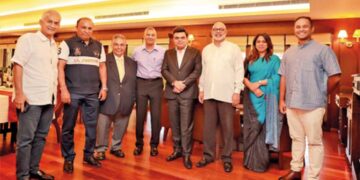
He further stated that the traditional political divide between the “right” and the “left” had effectively come to an end. He emphasized that Sri Lanka should move beyond crony capitalism and extreme liberal ideologies, as well as reject both extreme communism and rigid socialism, and instead steer the country toward a model of humane capitalism.