Amid the oil shock and supply chain disruptions caused by the U.S.-Israel war on Iran, Russia has assured that its energy companies have the capacity to “steadily increase” the supply of oil and liquified natural gas (LNG) to India, while also continuing to meet the country’s fertilizer requirements.
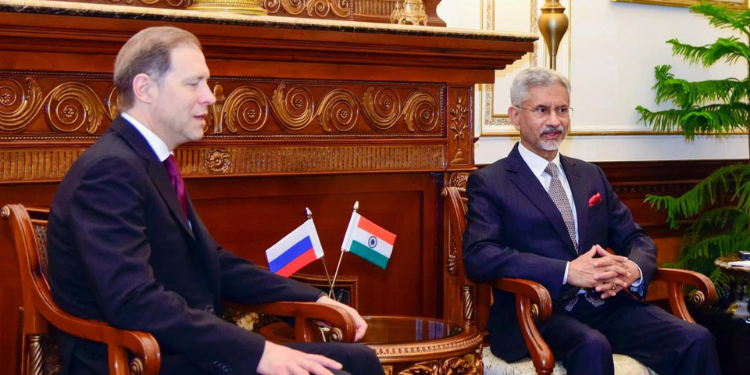
Russian Deputy Prime Minister Denis Manturov, on a two-day visit, met Prime Minister Narendra Modi on Thursday (April 2, 2026) to discuss fertilizer supply. He also held meetings with External Affairs Minister S. Jaishankar, Finance Minister Nirmala Sitharaman, and National Security Advisor Ajit Doval, where discussions focused on continued energy supply to India.
The high-level Russian visit is seen as part of preparations for the upcoming BRICS summit to be hosted by India and the India-Russia annual summit scheduled in Russia later this year.
“We discussed our mutually beneficial cooperation in trade, fertilizers, connectivity, and people-to-people ties,” said Prime Minister Modi, who “welcomed sustained efforts from both sides” to implement the agreements of the 23rd India-Russia Annual Summit held in December 2025.
In a press statement, the External Affairs Ministry said Mr. Jaishankar and Mr. Manturov “exchanged views on regional and global developments, including the conflict in West Asia.”
According to the Russian embassy, Mr. Manturov stated that Russia has increased supplies of “in-demand mineral fertilizers to India by 40 percent and is ready to continue meeting India’s needs for this product.” He also noted that a joint project for the production of carbamide (urea) is “under development.”
“Particular attention was paid to cooperation in the oil and gas sector. Denis Manturov confirmed that Russian companies have the capacity to steadily increase supplies of oil and liquified natural gas to the Indian market,” the embassy readout said.
Mr. Manturov also highlighted plans to deepen nuclear cooperation with India, in addition to discussions on industrial collaboration, space projects, and educational initiatives.
The visit, which concluded on Friday (April 3, 2026), came days after Russian Foreign Minister Sergei Lavrov and Mr. Jaishankar addressed a conference on bilateral relations via video link on March 23, 2026, during which Mr. Lavrov underlined Russia’s preparations for the annual summit.
Mr. Lavrov had reiterated Russia’s support for BRICS, where India currently holds the Chair. The grouping has drawn attention recently for its silence on the ongoing West Asia conflict, though Russia, India, and China — forming a trilateral sub-group called RIC — have committed to working closely within BRICS, the Shanghai Cooperation Organisation, and the UN on matters affecting the Global South.
This was followed by the March 30 Foreign Office Consultations between India and Russia, led by Foreign Secretary Vikram Misri and Russia’s Deputy Foreign Minister Andrey Rudenko. Earlier this week, India hosted Vladimir Yakushev, First Deputy Chairman of the Federation Council (upper house) of the Federal Assembly of Russia. On Thursday, Mr. Yakushev met Deputy Chairman of the Rajya Sabha Harivansh Narayan Singh, Lok Sabha Speaker Om Birla, and Bharatiya Janata Party president Nitin Nabin.
These exchanges between India and Russia coincide with growing energy insecurity in India and South Asia as the war in West Asia enters its second month. The U.S. had imposed penalty tariffs on India in August 2025, aiming to reduce Indian imports of Russian energy to pressure Russia over the war in Ukraine. However, amid the global energy crisis, the U.S. issued a “temporary 30-day waiver” on March 6, allowing Indian refiners to purchase Russian crude.