
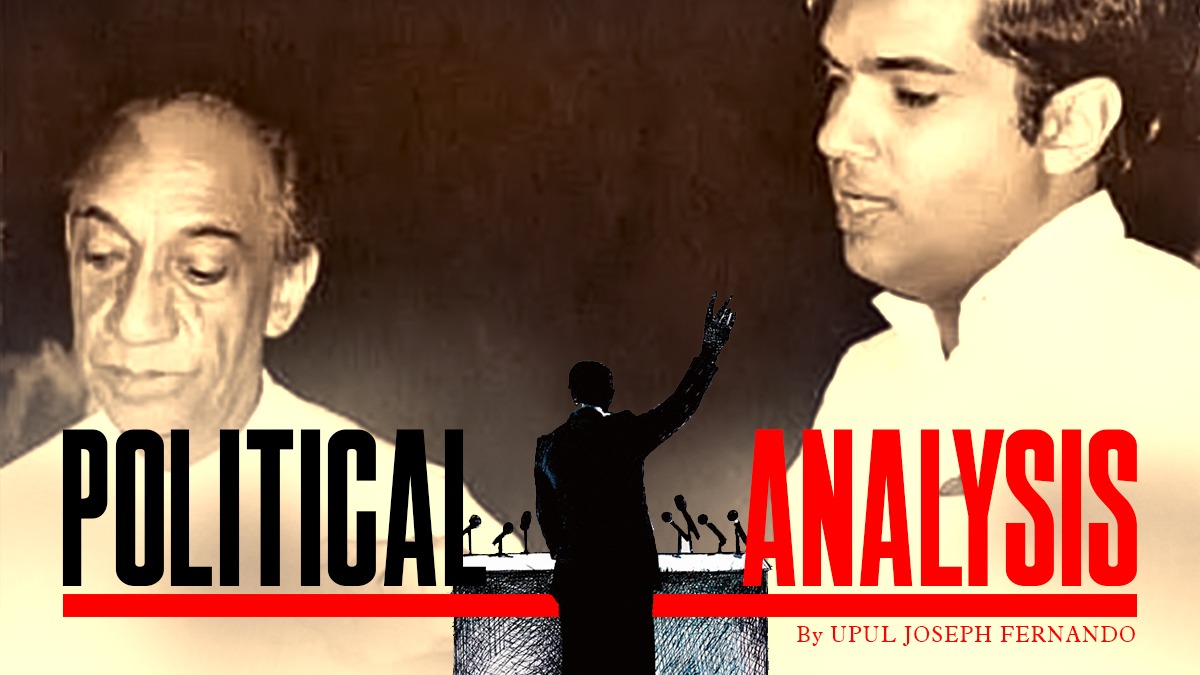
1982 marked the pinnacle of JR’s political career when he won the presidential election, solidifying his status as Sri Lanka’s most popular leader. His popularity was so immense that a group of police officers took a man to court for burning JR’s nose with a cigarette in a picture. Despite the immense support he enjoyed from the public, JR was hesitant to call for a general election after his presidential victory. He feared that the proportional voting system he had introduced in the 1978 constitution would drastically reduce his party’s power. If the 1983 general election had been held, it was projected that the UNP would lose five-sixths of its seats, allowing the opposition SLFP to gain a significant number of seats.
During that period, the primary opposition party, the SLFP, lacked a cohesive leadership, with divisions splitting it into two or three factions. Vijaya-Chandrika and the Communist Party wielded significant influence within the Sri Lanka Freedom Party (SLFP). Contrary to expectations, during JR’s victory, support came from unexpected quarters, including Mrs. Bandaranaike, her son Anura Bandaranaike, and the Rajapaksa family, particularly Mahinda Rajapaksa from the southern region.
Following JR’s triumph, concerns arose within the SLFP ranks. Mrs Bandaranaike, Anura, and the Rajapaksa family feared that Vijaya, Chandrika, and their allies would seize control of the party in the subsequent general election. Anura was particularly anxious about potentially losing his parliamentary seat, while Mrs. Bandaranaike worried about losing her leadership position.
JR propagated fears that the Vijaya-Chandrika Communist Party faction would infiltrate parliament, turning the nation into a bloodbath. In collaboration with Mrs. Bandaranaike and Anura, the UNP crafted a narrative to justify a referendum instead of a general election. JR claimed the referendum was necessary to safeguard parliament and the SLFP from the perceived threat of the Naxalites. This clandestine agreement between JR, Mrs. Bandaranaike, and Anura came to be known as the Lampu-Kalegedi game.
Maithripala Senanayake, the former Deputy Leader of the Sri Lanka Freedom Party and the former Deputy Prime Minister of the Samagi Peramuna government, also stood on JR’s platform in favour of the referendum. The Rajapaksa family also publicly favoured the referendum.
Without the crucial support of the SLFP, JR would have been unable to proceed with the referendum. Following his victory in the 1982 presidential election, JR leveraged this success to call for a referendum, seeking to consolidate power by asking the public to grant authority to the parliament they had elected. Additionally, JR issued a directive that all MPs who lost their seats in the referendum should contest in by-elections and regain their positions.
During the referendum, Mrs Bandaranaike unexpectedly lost in Attanagalla, a constituency she typically secured, suggesting a lack of favour in opposing the referendum. This loss underscored the complex dynamics, including strategic manoeuvring and differing agendas within the political landscape.
This is how JR held a referendum. JR’s nephew Ranil is trying to hold a referendum to extend the term of the President and Parliament. JR went to a referendum and took the support of the opposition as the popular favourite leader of Sri Lanka after winning the votes.
Today, Ranil discusses referendums having only one national list member to his party.
Ranil often attempts to emulate JR’s image, but JR was a leader who didn’t shy away from elections. He consistently garnered significant voter support, confident in his ability to secure victory. He was aware that in the anticipated 1983 general election, his party stood a strong chance of winning the majority of seats required to govern. Despite his success in the presidential election with 52.91% of the vote, JR hesitated to take the risk of a general election. Instead, he opted for a referendum, reflecting his uncertainty about securing the same level of support in a different electoral context.
Today, Ranil finds himself in a position even lower than where D.B. Wijetunga once stood. Wijetunga ascended to the presidency after contesting the 1989 general election, securing the highest number of votes from the public in the district and earning a seat in parliament. Additionally, he clinched the presidency with the support of MPs who won alongside him, collectively obtaining 125 seats in the 1989 election.
In contrast, Ranil’s path to the presidency differs significantly. He assumed the presidency with the votes of MPs from other parties, lacking the direct mandate from the electorate that Wijetunga garnered through public votes and parliamentary success.
This is why it is said that Ranil cannot be compared to JR, nor even to DB. While many believe this comparison is unfounded, Ranil and his UNP seem to think otherwise. They assume that just as JR won the 1977 general election and subsequently became President, Ranil too has won an election and is leading a UNP government. However, Ranil’s miscalculations lie in two key areas: assuming himself to be like JR and operating under the mistaken belief that the Constitution of Sri Lanka and the UNP party constitution are identical.
Ranil may believe that just as he amended the UNP constitution to maintain his leadership, he can similarly manipulate the clauses of the constitution to hold on to the presidency indefinitely. In the UNP, public voting is not required to remain the leader; it only takes appointing a few loyal members to the working committee to secure his position. These members, once appointed, protect the leader by consistently supporting him.
However, becoming the country’s president is a different matter. The president is elected by securing 50% or more of the valid votes cast in a national election, not through the votes of the UNP working committee. Achieving this level of public support is not an easy task and cannot be guaranteed through internal party maneuvers alone.
Ranil may consider bypassing the usual voting process by appointing all parliamentarians to the working committee and using their votes to extend his tenure for two more years. However, he is fully aware that the Constitution does not allow for such a maneuver. The constitution does permit the extension of the parliamentary term, but it requires a two-thirds majority in parliament and a referendum.
At the present moment, if a referendum is held, it would face opposition from Samagi Jana Balawegaya, Jathika Jana Balawegaya, Independent MPs from Pohottuwa, and various minority parties. Namal Rajapakse’s statement indicates that Pohottuwa would also oppose the move, suggesting that a referendum is unlikely to succeed. Furthermore, achieving a two-thirds majority in parliament is not feasible.
‘if so why did Ranil present a ‘feeler’ through Range ‘ ..?
Since the day he became the president he held onto power planting similar news
‘An emergency presidential election due to a presidential election in favour of Ranil…’
‘Signs that Ranil is heading for an emergency general election..’
‘People will split with Ranil..’
‘Minority party leaders join Ranil…’
’70 MPs from Pohottuwa to Ranil…’
’25 from Samagi Jana Balavega to Ranil…’
For almost two years, none of the false news stories have yielded any results. Now, with the presidential election approaching, he appears to be seeking a way to extend the terms of both the president and parliament by two years, allowing him to retain power for the remaining two or three months.
However, he seems to have forgotten his party chairman’s claim that Ranil would become president after securing 10 million votes. When the secretary attempted to delay the elections, he failed to realize how foolish the plan was. As a result, he now finds himself with no new stories to spread.