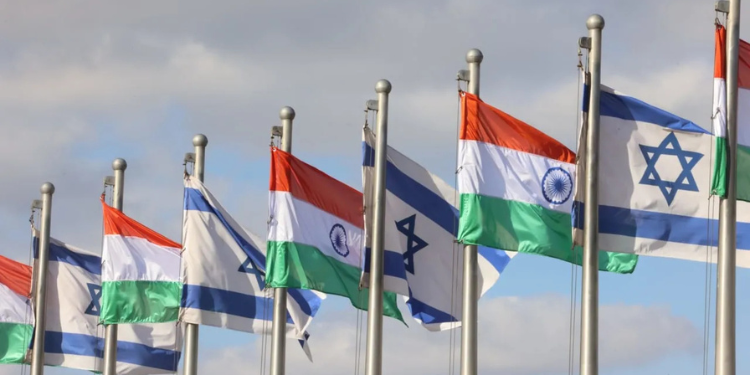
The Raisina Dialogue has increasingly evolved into more than just a conference. It now serves as a platform through which India signals the principles guiding its foreign policy. This year’s sequence of events — the virtual participation of Israeli Foreign Minister Gideon Sa’ar followed by the visit to Delhi by Iran’s Deputy Foreign Minister Saeed Khatibzadeh — offered a particularly clear example of how New Delhi manages competing relationships in a highly polarized geopolitical environment.
The order in which the two officials appeared was itself revealing. Israel’s foreign minister addressed the conference virtually first, outlining Israel’s security concerns and defending the military campaign launched against Iran. Shortly afterward, Iran’s deputy foreign minister appeared in Delhi and used the same platform to sharply criticize the war, warning that Tehran viewed the confrontation as an existential threat.
The presence of these two opposing perspectives within the same forum was not coincidental. Rather, it reflected India’s deliberate effort to maintain diplomatic engagement with rival actors even during periods of open conflict.
This year’s Raisina Dialogue, however, unfolded against a wider backdrop of events that underscored the complexity of India’s position.
Just days before the conflict escalated into open war, Prime Minister Narendra Modi had travelled to Israel, reinforcing the increasingly close strategic partnership between the two countries. Over the past decade, Israel has emerged as a key defense and technology partner for India, and the visit reaffirmed cooperation in areas ranging from security and innovation to agriculture and water management.
Within days of that visit, however, the regional situation changed dramatically. Israel and the United States launched military strikes on Iran, pushing the confrontation into open conflict.
At the same time, developments in the Indian Ocean unexpectedly connected India to the unfolding crisis.
In February, the Indian Navy hosted the International Fleet Review 2026 and the MILAN naval exercises in Visakhapatnam — one of the largest maritime gatherings ever organized by India — bringing together ships and personnel from dozens of foreign navies. Among the participating vessels was the Iranian frigate IRIS Dena, which had travelled to India as an invited guest of the Indian Navy.
On March 4, while returning home after participating in the Indian-hosted naval event, the ship was torpedoed and sunk by a US submarine in international waters off the coast of Sri Lanka, killing at least 87 sailors.
The incident quickly turned a naval exercise hosted by India into a geopolitical controversy. The vessel that had recently taken part in India’s maritime diplomacy became one of the earliest casualties of the widening conflict.
It was against this backdrop that Iran’s deputy foreign minister arrived in Delhi and addressed the Raisina Dialogue. During his remarks, he referred directly to the sinking of the Iranian warship, describing it as an unacceptable escalation and insisting that such an attack could not go unanswered.
In effect, the Raisina Dialogue became the first major international platform where Iran publicly framed the naval incident and the broader war.
For India, the convergence of these events created a delicate diplomatic moment. Within a matter of days, New Delhi had reaffirmed its partnership with Israel, hosted an Iranian warship as part of its naval diplomacy, witnessed that ship’s destruction during the escalation of the war, and then welcomed an Iranian deputy foreign minister to speak at its flagship strategic conference.
The situation illustrates a defining feature of India’s foreign policy: strategic autonomy. India has steadily expanded its partnership with Israel, particularly in defense technology, intelligence cooperation, and innovation. At the same time, it maintains long-standing ties with Iran rooted in geography, energy interests, and connectivity initiatives such as the development of the Chabahar port.
Both relationships serve critical Indian interests.
Energy security, maritime stability in the Indian Ocean, and the safety of millions of Indian citizens working across the Gulf region require India to maintain communication with multiple actors in West Asia simultaneously.
In this sense, the Raisina Dialogue served as a microcosm of India’s broader diplomatic approach. By hosting Israeli and Iranian voices within the same strategic forum, New Delhi demonstrated its willingness to engage with both sides without formally aligning itself with either.
This balancing strategy is increasingly central to India’s evolving geopolitical vision. New Delhi now views the region stretching from the Indian Ocean to the Mediterranean as an interconnected strategic space shaped by energy flows, maritime routes, and emerging economic corridors linking Asia and Europe.
The war between Israel and Iran therefore represents not only a regional security crisis but also a potential disruption to the connectivity architecture that India is attempting to build across the Indo-Mediterranean.
India’s response has not been to position itself as a mediator, nor to adopt neutrality in the traditional sense. Instead, New Delhi appears to be pursuing influence through continued engagement with all sides.
The Raisina Dialogue captured this posture with unusual clarity.
Israel spoke first.
Iran responded hours later.
Both did so on an Indian platform.
In an international system increasingly defined by rigid geopolitical blocs, India appears determined to remain something different — a power that maintains strategic partnerships while preserving the diplomatic space to engage with adversaries as well.