
Public attention is currently focused on the salaries received by Members of Parliament.
This follows the publication of several of his salary slips on his Facebook page by Samagi Jana Balawegaya MP for the Kalutara District, Jagath Withana.
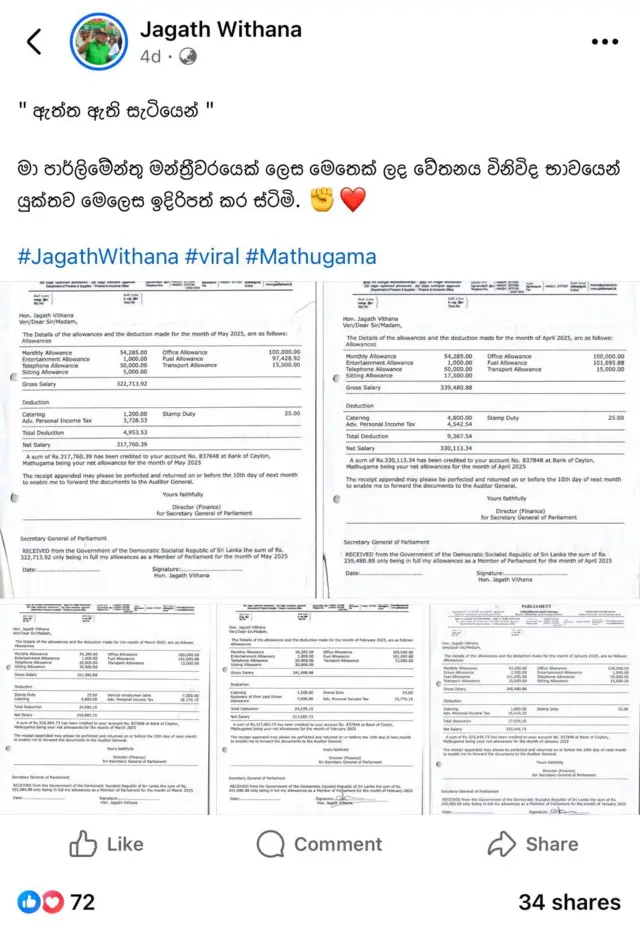
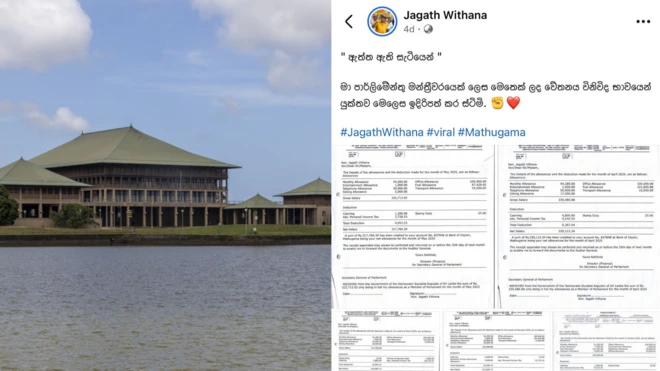
Along with the note “The truth as it is,” MP Jagath Withana posted his salary slips, which show the salary, allowances, and income tax deductions he received from January to May this year.
What has drawn the attention of many is the amount of income tax deducted from MPs’ salaries.
Tax disparity?
Many people on social media have questioned the income tax levied on MPs’ salaries.
“Are MPs exempt from income tax? Or if this is calculated under APIT (Advance Personal Income Tax), is it accurate?” noted Senior Lecturer Jayalath Aththanayake of Sabaragamuwa University on Facebook.
According to the tax revision made in April, a person earning around Rs. 300,000 monthly must pay approximately Rs. 20,000 per month as Advance Personal Income Tax (APIT) to the Inland Revenue Department. Prior to this, they had to pay around Rs. 36,000 monthly as tax.
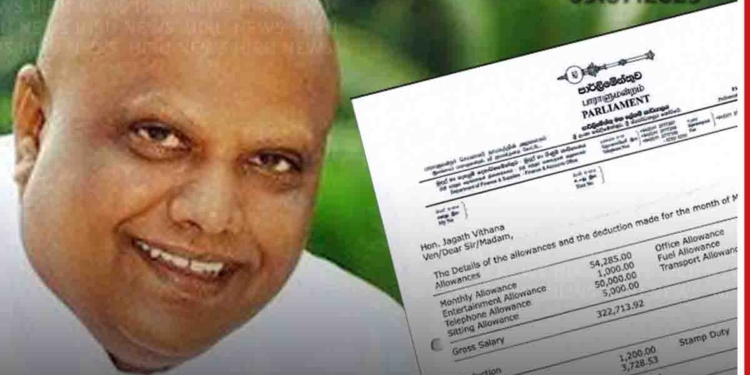
However, according to MP Jagath Withana’s salary slip, his salary for May 2025 is Rs. 327,713.92, and the income tax deducted is only Rs. 3,728.53.
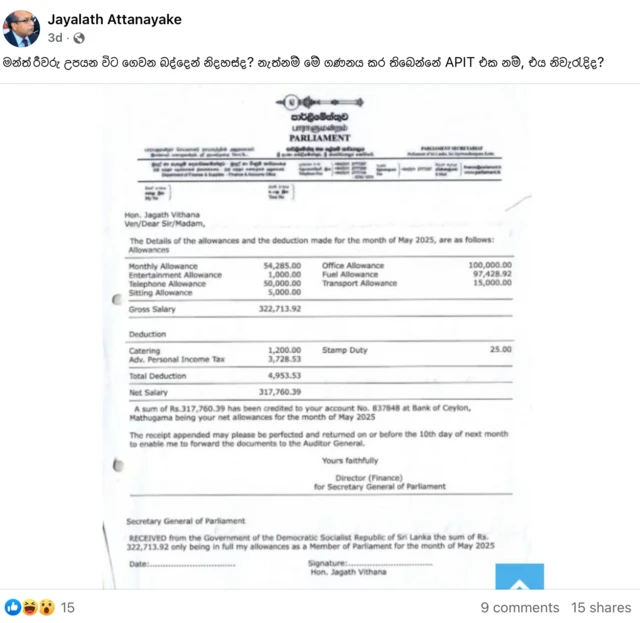
“Are MPs exempt from income tax? Or if this is calculated under APIT (Advance Personal Income Tax), is it accurate?” noted Senior Lecturer Jayalath Aththanayake of Sabaragamuwa University on Facebook.
According to the tax revision made in April, a person earning around Rs. 300,000 monthly must pay approximately Rs. 20,000 per month as Advance Personal Income Tax (APIT) to the Inland Revenue Department. Prior to this, they had to pay around Rs. 36,000 monthly as tax.
However, according to MP Jagath Withana’s salary slip, his salary for May 2025 is Rs. 327,713.92, and the income tax deducted is only Rs. 3,728.53.
‘The reduced tax charged from MPs has become a major issue’
Responding to a query from BBC Sinhala, Professor Aminda Methsila Perera from the Faculty of Management and Finance at Wayamba University said that many people are raising concerns over the relatively low tax deductions shown on MPs’ salary slips.
“A recent post circulating on social media showed the salary slip of a Member of Parliament. Most people focused on how much salary the MP is actually receiving. Normally, people are subject to tax on what they earn. We now refer to it as Advance Personal Income Tax.”
“Looking at how much the tax has been reduced for MPs, we can clearly see that the deduction rate is very minimal. Normally, an MP earning around Rs. 300,000 monthly should pay at least Rs. 20,000 in tax. But what we now see is MPs paying between Rs. 4,000 and Rs. 5,000. So, there’s a serious issue as to why MPs are subject to such low taxes.”
“Perhaps some of their allowances are excluded from tax. But according to the Income Tax Act, all income earned by an MP should be subject to tax. The next issue is that if MPs pay tax at the end of the year, they may adjust what they have already paid. If they’ve paid less tax earlier, they will have to pay a higher amount at year-end.”
“All MPs should maintain tax files with the Inland Revenue Department. Then, they will all have to pay a large tax sum at the end of the year if they’re currently paying less,” the Professor clarified.
Why are MPs paying less tax?
BBC Sinhala inquired from the Inland Revenue Department regarding the reasons for the minimal tax deductions mentioned on the salary slip shared by an MP on social media.
A senior official at the department, who wished to remain anonymous, explained that a circular issued around two years ago introduced certain thresholds for taxing allowances of government employees.
“According to this MP’s salary slip, there are allowances for phone, transport, and fuel. A circular issued on April 6, 2023, stated that when calculating employment income, some limits should be applied for certain benefits.”
“In items 03 and 04 of that circular, it was specified that only 25% of the amount allocated for fuel and vehicles would be taxed. The remaining 75% is not subject to tax.”
“These MPs are considered government employees. The expenses they incur for official duties such as travel are considered job-related.”
“When looking at this MP’s salary, the allowances for fuel, transport, and phone amount to over Rs. 200,000. From this total, only about 25% appears to be subject to tax.”
“This tax relief is not limited to government employees—it also applies to those in the private sector, according to the circular,” the official added.
Parliamentary clarification
To verify the widespread discussion about tax levied on MPs’ salaries, BBC Sinhala also reached out to the head of the finance division of Parliament.
He stated that a formal request should be submitted under the Right to Information Act to obtain this data.
Accordingly, BBC Sinhala has submitted a request for the relevant information and will publish the findings upon receipt.
BBC Sandeshaya