
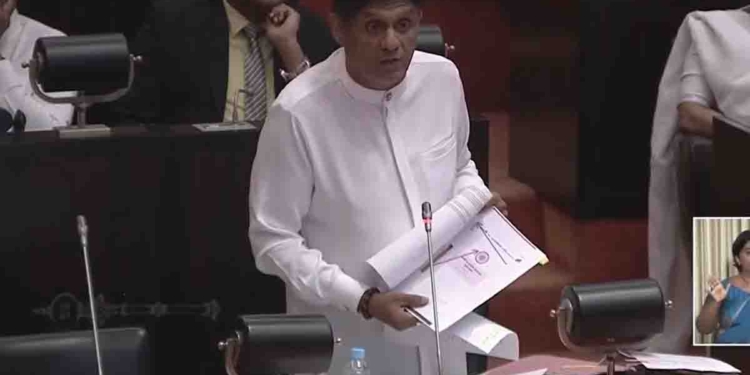
The Opposition Leader stated that the Samagi Jana Balawegaya presented a motion in Parliament today concerning the process of the dispensation of justice. However, he alleged that the Speaker, instead of safeguarding democracy within the legislature, acted arbitrarily and refused to allow discussion of the motion.
He further noted that, according to the Constitution of Sri Lanka, Articles 107 and 108 set out the provisions relating to the tenure and appointment process of judges in the higher courts. He pointed out that although the retirement age of Court of Appeal judges is 63 years and Supreme Court judges is 65 years, there is widespread discussion in society regarding an attempt by the government to extend this retirement age without a scientific basis. Sri Lanka Latest News
Opposition Leader Sajith Premadasa also stated that the Bar Association of Sri Lanka, the Law Society of the Colombo High Court, and the Commonwealth Bar Association have expressed protest against what they describe as an attempt by the government to undermine the independence of the judiciary. He added that any constitutional amendment made to suit the interests of an individual or a group would be a dangerous anti-democratic act. He further noted his opposition to any move, as stated by the Commonwealth Bar Association, to amend the Constitution through a temporary procedural bill aimed at changing the retirement age of judges.
He made these remarks while addressing Parliament today.
The Opposition Leader further said that although constitutional amendments should be made through the involvement of all parties, the government is currently attempting to increase the retirement age of judges while eroding public confidence in the judiciary and dealing a serious blow to its independence. He described the move as unacceptable and emphasized that all processes must be carried out in a manner that protects judicial independence and upholds the rule of law.
He also stated that this amounts to severe pressure on the judiciary. He pointed out that although there are currently four vacancies in the Court of Appeal and four vacancies in the Supreme Court, the President, despite having the authority to make these appointments, has not done so for six months. He said there is suspicion that the delay in filling these vacancies amounts to exerting pressure on judges and could be perceived as a form of psychological inducement. He added that even the Bar Association has submitted information to the President regarding the impact on judicial independence, noting concerns that appointments in other courts are being made without following the traditional seniority system. According to him, such arbitrary executive action is a major blow to the rule of law and judicial independence.
He further said that the government, which previously spoke in favour of judicial independence, is now undermining it. He described the situation as a serious blow to the integrity and stability of the judiciary, as well as to the sovereignty of the people and the rule of law. He added that although the President has spoken in support of judicial independence in the past, current actions—such as delaying appointments and attempting to extend the retirement age—amount to a direct threat to democracy.
He also referred to Article 4(d) of the Constitution, stating that while the sovereignty of the people is exercised through the judiciary, it must be implemented through the legitimate framework of Parliament, as the supreme law of the land.
Finally, the Opposition Leader claimed that the country is now effectively under single-party rule without democratic balance, stating that this is strengthening a dictatorial system. He alleged that the government, led by the President, has directly interfered in the functioning of the judiciary, and warned that any attempts to influence judicial independence through external pressure or false claims regarding promotions would be unconstitutional.