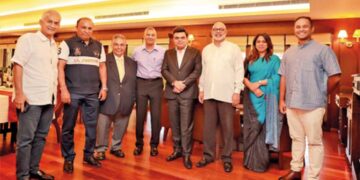
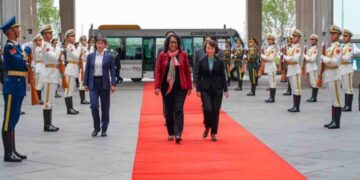
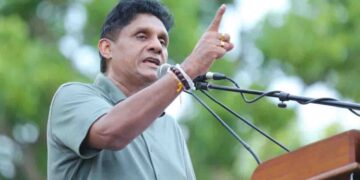
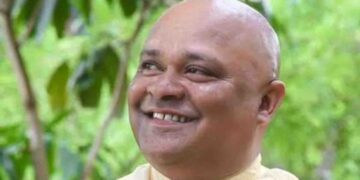
A widely circulated social media post compares two contrasting images: one depicting Foreign Minister Vijitha Herath engaging with the Sri Lankan diaspora in Rome during his attendance at the Pope’s funeral, and the other showing former President Ranil Wickremesinghe meeting foreign dignitaries while attending Queen Elizabeth II’s funeral.
This comparison is being used to critique the NPP government’s perceived shortcomings in foreign diplomacy.
Supporters of the NPP, however, counter this narrative by asserting that while Ranil’s engagements with world leaders did little to secure electoral success, the NPP’s outreach to the Sri Lankan diaspora has resonated more effectively with voters.
Regardless of this social media battle, major weaknesses exist in the NPP government’s foreign relations management. President Anura Kumara is going to Vietnam in the first week of May to win over the Sinhala Buddhist people of Sri Lanka in the upcoming LG election. He held an exposition of the sacred Tooth Relic and go to participate in the Vesak celebrations in Vietnam to show that he is a Sinhala Buddhist leader similar to Mahinda Rajapaksa.
As soon as Anura became president, Russia extended him a special invitation. That is, to attend the BRICS summit being held in Russia. But Anura did not attend it. His foreign minister did not participate in it either. Anura did not attend the UN General Assembly session that followed. The foreign minister did not attend either. The reason given was the general election. Although Prime Minister Harini participated in the BIMSTEC summit held in Thailand recently, there were no reports of her meeting with foreign heads of state who attended the summit.
President Anura does not meet with foreign ambassadors in Sri Lanka or with Sri Lankan ambassadors stationed abroad. According to the Presidential Secretariat, this is a matter of policy.
Following independence, Sri Lanka’s Foreign Ministry operated under the Prime Minister, who also served as the head of state. The prime minister didn’t take the Finance Ministry under himself. The Foreign Ministry remained under the Prime Minister’s direct control. This arrangement was altered by J.R. Jayewardene. However, while J.R. and each of his successors appointed a separate foreign minister, they retained overall authority over the ministry themselves.
Like Anura, Mahinda did not pay much attention to the foreign ministry during his early years as president. He handed it over to Foreign Minister Mangala. Mangala did not consult Mahinda when making foreign policy decisions, thinking that Mahinda had no understanding or interest in it. Sri Lanka had voted against Palestine in a resolution submitted to the United Nations regarding the Israeli-Palestinian issue. Mahinda learned of this only when the Arab countries protested. He immediately removed Mangala from the post of foreign minister as he understood how crucial the post of foreign minister was. It is too early to say how long it would take Anura to understand this.