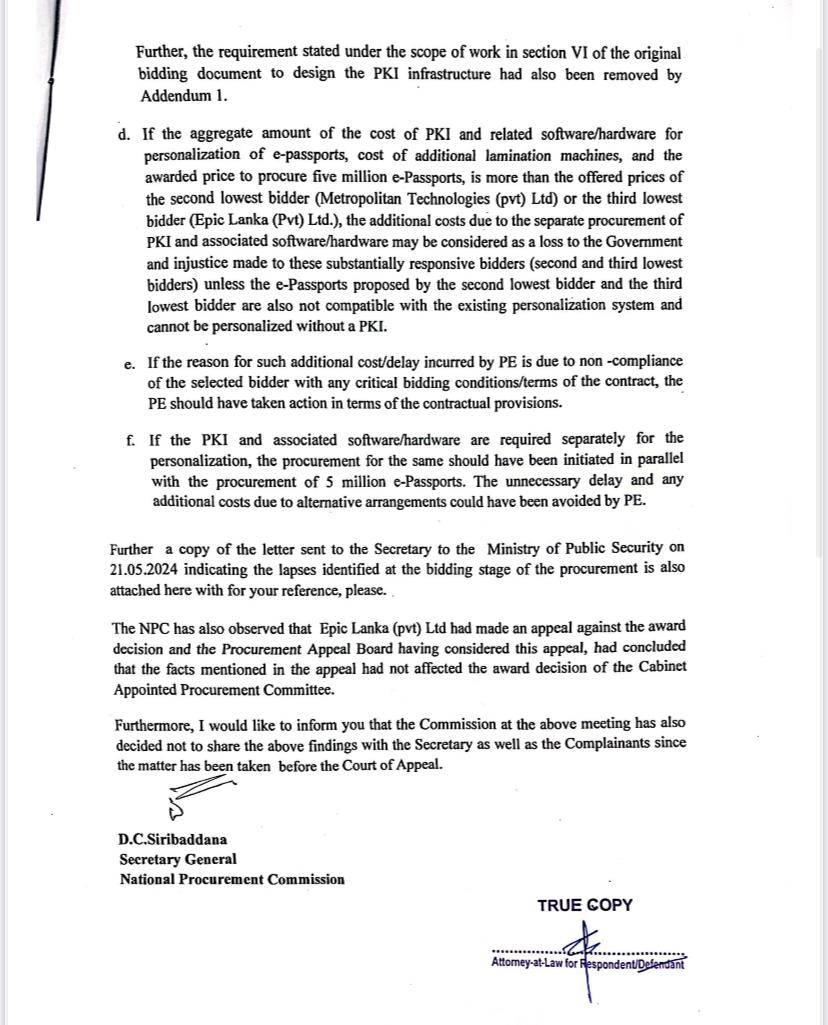


The National Procurement Commission (NPC) has issued its observations regarding complaints related to the procurement of e-passports, following a letter from the Honourable Attorney General, referenced as No. CA/WRIT/609/2024/DIE/LU/CA/02/05/2024, dated November 11, 2024. The letter was addressed to the Acting Controller of the Department of Immigration and Emigration and the Secretary to the Ministry of Public Security, with a copy forwarded to the NPC.
In its meeting on November 28, 2024, the NPC reviewed the complaints and the accompanying documents submitted by the Secretary to the Ministry of Public Security. Based on these deliberations, the NPC has outlined the following observations:
Key Observations
A. Personalization and Chipless Passports:
- If the personalization of e-passports is feasible using the existing system, or if the e-passports of the selected bidder align with the current system, the procurement of 750,000 “chipless” passports would be unnecessary.
- Furthermore, the existing technical infrastructure could adequately handle the personalization process.
B. Cost-Effectiveness:
- The unit cost of “chipless” passports (€4.52) appears inefficient compared to that of e-passports (€4.62).
- Had the need for 750,000 “chipless” passports been identified earlier and included in the annual procurement plan, a competitive bidding process could have resulted in more cost-effective procurement.
C. Questionable Processes:
- If procuring common core infrastructure for e-passport personalization is unavoidable, the process raises questions under Section VI, Clause 12.1 of the bidding documents.
- The Ministry has not provided sufficient justification for the claim that personalization must use the existing infrastructure already purchased by the government.
- Moreover, the requirement for designing a common key infrastructure, initially outlined in Section VI of the bid documents, was later removed under Appendix 01.
D. Additional Costs and Unjustified Decisions:
- If the total cost of common core infrastructure, related software/hardware, additional lamination machines, and the price of five million e-passports exceeds the bids of the second and third lowest bidders (Metropolitan Technologies Pvt. Ltd. and Epic Lanka Pvt. Ltd., respectively), this could constitute financial loss to the government.
- It may also undermine fairness, as both bidders proposed significant solutions, albeit with some compatibility issues for the third-lowest bidder.
E. Non-Compliance with Critical Conditions:
- Any additional costs or delays arising from the selected bidder’s failure to meet critical bid conditions or contract terms should have been addressed through appropriate contractual measures.
F. Simultaneous Procurement:
- If the procurement of common core infrastructure and associated hardware/software was indispensable, it should have been initiated concurrently with the procurement of five million e-passports to avoid unnecessary delays and costs.
The NPC emphasizes the importance of aligning procurement practices with established guidelines to prevent inefficiencies, delays, and financial loss to the government.