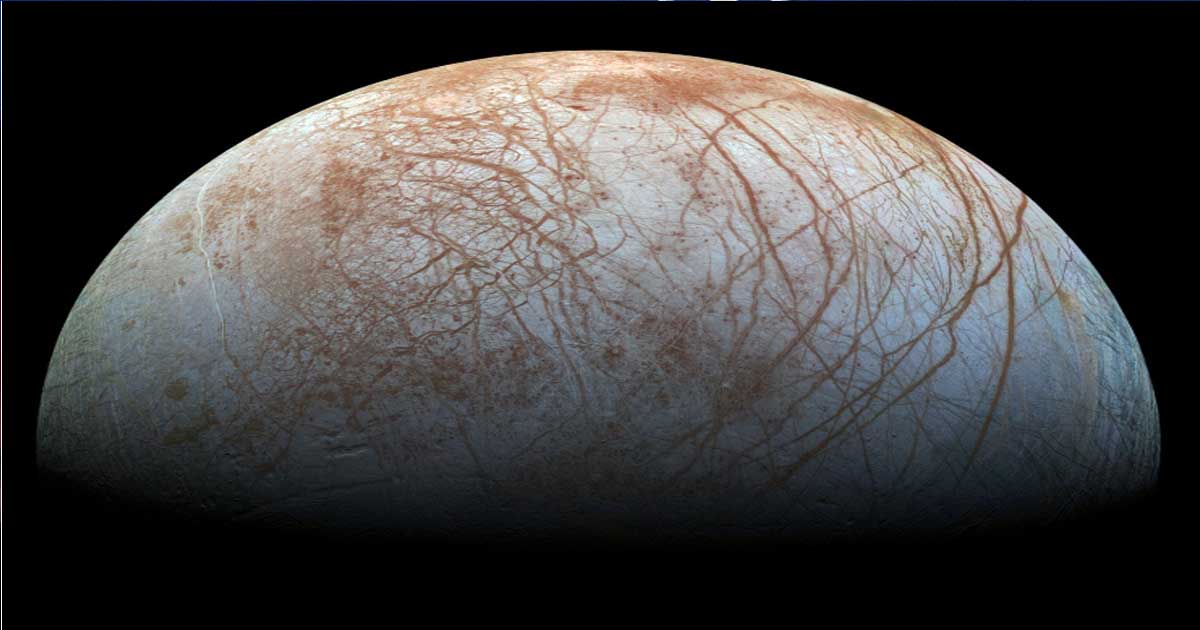
NASA’s James Webb Space Telescope has made a groundbreaking discovery on Jupiter’s moon, Europa. The telescope’s infrared camera captured images of this moon’s unique terrain, revealing intriguing traces of life in the form of abundant carbon dioxide.
To understand the significance of these findings, it’s essential to grasp the concept of a “frigid terrain,” characterized by extreme cold temperatures. In the frigid zones of Europa, researchers found an abundance of carbon dioxide.
The James Webb Space Telescope’s observations hint at the presence of carbon, a building block of life, within an ocean beneath Europa’s icy surface. On September 21, 2023, the journal ‘Science’ published a remarkable study detailing the discovery of carbon on this icy moon. Two teams of independent astronomers collaborated on this endeavour, each tasked with detecting signs of a space observatory on the moon’s surface. The study’s findings strongly suggest the abundant presence of carbon dioxide on Europa, offering promising indicators of potential life in the future.
Geronimo Villanueva, the lead author of the study, emphasized the importance of chemical diversity for life on Earth, stating that greater diversity enhances the likelihood of life. He further explained that Europa’s ocean holds the key to determining whether the carbon gas is conducive to or inhibitive of life.
Europa stands out as one of the few celestial bodies in our solar system where scientists believe life could exist. Beneath its thick ice sheet lies an ocean containing twice the amount of water found in Earth’s oceans. However, NASA reminds us that the presence of carbon alone is not sufficient for life to thrive; it requires an energy source, such as organic nutrients, and a continuous supply of organic molecules.
Source: timesofindia.indiatimes.com