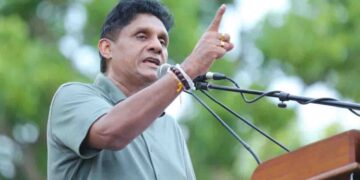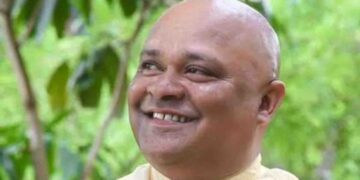

Bimal Rathnayake was a notable absentee during Modi’s visit to Sri Lanka. Although other key figures like Lalkantha and Samantha Vidyaratna were also absent, Bimal’s absence stood out significantly.
Recently, Bimal was appointed president of the China-Sri Lanka Parliamentary Friendship Association and even joined President Anura Kumara on his official tour to China. Interestingly, during Anura Kumara Dissanayake’s visit to India, only the foreign minister, Vijitha Herath, accompanied him. However, during Anura’s visit to China, Bimal was part of the delegation, highlighting his growing ties with China.
During the presidential and general elections, Bimal was tasked with securing victories for the NPP (National People’s Power) in the North and East of Sri Lanka. In the general elections, he successfully led the NPP to triumph over the India-leaning TNA (Tamil National Alliance). Following this victory, the Chinese Ambassador to Sri Lanka made a special statement indicating China’s appreciation.
Bimal’s absence at Modi’s events remains unexplained. It is speculated that he either wanted to avoid jeopardizing his relationship with China or felt uncomfortable due to his previously expressed anti-India sentiments. For context, Minister Nalinda Jayatissa had claimed in an earlier statement to the BBC that India was involved in the Easter Sunday attacks, yet he still participated in Modi’s visit as a government minister in attendance. This raises the question: If Nalinda could attend despite his controversial statements, why couldn’t Bimal?
In historical perspective, Modi’s visit coincided with the 54th anniversary of the JVP’s (Janatha Vimukthi Peramuna) failed uprising in 1971. One of the core lectures during that period focused specifically on Indian expansionism. Furthermore, during the JVP’s second insurrection in 1987, party leader Rohana Wijeweera asserted that his warnings about Indian expansionism had come true. His stance attracted many young followers to the movement. Wijeweera had even referenced a 1940 proposal by J.R. Jayewardene in the Ceylon National Congress to create an Indo-Lanka federation, claiming that the 1987 Indo-Lanka Accord was a continuation of that betrayal.
JVP General Secretary Tilvin Silva and leaders, including Anura, joined the JVP through the anti-India slogan. That is why the Indian and foreign media said that an anti-India and pro-China president had come to power in Sri Lanka as soon as Anura became president. But Modi showed the world through his Sri Lankan visit that he had tamed the anti-India elements. On the one hand, he used his visit to raise the image of Anura and the NPP government, and on the other hand, he went to the Indian Peace Keeping Force Memorial to pay homage to the Indian peacekeeping force killed by the JVP. The JVP killed 29 Indian army soldiers and officers in the 1987 mutiny. The chairperson of the State Pharmaceuticals Corporation was killed for importing Indian medicines.
Modi and Anura showed that in politics as well as in international relations, there are no permanent enemies or friends. The statement issued by India and Sri Lanka before Modi’s arrival in Sri Lanka stated that Modi would meet Prime Minister Harini. Despite Prime Minister Harini attending the banquet hosting PM Modi, not having a one-to-one meeting raises the eyebrows of many analysts.